

Tesla junk title rate hits 18.5%, far exceeding legacy EV peers


- Tesla vehicles show an 18.5% junk title rate, far exceeding legacy EVs
- Legacy automaker EV salvage rates range from 1.0% to 9.5%
- Tesla's rate remains static at ~18% across all age groups
- Non-Tesla EV salvage rates increase as vehicles age
- Data sourced from Copart and IAAI auction records

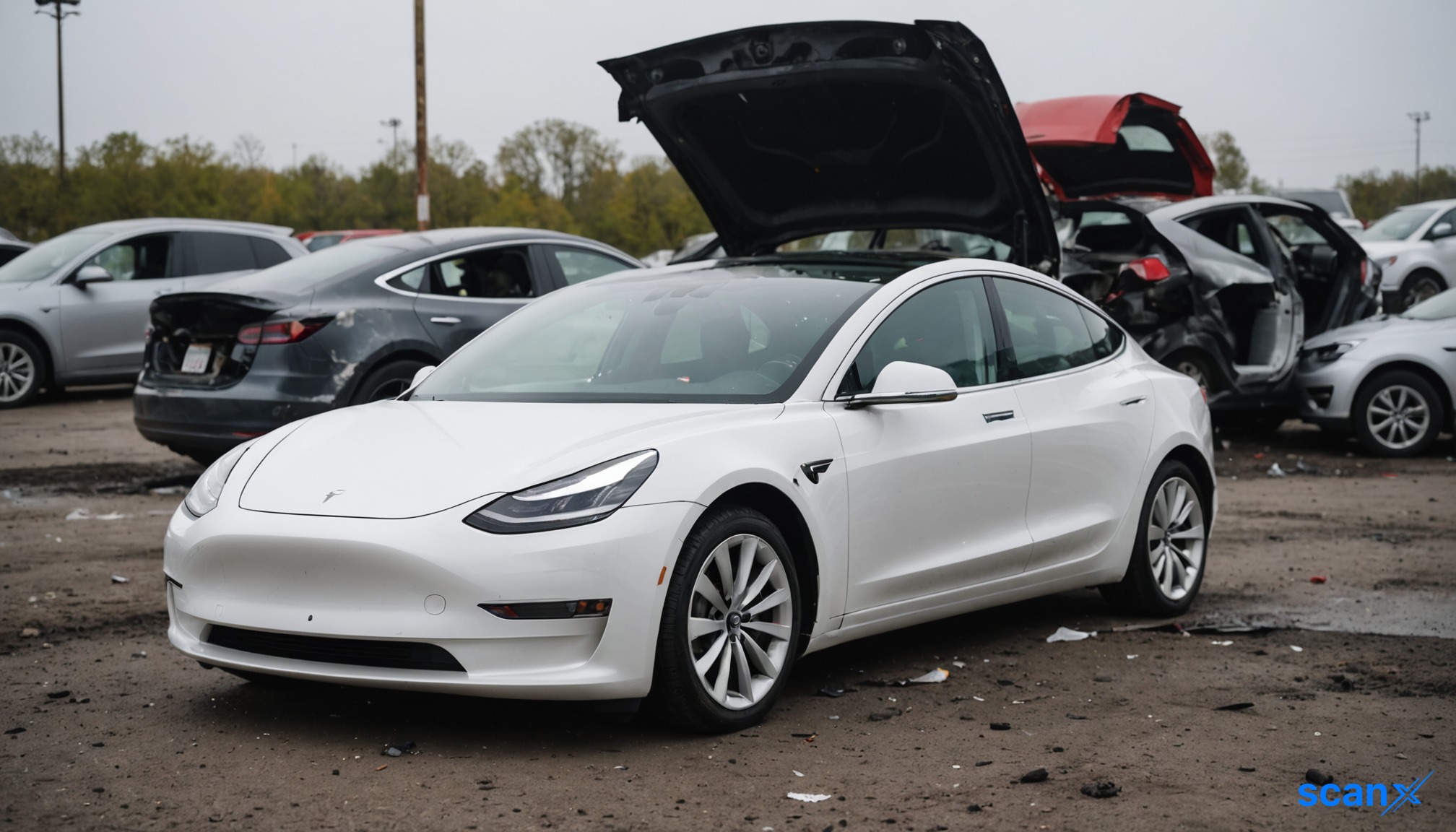

*this image is generated using AI for illustrative purposes only.
An analysis of auction and sales-listing records reveals that Tesla Inc. (NASDAQ: TSLA) vehicles carry a salvage or junk title rate of 18.5%, significantly higher than legacy electric vehicle models.
Data from EpicVIN, compiled from 296 million vehicles including records from Copart and IAAI, indicates that Tesla’s high volume in the pure battery-electric vehicle segment drives this disparity. The dataset excluded plug-in hybrids, hybrids, and extended-range electric vehicles to isolate fully electric models.
Tesla Salvage Rates Far Exceed Other EVs
The dataset comprised 2,807,799 purely electric vehicles, with Tesla accounting for 751,766 units. Of these, 138,839 Tesla vehicles held salvage titles.
The breakdown by model shows consistent high rates across the lineup:
| Model | Total Vehicles | Junk Titles | Rate |
|---|---|---|---|
| Model Y | 225,106 | 42,900 | 19.1% |
| Model 3 | 341,078 | 64,749 | 19.0% |
| Model S | 114,449 | 21,539 | 18.8% |
| Model X | 64,759 | 9,035 | 14.0% |
| Cybertruck | 6,374 | 616 | ~10% |
The Cybertruck, the newest and most expensive model, recorded the lowest rate at nearly 10%. However, older models like the Model 3 and Model Y exceeded 19%.
Legacy Automaker Comparison
In contrast, the 10 largest non-Tesla EV volume models from legacy automakers showed salvage rates ranging from 1.0% to 9.5%. Each model in this comparison had over 60,000 units in the dataset.
Notable comparisons include:
- Nissan Leaf: 9.5% (17,443 of 183,095 units)
- Chevrolet Bolt EV: 5.7% (7,920 of 138,593 units)
- Kia EV6: 3.6% (2,434 of 67,273 units)
- Hyundai Ioniq 5: 2.4% (3,843 of 159,202 units)
- Ford Mustang Mach-E: 2.6% (5,150 of 195,448 units)
- BMW i4: 2.7% (1,997 of 73,084 units)
- Volkswagen ID.4: 3.2% (3,272 of 101,308 units)
- Honda Prologue: 1.4% (1,111 of 81,657 units)
- Chevrolet Equinox EV: 1.0% (761 of 76,861 units)
- Cadillac Lyriq: 1.1% (737 of 68,163 units)
What the Numbers Show
Vehicle age typically correlates with salvage rates, yet Tesla’s rates remain static near 18% across all age groups, whereas non-Tesla EV rates increase as vehicles mature.
Tesla vehicles in the dataset have an average age of 5.4 years, compared to 3.0 years for the 65 non-Tesla models. Even when controlling for age, the divergence persists:
- Under 5 Years: Tesla Model Y and Cybertruck showed an 18.8% junk title rate (43,516 of 231,480 units), compared to 2.3% for non-Tesla makers (36,829 of 1,625,624 units).
- 5 to 8 Years: Tesla Model 3 and Model X held an 18.2% rate (73,784 of 405,837 units), versus 5.8% for non-Tesla vehicles (10,095 of 174,542 units).
- 8 to 11 Years: Tesla Model S recorded an 18.8% rate (21,539 of 114,449 units), compared to 9.5% for traditional automakers (23,711 of 249,631 units).
EpicVIN noted that these figures reflect vehicles appearing in auction and sales-listing records rather than state title registries, meaning they do not represent the total salvage rate of Tesla vehicles on U.S. roads.

How might the significantly higher salvage title rates impact Tesla's residual values and financing costs for used vehicles in the secondary market?
Will insurance companies adjust premiums or coverage terms for Tesla models in response to these elevated junk title statistics?
Could these findings influence consumer confidence and sales velocity for upcoming Tesla models like the next-generation Roadster or Cybercab?
 19
19





 Create Custom Screeners
  Access 200+ Pre-built Filters
  Use 50+ Readymade Screener





