Tesla, SpaceX sue TERA-print over Terafab name for $16.8 billion chip plant

scanx
Reviewed by
Suketu GScanX News Team
Key Highlights
  • Tesla and SpaceX sued TERA-print LLC in Austin federal court over the 'Terafab' trademark.
  • The dispute involves a planned $16.8 billion AI chip complex in Grimes County, Texas.
  • TERA-print claims its 'Tera-Fab' mark for bioengineering lithography systems is infringed.
  • Musk estimates 75% of compute output will go to SpaceX, with 25% for Tesla robots.
  • Future investment phases could raise total spending to as high as $119 billion.
powered bylight_fuzz_icon
51186981

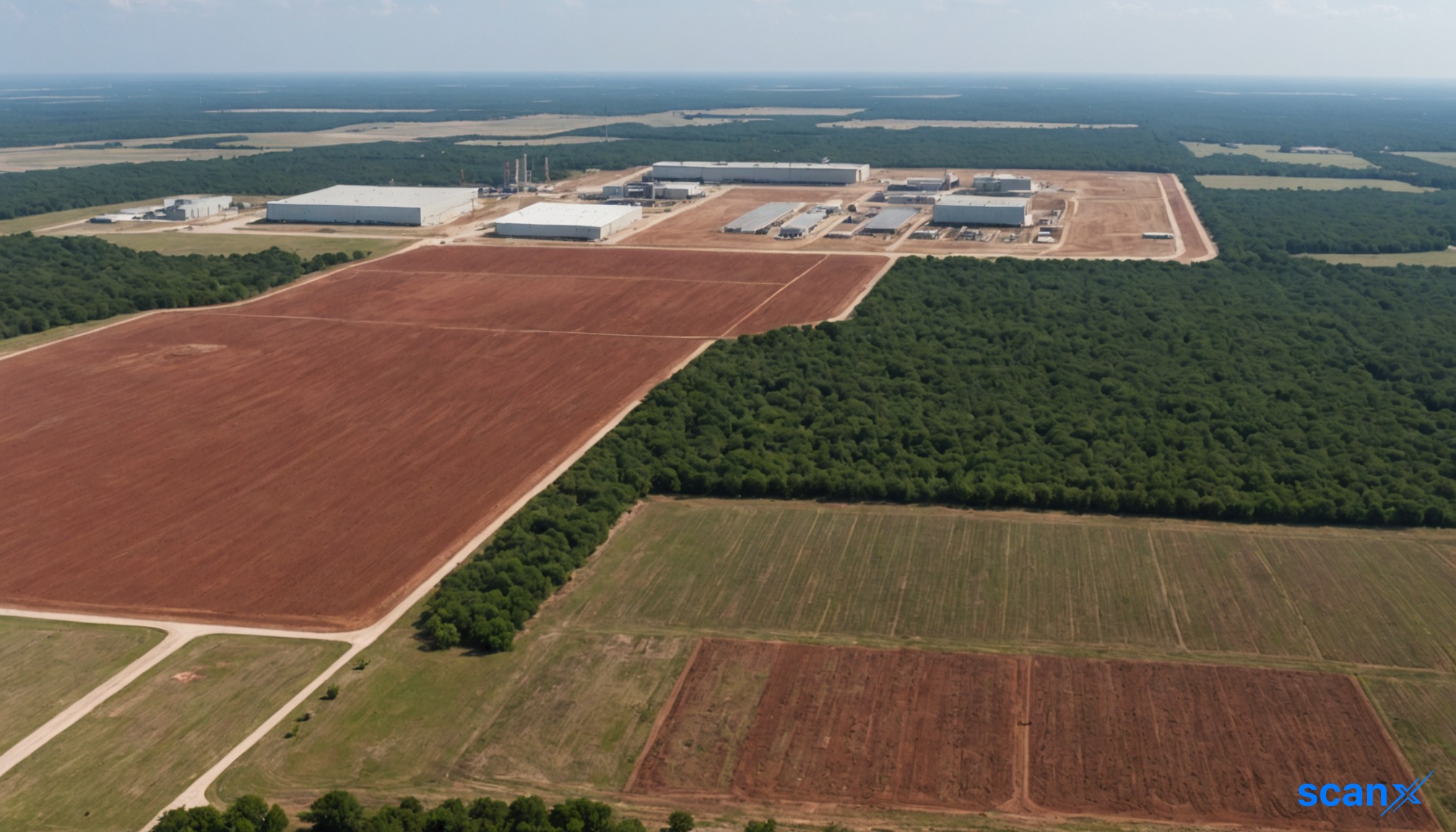
*this image is generated using AI for illustrative purposes only.

Tesla Inc. (NASDAQ: TSLA) and Space Exploration Technologies Corp. (NASDAQ: SPCX) filed a lawsuit against Illinois-based nanotechnology firm TERA-print LLC in federal court in Austin on Tuesday. The companies seek a declaration that their use of the "Terafab" name for a planned $16.8 billion AI chip complex in Texas does not infringe TERA-print’s registered "Tera-Fab" trademark.

The legal action follows a cease-and-desist letter from TERA-print after Tesla filed three trademark applications with the U.S. Patent and Trademark Office (USPTO) in May. TERA-print holds a federal registration for "TERA-FAB," which covers a desktop photolithography system used in bioengineering. The company argued in June that Musk’s ventures could create consumer confusion and threatened litigation.

Trademark Dispute Details

Tesla and SpaceX reject the infringement claim, stating that "no reasonable consumer is likely to believe" their chip manufacturing facility is affiliated with TERA-print’s desktop lithography products. The complaint emphasizes that the entities serve different customers and operate in distinct technology sectors.

TERA-print stated it discussed a settlement with Tesla as recently as Sept. 2. However, the company said it was "misled by Tesla’s professed interest in settling this matter" and will now "vigorously defend its rights." Tesla did not immediately respond to requests for comment.

Terafab Project Scale

The dispute coincides with significant expansion plans for Musk’s manufacturing ambitions. In August, Tesla and SpaceX confirmed Grimes County as the site for Terafab. The initial investment of $16.8 billion targets a 100-million-square-foot complex designed to make, package, and test advanced logic and memory chips under one roof.

SpaceX indicated the facility will employ at least 3,000 people. Filings suggest future phases could push total investment as high as $119 billion. Musk has described the facility as essential for producing AI chips "at scale for use on Earth and in space."

Compute Allocation Estimates

Musk previously estimated the split of Terafab’s AI-compute output, though he characterized the figures as a "very approximate guess." The projected allocation is as follows:

End User Estimated Share
SpaceX (AI spacecraft) 75%
Tesla (Optimus robots) 25%

The plant aims to supply chips for Tesla’s Optimus robots and Cybercabs, as well as SpaceX’s proposed space-based data centers. Nvidia CEO Jensen Huang recently commented that while the project may look audacious, Musk is capable of executing it.

Disclaimer: This article is AI-generated using data from ViewTrade. ScanX is not liable for any inaccuracies.

How might a prolonged legal battle over the 'Terafab' trademark impact the $16.8 billion construction timeline and initial production schedules for the Texas AI chip complex?

Given the projected 75% allocation of compute to SpaceX, what are the potential regulatory or geopolitical implications of developing space-based data centers and AI spacecraft capabilities?

If TERA-print prevails in court, how significant would a rebranding effort be for Tesla and SpaceX in terms of marketing costs and brand recognition for the massive Grimes County facility?

like18
dislike

Tesla Q2FY26 Results: Auto margins dip to 16.3%, record deliveries

scanx
Reviewed by
Shriram SScanX News Team
Key Highlights
  • Automotive gross margins excluding credits fell to 16.3% from 19.2%, impacted by the absence of $230 million in Q1 benefits
  • Net income boosted by $1 billion mark-to-market gain on SpaceX holdings, offsetting FX and Bitcoin losses
  • Energy storage deployments rose 53% sequentially to 13.5 GWh, though margins dropped to 20.4%
  • Capex expected to exceed $25 billion in 2026, supported by new $30 billion debt facilities
  • Robotaxi fleet logged 380,000 unsupervised miles with zero notable incidents across seven US markets
powered bylight_fuzz_icon
51177930

*this image is generated using AI for illustrative purposes only.

Tesla Inc (NASDAQ: TSLA) reported record second-quarter 2026 deliveries driven by strong Model Y demand, while automotive gross margins excluding regulatory credits declined to 16.3% from 19.2% in the prior quarter.

The company’s net income benefited significantly from a $1 billion mark-to-market gain on its SpaceX holdings, which offset foreign exchange losses of approximately $300 million and Bitcoin losses of about $100 million. Full Self-Driving (FSD) subscriptions were enabled on 55% of North American deliveries in Q2, with total paid FSD customers reaching nearly 1.5 million globally.

What the Numbers Show

Automotive gross margin contraction was largely non-operational. CFO Vaibhav Taneja noted that a $230 million benefit from warranty true-downs and tariff relief in Q1 did not repeat in Q2. Controlling for these prior-quarter benefits, automotive gross margins excluding credits would have been approximately flat, indicating stable underlying pricing and cost management despite rising commodity prices and interest rate subvention costs.

Energy and Service Segments

The energy business deployed 13.5 GWh of storage, a 53% sequential increase, marking its second-largest quarter. However, energy gross margins fell sharply from 39.5% to 20.4%. This decline was driven by a $240 million warranty true-up related to legacy vendor cell issues and the absence of over $200 million in tariff benefits recognized in Q1. Management expects long-term energy gross margins to normalize in the mid-to-low 20% range.

Service and other margins improved to an all-time high of 14.1% from 9.2%, supported by higher volume and better cost management across used car sales, supercharging, and insurance operations.

Capital Expenditure and Balance Sheet

Free cash flow turned negative as capital expenditure more than doubled sequentially. Tesla expects total capex to exceed $25 billion in 2026, funding expansion in Robotaxi fleets, Optimus robot production, semiconductor fabs, and solar manufacturing. To support this investment cycle, the company secured debt facilities allowing it to borrow up to $30 billion.

Metric Q2 2026 Prior Period Change
Automotive Gross Margin (ex-credits) 16.3% 19.2% -290 bps
Energy Gross Margin 20.4% 39.5% -1910 bps
Service & Other Margin 14.1% 9.2% +490 bps
FSD Attach Rate (North America) 55% N/A N/A

Operational Updates

Robotaxi operations have expanded to seven US markets, logging over 380,000 miles of unsupervised driving with zero notable incidents. The fleet is growing at double-digit weekly rates. Production has commenced for the Cybercab, Tesla Semi, and lithium/cathode refineries, with Megapack 3 production imminent. CEO Elon Musk emphasized that Optimus robot scaling faces significant challenges due to the lack of an existing supply chain, requiring substantial in-house manufacturing development.

Disclaimer: This article is AI-generated using data from ViewTrade. ScanX is not liable for any inaccuracies.

How will Tesla's projected $25 billion capital expenditure in 2026 impact its free cash flow trajectory and debt servicing obligations given the recent expansion of borrowing facilities?

What specific supply chain innovations or partnerships is Tesla pursuing to overcome the manufacturing bottlenecks for Optimus robots, and how might this affect near-term profitability?

Given the sharp decline in energy gross margins due to warranty issues, what corrective measures is Tesla implementing to ensure the mid-to-low 20% margin target is sustainable in subsequent quarters?

like20
dislike

More News on Tesla Inc