News Stocks India's ₹4.5 Trillion Power Investment Plan Creates Growth Opportunities for Major Players
India's ₹4.5 Trillion Power Investment Plan Creates Growth Opportunities for Major Players


India's power sector is set for a major transformation with a ₹4.5 trillion investment plan announced by Union Power Minister Manohar Lal Khattar, targeting completion by 2032. The investment includes $346 billion for power generation, $68.2 billion for transmission and distribution, and $35.2 billion for energy storage systems. With installed capacity exceeding 500 GW and peak demand reaching 250 GW in 2024, major players like NTPC, Adani Group, and Tata Power are positioned to benefit from this multi-year expansion across generation, transmission, and storage segments.
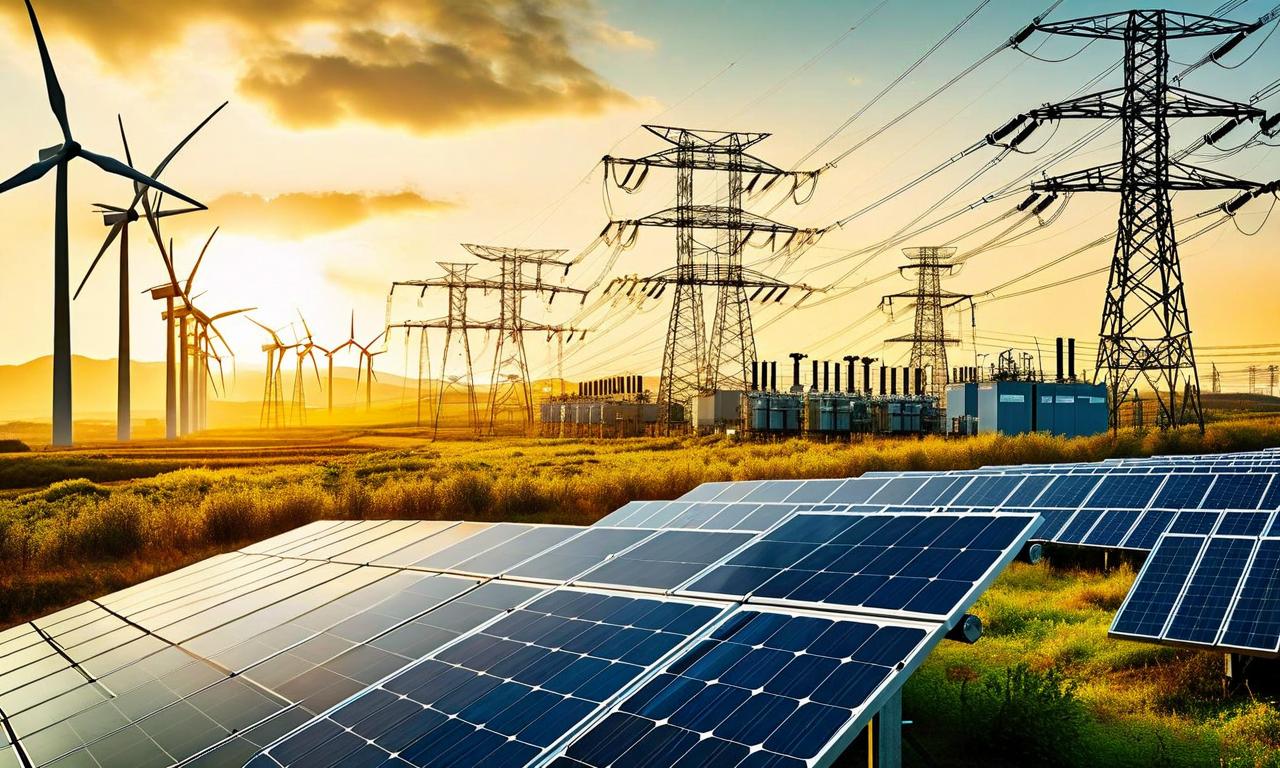

*this image is generated using AI for illustrative purposes only.
India's power sector is entering a decisive new phase with Union Power Minister Manohar Lal Khattar announcing a cumulative investment opportunity of ₹4.5 trillion by 2032. This massive investment plan marks a strategic shift from addressing power deficits to building surplus capacity focused on long-term growth, grid reliability, and clean energy integration. The announcement comes as the country's installed electricity capacity has crossed 500 GW, with non-fossil fuel sources accounting for more than half of that capacity.
Market Dynamics and Current Position
India's power industry has experienced significant transformation over the past decade, driven by rising demand, policy support, and rapid capacity additions across conventional and renewable sources. The sector has achieved notable milestones with peak demand touching 250 GW in 2024 and installed capacity expanding beyond 510 GW by November 2025.
| Parameter: | Current Status |
|---|---|
| Total Installed Capacity: | Over 500 GW |
| Peak Demand (2024): | 250 GW |
| Non-fossil Fuel Share: | More than 50% |
| Installed Capacity (Nov 2025): | Beyond 510 GW |
Investment Allocation Across Segments
Power Generation Expansion
The largest portion of the investment pipeline is allocated to power generation, expected to attract around $346 billion by 2032. This segment encompasses renewable energy additions, upgrades to conventional capacity, and emerging areas such as nuclear power. NTPC, India's largest power producer, is positioned to benefit given its scale, existing thermal base, and expansion into renewables. Adani Power and Adani Green Energy are also well-placed for fresh capacity additions, particularly as renewable energy capacity has grown more than threefold over the past decade.
Transmission and Distribution Infrastructure
Approximately $68.2 billion is earmarked for transmission and distribution infrastructure development. This investment addresses the growing need to evacuate renewable power from resource-rich regions and improve grid resilience as demand increases. India's transmission network is approaching a significant milestone, with circuit length nearing five lakh circuit kilometres after reaching 4.97 lakh circuit kilometres.
Energy Storage Development
Energy storage represents a standalone opportunity within the ₹4.5 trillion investment roadmap, with an estimated investment potential of $35.2 billion. This includes battery energy storage systems and pumped storage projects, both critical for managing intermittency from solar and wind power sources.
| Investment Segment: | Allocation |
|---|---|
| Power Generation: | $346 billion |
| Transmission & Distribution: | $68.2 billion |
| Energy Storage: | $35.2 billion |
Policy Framework and Clean Energy Progress
Policy visibility strengthens the investment appeal, with India already achieving 52 percent non-fossil fuel capacity in its installed power mix, well ahead of its climate commitments. The government's focus on digital grids, flexible generation, and energy storage, along with the proposed Electricity Amendment Bill, 2026, is expected to strengthen the regulatory framework and improve investment ease.
Strategic Positioning of Major Players
The scale and breadth of the ₹4.5 trillion investment cycle favor companies with diversified exposure across generation, transmission, distribution, and storage segments. NTPC's dominant position in generation, Adani's integrated presence across power and infrastructure, and Tata Power's end-to-end portfolio position them as natural beneficiaries of this transition. Large players with balance sheet strength and technical expertise are increasingly focusing on storage as a natural extension of their renewable portfolios.
The announced investment roadmap signals the start of a multi-year structural opportunity rather than a short-term capital expenditure burst. As India transitions from managing shortages to optimizing surplus power and preparing for structurally higher demand, major listed players are positioned for stronger growth pipelines and a central role in shaping India's power sector evolution through 2032.
 17
17