Apple Latest Results: Revenue growth trails industry average at 16.36%

scanx
Reviewed by
Suketu GScanX News Team
Key Highlights
  • Revenue growth of 16.36% lags significantly behind the industry average of 60.55%
  • EBITDA of $39.02 billion exceeds the industry average by 24.09x
  • ROE of 27.84% outperforms the sector average of 20.48%
  • Debt-to-equity ratio of 0.78 indicates lower leverage than top peers
powered bylight_fuzz_icon
53604376

*this image is generated using AI for illustrative purposes only.

Apple Inc reports a revenue growth rate of 16.36%, significantly trailing the Technology Hardware, Storage & Peripherals industry average of 60.55%.

Despite this slower top-line expansion, Apple maintains robust profitability metrics. The company's EBITDA stands at $39.02 billion, which is 24.09x higher than the industry average. Similarly, gross profit reaches $54.77 billion, exceeding the peer average by 27.94x. These figures indicate that while sales volume growth has decelerated relative to competitors, core operational profitability remains exceptionally high.

Valuation Metrics Comparison

Apple's valuation multiples present a mixed picture when compared to its peers. The Price-to-Earnings (P/E) ratio is 39.33, which is 0.95x lower than the industry average of 41.44, suggesting potential value relative to earnings. However, other metrics indicate a premium valuation:

  • Price-to-Book (P/B): At 46.55, Apple trades at 2.85x the industry average, implying a high market valuation of its book value.
  • Price-to-Sales (P/S): The ratio of 10.86 is 1.99x the industry average, reflecting investor willingness to pay a premium for each dollar of sales.
Company P/E P/B P/S ROE EBITDA ($B) Gross Profit ($B) Rev Growth
Apple Inc 39.33 46.55 10.86 27.84% $39.02 $54.77 16.36%
SanDisk Corp 19.03 12.89 10.74 46.78% $7.89 $7.58 371.59%
Seagate Tech 51.33 74.87 13.40 79.34% $1.64 $1.90 48.49%
Western Digital 13.53 15.38 10.79 34.30% $3.36 $2.03 43.84%
HPE Co 32.53 3.16 2.13 5.83% $2.33 $4.90 33.68%
Everpure Inc 193.82 30.60 11.51 4.97% $0.11 $0.81 37.73%
NetApp Inc 31.38 29.19 6.02 26.35% $0.55 $1.42 29.89%
Super Micro 10.98 2.29 0.64 12.83% $1.57 $1.94 93.16%
Logitech Intl 18.55 6.15 3.02 10.33% $0.28 $0.61 6.93%
Diebold Nixdorf 21.29 2.25 0.60 1.56% $0.09 $0.24 1.70%
Corsair Gaming 42.55 2.15 0.98 1.04% $0.02 $0.10 -1.80%
Immersion Corp 20.84 0.79 0.14 1.93% $0.01 $0.06 0.81%
Average 41.44 16.34 5.45 20.48% $1.62 $1.96 60.55%

Return on Equity and Financial Health

Apple demonstrates efficient equity utilization with a Return on Equity (ROE) of 27.84%, surpassing the industry average of 20.48% by 7.36 percentage points. This indicates superior profit generation from shareholder capital compared to the broader sector.

In terms of leverage, Apple maintains a conservative balance sheet with a debt-to-equity ratio of 0.78. This figure is lower than its top four peers, signaling reduced reliance on debt financing and a stronger financial position amidst competitive pressures.

What the Numbers Show

A divergence exists between Apple's absolute profitability and its growth trajectory. While the company generates an EBITDA 24.09x higher than the industry average, its revenue growth of 16.36% is less than one-third of the sector average (60.55%). This suggests that Apple's market dominance allows it to sustain massive absolute profits even as its percentage growth slows compared to smaller, faster-scaling competitors like Super Micro Computer (93.16% growth) or SanDisk (371.59% growth). Investors are paying a premium for stability and scale rather than rapid expansion.

Disclaimer: This article is AI-generated using data from ViewTrade. ScanX is not liable for any inaccuracies.

How might Apple's AI integration strategy in upcoming hardware cycles impact its revenue growth trajectory relative to high-growth peers like Super Micro?

What specific services or emerging product categories are expected to drive Apple's next phase of top-line expansion to close the gap with the 60.55% industry average?

Given the significant P/B premium, how sensitive is Apple's stock price to potential shifts in investor sentiment toward value stocks versus growth stocks in the tech sector?

Apple HomeView launch may drive iCloud+ subscription growth, says JPMorgan

scanx
Reviewed by
Suketu GScanX News Team
Key Highlights
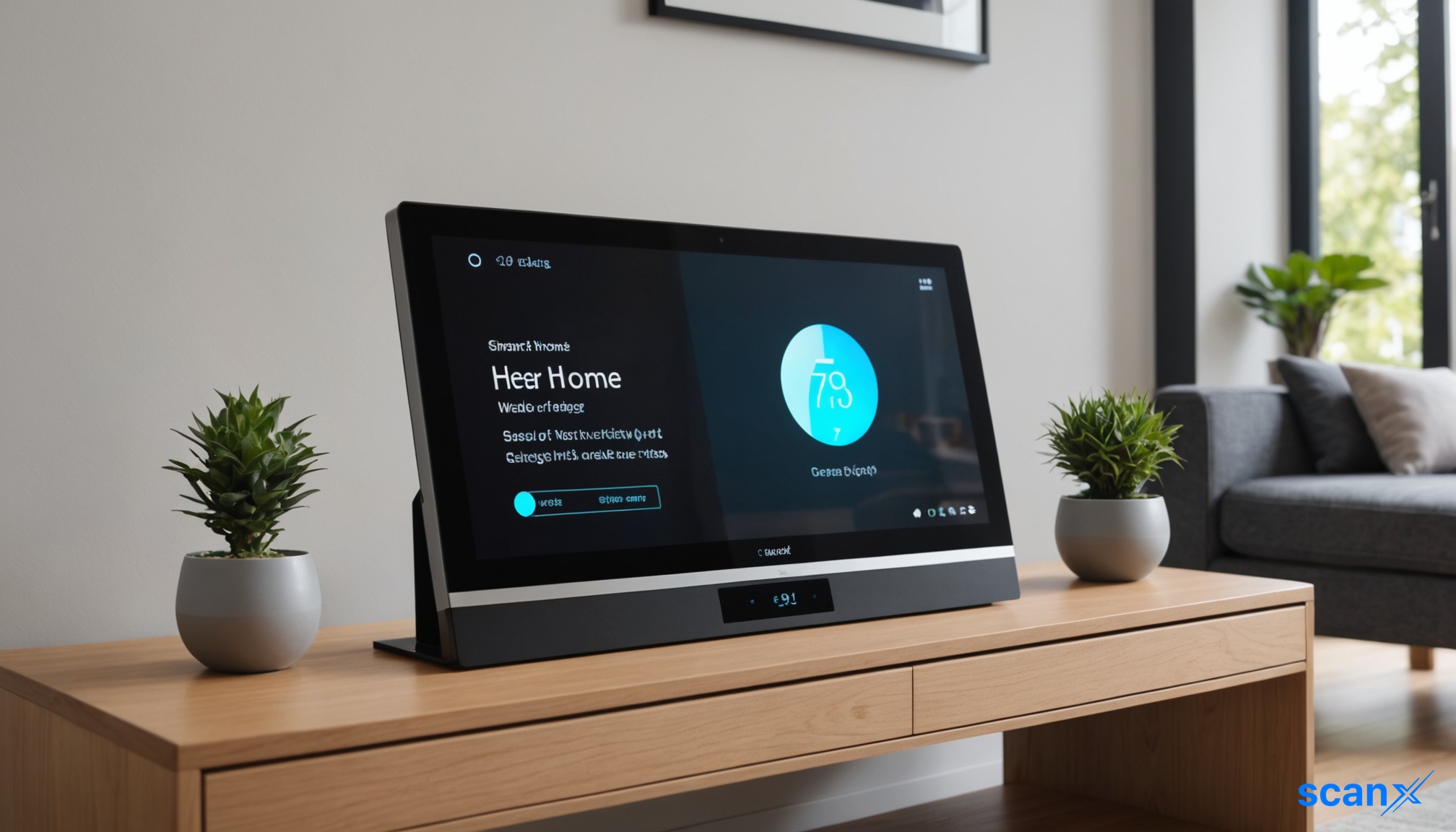
  • Apple launched the $299 HomeView smart display to integrate household devices with Siri.
  • JPMorgan analysts view the launch as a driver for recurring iCloud+ subscription revenue rather than just hardware sales.
  • The new Home Collection includes cameras starting at $199.95 and smart locks at $349.95, available from December.
  • Investor Ross Gerber criticized the need for another screen, while Mark Gurman deemed the HomeView price reasonable.
powered bylight_fuzz_icon
53509674

*this image is generated using AI for illustrative purposes only.

Apple Inc. launched its new HomeView smart display at $299 on Tuesday, aiming to integrate household devices with its Siri assistant. While the announcement drew immediate criticism from Gerber Kawasaki CEO Ross Gerber, who questioned the need for another screen in consumers' homes, JPMorgan analysts see a larger financial opportunity in recurring Services revenue.

The device, scheduled to ship next month, allows users to manage connected products such as cameras and smart locks. It personalizes Siri for up to six people. Apple also introduced updates to the HomePod and Apple TV, alongside accessories developed with LG and Schneider Electric.

Subscription opportunity over hardware sales

JPMorgan analyst Samik Chatterjee and his team noted that the "Welcome Home" launch expands Apple's ability to monetize existing households through additional hardware purchases and recurring Services revenue. The subscription opportunity centers on Apple's new Home Collection, which includes cameras, a video doorbell, smart locks, thermostats and room sensors. Availability begins in December, with select accessories following in early 2027. Cameras start at $199.95, while the smart lock starts at $349.95.

JPMorgan identifies camera recording, AI-generated video descriptions and footage search on supported iCloud+ plans as potential drivers of subscription additions and upgrades. Customers buying connected cameras may also want cloud-based video history and AI-enabled monitoring, making paid iCloud+ plans more valuable. This creates a different revenue opportunity from hardware sales; a device generates revenue when purchased, while a subscription produces recurring payments over time.

Investor skepticism over pricing and utility

Ross Gerber expressed strong disapproval of the product launch. "Thanks but not thanks Apple. Last thing I want in my home…. Another screen?" he wrote on X. His comment reflects a segment of investors concerned about market saturation in the smart home category.

Mark Gurman, a Bloomberg columnist, offered a more nuanced view. He described the $299 starting price for HomeView as "solid" and "reasonable." He also deemed the second-generation HomePod mini’s $149 price acceptable. However, Gurman criticized the reported $299 price for the Apple TV, calling it "a huge stretch" and suggesting a cheaper model is essential.

Execution challenges and market context

The hardware refreshes could support upgrades, but JPMorgan expects the immediate replacement catalyst for Apple TV and HomePod to be modest. Software availability also limits the initial opportunity: HomeView will not launch in the European Union because Siri AI is unavailable there, while certain AI features have usage limits. Additionally, Apple has not disclosed its revenue-sharing arrangements with LG and Schneider Electric, leaving the direct financial contribution from partner-developed accessories unclear.

Apple faces intense competition from established players like Amazon.com Inc., whose Echo speakers and Ring doorbells dominate the connected home market. Alphabet Inc.’s Google and emerging AI firms like OpenAI also pose challenges as artificial intelligence expands beyond chatbots into everyday devices.

Shay Boloor, chief market strategist at Futurum Equities, noted that Apple’s strategy relies on its hardware ecosystem and privacy positioning. This approach aims to keep Siri central to the home as Meta Platforms Inc., Google, and Amazon introduce their own AI assistants.

Market performance and rankings

Apple shares closed up 0.088% at $341.27 on Tuesday. In after-hours trading, the stock slipped 0.27% to $340.35.

Metric Value Change
Closing Price $341.27 +0.088%
After-Hours Price $340.35 -0.27%

According to Benzinga Edge Stock Rankings, Apple ranks in the 97th percentile for Quality. The company exhibits positive price trends across short, medium, and long terms.

Disclaimer: This article is AI-generated using data from ViewTrade. ScanX is not liable for any inaccuracies.

How might the exclusion of HomeView from the EU due to Siri AI restrictions impact Apple's long-term smart home market share in Europe?

What specific revenue-sharing terms with LG and Schneider Electric could significantly alter Apple's gross margins on partner-developed accessories?

Will the $299 price point for the updated Apple TV drive sufficient upgrade volume, or will it accelerate consumer migration to cheaper streaming alternatives?

More News on Apple