

SpaceX IPO redefines launch market as investors hunt for proxies


SpaceX's IPO has created a benchmark for the launch economy, driving investors toward public proxies like Rocket Lab, which posted record Q1 revenue of US$200.3 million. Rocket Lab's Neutron rocket, slated for a 2026 debut, is seen as a key catalyst to compete in the medium-lift market. Other players like Firefly Aerospace and Karman Holdings are also gaining attention as the sector undergoes a broad repricing.

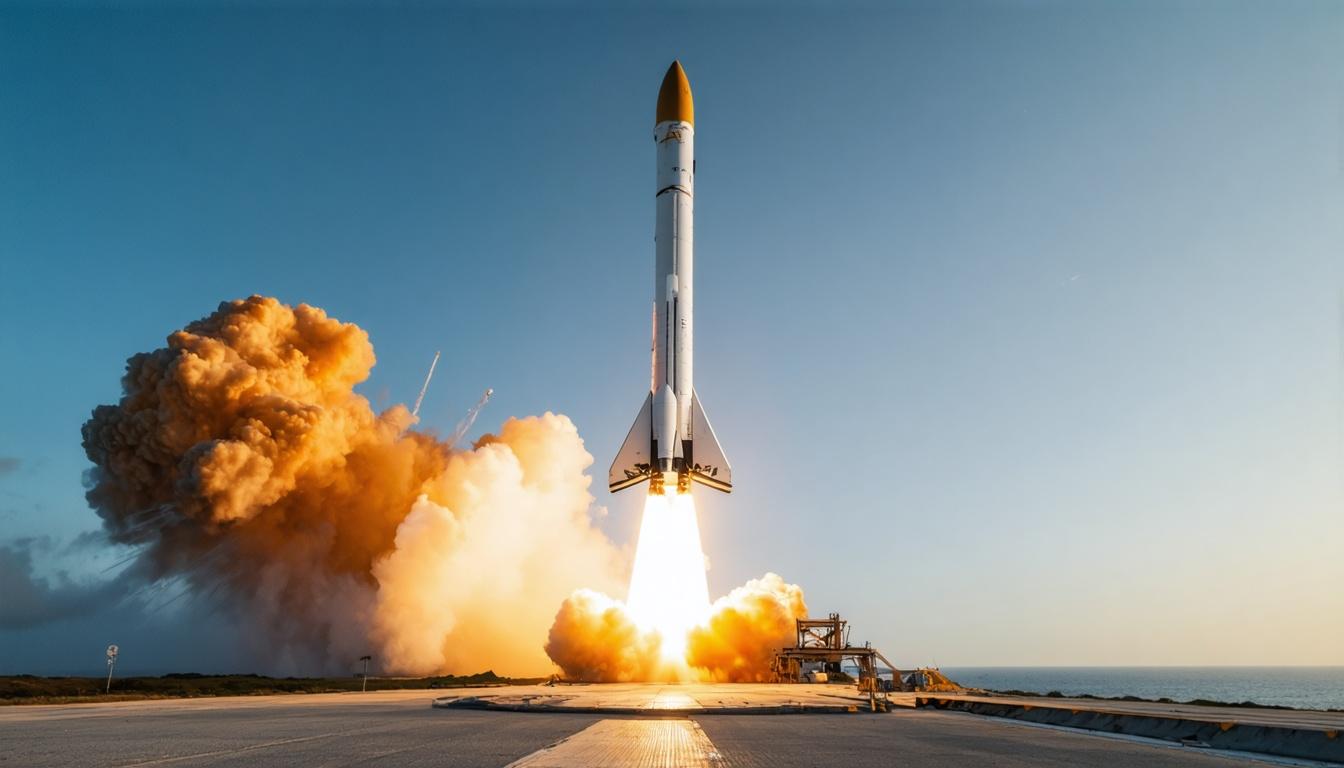

*this image is generated using AI for illustrative purposes only.
Space Exploration Technologies Corp. (SpaceX) has filed for an initial public offering under the proposed ticker SPCX in 2026, marking the first time public investors can access the leading company in the modern space economy. This move has established a market reference price for the launch sector, prompting a repricing of related stocks and intensifying the search for listed companies with credible exposure to the industry. The IPO has triggered a rotation of capital into the new mega-cap while validating the commercial space category as investable at scale.
Rocket Lab Corporation has emerged as a frequently cited public proxy for the launch economy. The company reported record Q1 2026 revenue of US$200.3 million, an increase of approximately 63% year-over-year, marking its first quarter above the US$200 million threshold. Its backlog stands above US$2.2 billion. Rocket Lab operates two primary revenue engines: the Electron rocket, the most frequently launched orbital small rocket globally, and a Space Systems segment that now accounts for the majority of its business through satellites, components, and spacecraft.
Strategic developments have further bolstered Rocket Lab's profile. The company completed the acquisition of laser-communications specialist Mynaric and signed a deal for space-robotics firm Motiv Space Systems. Additionally, Rocket Lab secured its largest single contract to date, an US$816 million award from the Space Development Agency for 18 satellites. Analysts have increasingly characterized Rocket Lab as the "clear number two" to SpaceX among public launch names.
Neutron: A Strategic Catalyst
The Neutron medium-lift rocket represents Rocket Lab's effort to compete directly in the market segment dominated by SpaceX's Falcon 9. Designed to carry roughly 13,000 kilograms to low Earth orbit, Neutron is a partially reusable rocket. Management continues to target a 2026 first flight, having reached key engine and structural milestones. A successful debut would provide a U.S.-listed pure-play with a credible competitor for large constellation deployments, commercial cargo, and government payloads.
However, execution risks remain. Neutron has not yet flown, and first launches of new rockets frequently experience delays. Rocket Lab also faces integration risks from recent acquisitions and the lower-margin ramp associated with large government contracts.
Broader Industry Landscape
While Rocket Lab is a prominent focus, other public companies are also framing the post-SpaceX-IPO landscape. Firefly Aerospace, which listed on the Nasdaq in 2025, reported record Q1 2026 revenue of approximately US$80.9 million, up 45% year-over-year. The company combines its Alpha small-lift rocket and Blue Ghost lunar-lander heritage with a growing spacecraft-solutions business, though it continues to invest heavily and operate at a loss.
Karman Holdings rounds out the sector on the systems side, designing payload-protection, propulsion, and interstage hardware for missile-defense, hypersonics, and space-launch programs. The company has posted strong revenue growth driven by accelerating demand in defense and hypersonics. These distinct businesses—launch, satellites, and defense—are being re-rated together following SpaceX's public debut, even as each company's performance depends on its own execution.
Key Financial Metrics
| Company | Ticker | Q1 2026 Revenue | YoY Growth | Backlog / Key Contract |
|---|---|---|---|---|
| Rocket Lab Corporation | RKLB | US$200.3 million | ~63% | > US$2.2 billion |
| Firefly Aerospace | FLY | ~US$80.9 million | ~45% | N/A |
| Karman Holdings | KRMN | N/A | N/A | N/A |

How will the pricing of SpaceX's IPO influence the valuation multiples of smaller pure-play launch companies like Rocket Lab and Firefly Aerospace?
Can Rocket Lab successfully manage the integration of Mynaric and Motiv Space Systems while simultaneously executing the capital-intensive Neutron rocket development?
What impact will SpaceX's public status and increased transparency have on the competitive landscape for government contracts, specifically regarding the Space Development Agency?
 18
18








 Access 50+ Readymade Screeners
  Use 200+ Custom Filters
  Get Full Market Insights





