

SpaceX IPO lifts space economy, Intuitive Machines reports record revenue


SpaceX's IPO has catalyzed investor interest in the space economy, particularly in lunar infrastructure. Intuitive Machines leads this trend with record Q1 2026 revenue of US$186.7 million and a US$1.1 billion backlog, bolstered by the Lanteris acquisition and major government contracts. The sector is shifting from exploration to commercial procurement, offering recurring revenue opportunities for firms like Voyager Technologies and Boeing.

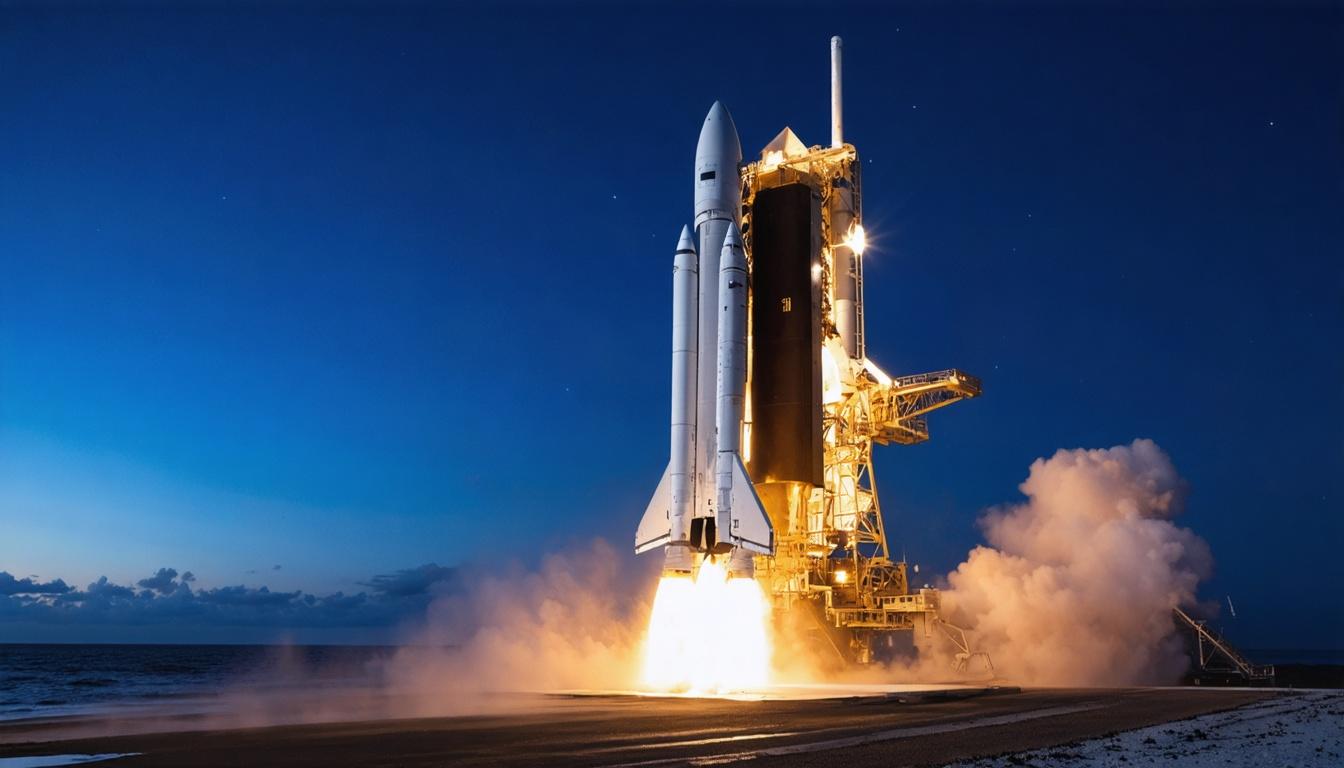

*this image is generated using AI for illustrative purposes only.
The public listing of Space Exploration Technologies Corp. (SpaceX) has reframed the space sector as an investable theme, drawing fresh capital to companies building lunar infrastructure. Reporting noted a rally across space stocks tied to NASA's lunar ambitions and Moon-base planning. As SpaceX arrived on the public market, investors began searching for listed names attached to the broader opportunity, with the return to the Moon emerging as a key focus.
Intuitive Machines has positioned itself as a leading public name in NASA's commercial Moon program. The company reported record Q1 2026 revenue of about US$186.7 million, nearly triple the prior-year period. It also posted positive adjusted EBITDA of US$2.7 million and a contracted backlog of roughly US$1.1 billion.
Financial Performance and Contracts
The company's growth was driven by its roughly US$800 million acquisition of Lanteris Space Systems, which expanded its capabilities beyond lunar landers. Management highlighted a revenue mix split across commercial, civil, and national-security customers. Key milestones included a NASA Commercial Lunar Payload Services task order for its IM-5 mission and selection for the U.S. Space Force's Andromeda IDIQ, a space-domain-awareness program with a ceiling reported as high as US$6.2 billion.
Q1 2026 Key Metrics
| Metric | Value |
|---|---|
| Revenue | About US$186.7 million |
| Adjusted EBITDA | US$2.7 million |
| Contracted Backlog | About US$1.1 billion |
| Acquisition Cost | About US$800 million |
Intuitive Machines reaffirmed its full-year 2026 revenue guidance of US$900 million to US$1 billion. The company is pivoting from a single-mission lunar specialist to a vertically integrated, multi-domain space contractor.
Broader Sector Implications
The SpaceX IPO helped surface a deeper shift: "going to the Moon" has become a procurement program rather than just an exploration goal. NASA's Artemis effort and associated Moon-base planning are designed to be executed through commercial contracts, converting a national ambition into recurring revenue for positioned firms. Intuitive Machines has leaned into this by expanding from landers into space-to-Earth data relay through planned acquisitions of ground-station assets.
Other listed companies frame the broader infrastructure landscape. Voyager Technologies is a space-and-defense technology company working across propulsion and precision systems, while Boeing anchors the large-cap, incumbent end with deep space heritage. Each represents a distinct route into the lunar and space-services theme, tied to its own contracts and execution risks.

How will Intuitive Machines balance the integration of the $800 million Lanteris acquisition with maintaining its growth trajectory in lunar lander services?
What are the execution risks associated with scaling operations to meet the full-year 2026 revenue guidance of $1 billion?
To what extent will the recurring revenue model from NASA's Artemis program mitigate the volatility typically associated with single-mission space contracts?
 17
17







 Access Market Heat-map & Insights
  Create, Save & Share your Screener
  Use 200+ Screening Filters





