Ford to shift Lincoln production from China to US by 2030 amid tariffs

scanx
Reviewed by
Suketu GScanX News Team
Key Highlights

Ford Motor is moving Lincoln production from China to the U.S. by 2030 to avoid a 52.5% tariff on the Nautilus SUV. CEO Jim Farley cited domestic manufacturing advantages and new tech restrictions. The shift coincides with the launch of the $30,000 Fathom EV pickup.

powered bylight_fuzz_icon
48194118

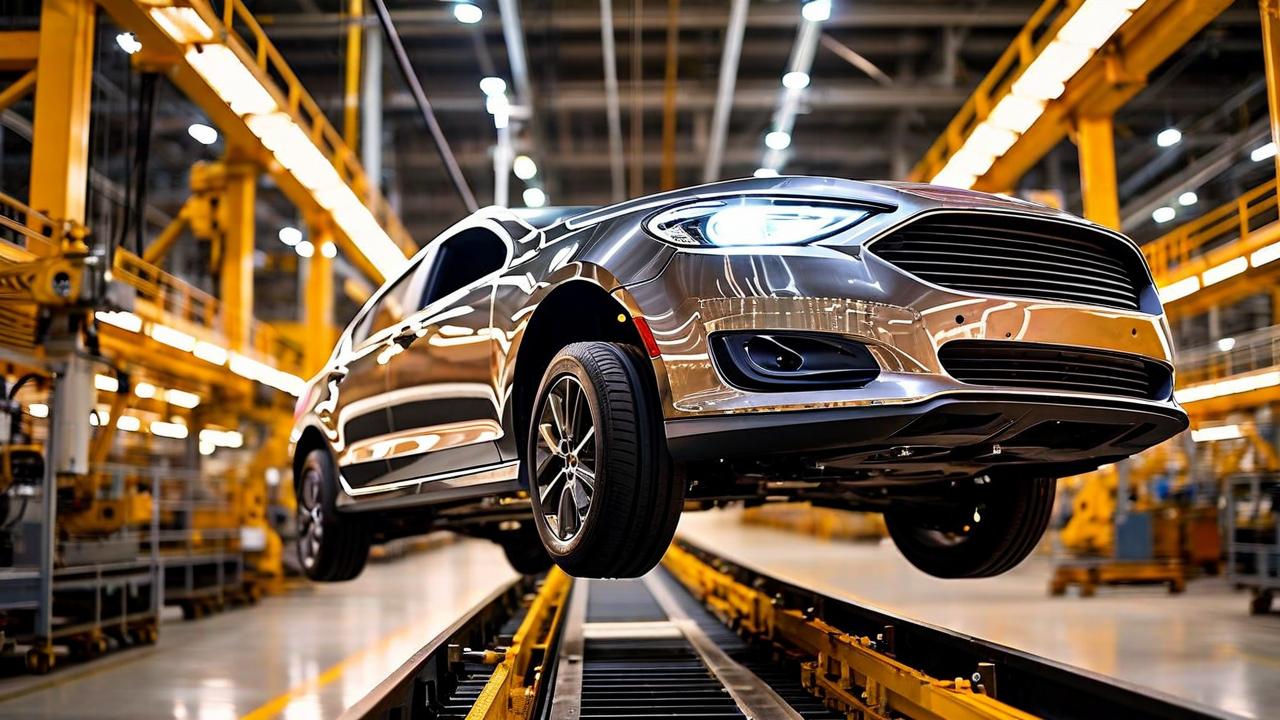
*this image is generated using AI for illustrative purposes only.

Ford Motor Co. (NYSE: F) will begin shifting production of select Lincoln vehicles from China to the United States in 2030, CEO Jim Farley confirmed in an interview with Reuters. The strategic pivot aims to mitigate the impact of high tariffs imposed by the Trump administration and comply with tightening restrictions on Chinese vehicle technology in the U.S. market.

The immediate catalyst for the decision is the 52.5% tariff currently applied to the Lincoln Nautilus SUV, which Ford imports from China for U.S. sales. Farley stated that the company made the decision as soon as the administration’s policy framework was established, emphasizing that domestic manufacturing provides a competitive edge.

Production Strategy Shift

Ford announced it will phase out the importation of vehicles from China for the U.S. market entirely. In an official statement, Farley noted, "Ford builds in America because we believe in America, and we're betting on that belief again." U.S. Commerce Secretary Howard Lutnick echoed this sentiment, asserting that domestic manufacturing holds a distinct advantage under the current regulatory environment.

This move aligns with broader efforts to secure favorable trade terms. During the second-quarter earnings call, Farley described a renewed U.S.-Mexico-Canada Agreement (USMCA) as "critical" to Ford’s business model, suggesting that an improved agreement could present significant opportunities for the industry.

New Product Launch

Alongside these operational adjustments, Ford recently unveiled its sub-$30,000 electric pickup truck, named the Fathom. The automaker stated the name reflects a deep understanding of customer lifestyles.

Ford shares rose 0.07% to $13.85 in premarket trading on Thursday.

What the Numbers Show

The 52.5% tariff on the Lincoln Nautilus represents a substantial cost burden for an imported luxury vehicle. By shifting production to the U.S., Ford aims to eliminate this specific tariff liability. This operational change directly links regulatory policy costs to supply chain restructuring, highlighting how trade barriers can dictate manufacturing geography for premium brands targeting the domestic market.

Disclaimer: This article is AI-generated using data from ViewTrade. ScanX is not liable for any inaccuracies.

How will the capital expenditure required to retool U.S. facilities for Lincoln production impact Ford's near-term profit margins and cash flow?

Will other automakers with significant Chinese manufacturing footprints, such as BMW or Volvo, follow Ford's lead in shifting production to avoid similar tariff liabilities?

How might the introduction of the sub-$30,000 Fathom electric pickup influence consumer adoption rates for affordable EVs in a high-interest-rate environment?

like16
dislike

Ford unveils $28,350 Fathom EV pickup to boost margins

scanx
Reviewed by
Suketu GScanX News Team
Key Highlights

Ford Motor Company launches the Fathom EV pickup at $28,350, undercutting the Tesla Cybertruck by 2.5x. The vehicle includes BlueCruise and Apple Maps, with preorders set for early 2027. This move aligns with Ford's strategy to improve EV profitability after discontinuing the F-150 Lightning.

powered bylight_fuzz_icon
47673599

*this image is generated using AI for illustrative purposes only.

Ford Motor Company (NYSE:F) unveiled the Fathom, a new electric pickup truck priced at $28,350, marking a strategic pivot toward profitability in its electric vehicle segment. The launch follows the company’s decision last year to halt sales of the F-150 Lightning and other EV models to focus on cost-effective vehicles under the $30,000 threshold. With preorders expected in early 2027, the Fathom represents Ford’s effort to capture price-sensitive consumers while addressing previous margin challenges in its EV lineup.

The Fathom is designed with an expansive interior that seats five adults comfortably and offers more passenger volume than the Toyota RAV4. Key technological features include bidirectional power capabilities, BlueCruise advanced driver-assistance systems, and a navigation system powered by Apple Maps from Apple Inc (NASDAQ:AAPL). The vehicle is compatible with both Apple CarPlay and Android Auto from Alphabet.

Competitive Pricing Landscape

The Fathom’s starting price of $28,350 positions it significantly below major competitors in the electric pickup market. This pricing strategy aims to attract consumers who have previously avoided EVs due to high costs. The following table compares the Fathom’s starting price with key competitors:

Vehicle Model Starting Price Price Difference vs. Fathom
Ford Fathom $28,350 —
Slate Tuck $24,950 $3,400 cheaper
Chevrolet Silverado EV $55,985 $27,635 more expensive
Tesla Cybertruck $69,990 $41,640 more expensive
Rivian R1T $79,900 $51,550 more expensive

At its base price, the Fathom is approximately 2.47 times cheaper than the Tesla Cybertruck. It is also roughly 1.75 times cheaper than Ford’s own discontinued F-150 Lightning. While Slate Auto, a startup backed by Jeff Bezos, offers the Slate Tuck at $24,950, that model ships with limited features and requires additional customization costs, whereas the Fathom includes core technologies like BlueCruise out of the box.

Market Context and Sales Performance

Ford’s move comes amid mixed performance in the EV sector. In 2025, Ford sold 27,307 F-150 Lightning units, outselling the Tesla Cybertruck, which saw 20,237 units sold—a 48% decline from the 39,965 units sold in 2024. Despite lower EV sales volumes in the second quarter of 2026, Ford raised its full-year EBIT guidance, citing strong financial metrics and a focus on bottom-up margin improvement.

What the Numbers Show

The significant price disparity between the Fathom and established competitors highlights a shift in the EV pickup market toward affordability. By pricing the Fathom at $28,350, Ford is targeting a broader consumer base beyond early adopters who were willing to pay premiums for brands like Tesla and Rivian. The success of this strategy will depend on whether Ford can maintain acceptable profit margins at this lower price point, a challenge it explicitly acknowledged by halting higher-priced EV production last year. If executed correctly, the Fathom could redefine value expectations in the electric truck segment.

Disclaimer: This article is AI-generated using data from ViewTrade. ScanX is not liable for any inaccuracies.

How will Ford's supply chain partners adapt to maintain acceptable profit margins on the Fathom given its significantly lower price point compared to previous EV models?

What impact might the Fathom's sub-$30,000 pricing have on the strategic roadmaps of competitors like Rivian and Tesla in the mid-tier electric pickup segment?

Will the inclusion of BlueCruise and Apple Maps integration at this price point pressure legacy automakers to bundle advanced driver-assistance systems as standard features rather than optional upgrades?

like17
dislike

More News on Ford Motor