Seagate says smarter storage unlocks Nvidia GPU efficiency

scanx
Reviewed by
Ashish TScanX News Team
Key Highlights

Seagate Technology Holdings PLC argues that smarter storage architecture, particularly key-value cache, is essential for maximizing Nvidia GPU efficiency in AI inference. By storing context rather than recomputing it, storage reduces GPU load and lowers infrastructure costs. With cloud data centers accounting for 90% of exabyte shipments and commitments extending to 2029, Seagate positions itself as a critical enabler of AI performance beyond just physical AI data storage.


powered bylight_fuzz_icon
46895975

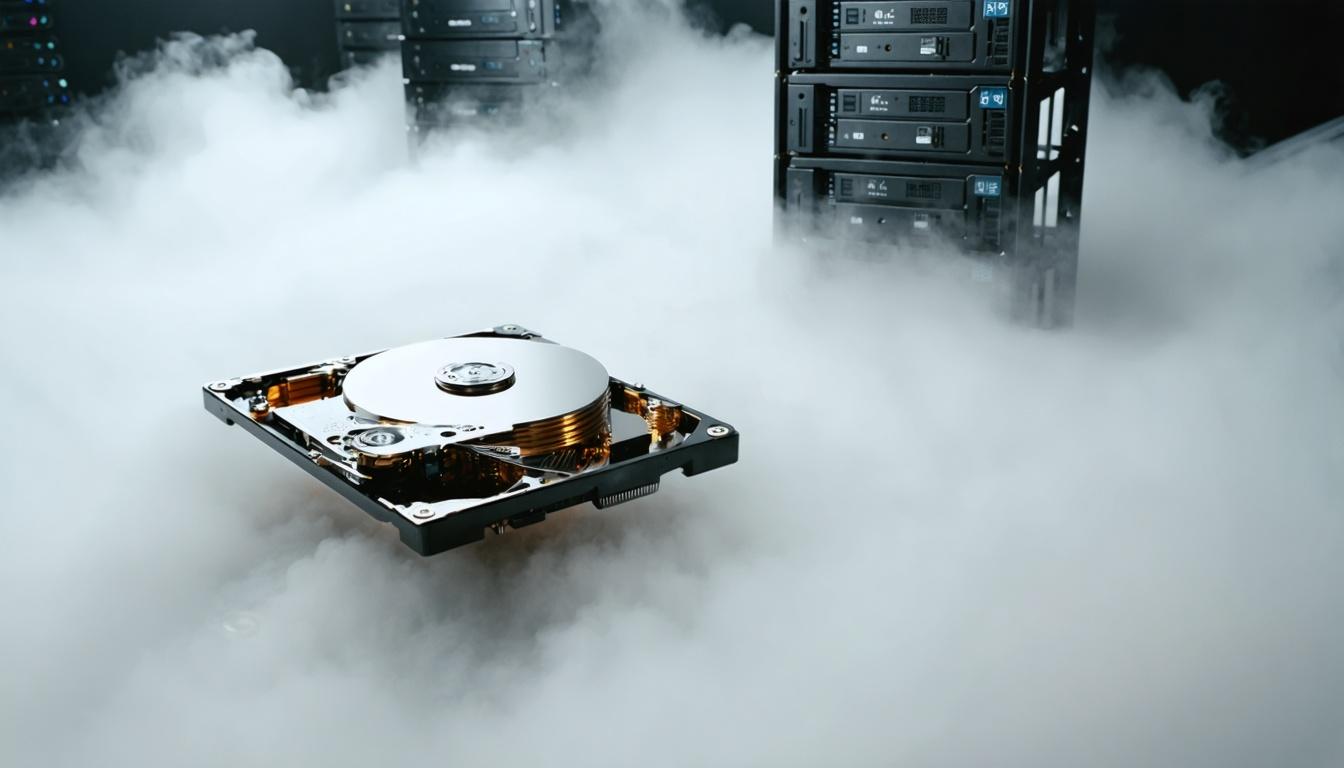
*this image is generated using AI for illustrative purposes only.

Seagate Technology Holdings PLC (NASDAQ: STX) CEO Dave Mosley argues that the next leap in artificial intelligence performance will not come from compute power alone, but from smarter storage architecture that maximizes the efficiency of expensive Nvidia Corp. (NASDAQ: NVDA) GPUs. During the company’s fiscal fourth-quarter earnings call, Mosley highlighted a joint white paper with SK hynix Inc. (NASDAQ: SKHY) demonstrating how tiered storage and key-value (KV) cache can reduce GPU usage during intensive inference workloads, thereby lowering infrastructure costs and boosting productivity.

The core of this strategy involves retaining context across interactions rather than repeatedly generating it. By moving context across memory, solid-state drives, and hard drives, AI systems can retrieve previously generated information instead of forcing GPUs to recompute it. This approach frees up GPU resources for additional revenue-generating tasks, making storage an increasingly vital component of the AI stack alongside compute and memory.

The Role of KV Cache in AI Economics

Mosley emphasized that modern AI applications, particularly agentic AI and inference workloads, rely heavily on reusing context. "Key-value, or KV cache, is used to retain and reuse that context efficiently," Mosley stated. This mechanism allows systems to store previously generated context in high-capacity hard drives, reducing the computational burden on accelerators.

This shift has significant implications for AI economics. By minimizing redundant computation, organizations can extend the utility of their existing hardware investments. "This drives the need for increased hard drive storage and reduces GPU usage during the most compute-intensive phases of an agentic application," Mosley explained. Consequently, storage architecture is becoming a primary driver of performance gains as models retain more context over time.

Impact on Infrastructure Efficiency

Component Traditional Approach Seagate’s Proposed Approach Benefit
Context Management Recreate context via GPU computation each time. Store context in KV cache on HDDs/SSDs. Reduces GPU load; lowers costs.
GPU Utilization High usage for repetitive tasks. Freed up for new, revenue-generating workloads. Increases overall infrastructure productivity.
Storage Role Passive data repository. Active participant in AI performance optimization. Enhances value of storage in AI stack.

Physical AI and Data Demand

Beyond inference efficiency, Mosley reiterated that physical AI—driven by humanoid robots and autonomous vehicles—represents a massive long-term growth catalyst for storage demand. He described robots as networks of cameras and sensors generating continuous unstructured video data. This footage must be retained to train "world models" that enable machines to understand their physical environment.

"People focus very much on the end product—the robot—but I actually think it’s a lot more of a data play," Mosley said. The requirement to preserve years of historical video for future training cycles creates sustained demand for enterprise-grade storage capacity, reinforcing Seagate’s position as a critical infrastructure provider.

What the Numbers Show

The strategic pivot toward storage as an active enabler of AI performance is supported by strong market signals. Management reported that cloud data centers now account for roughly 90% of Seagate’s exabyte shipments. Furthermore, customers are extending long-term supply commitments into 2029 and beyond, indicating confidence in the structural demand for high-capacity storage as AI infrastructure scales.

For investors, the narrative shifts from viewing storage as a passive commodity to recognizing it as a lever for optimizing expensive compute resources. As companies seek to squeeze more value from every Nvidia accelerator, the integration of efficient storage solutions like KV cache becomes a decisive competitive advantage in the AI race.

Disclaimer: This article is AI-generated using data from ViewTrade. ScanX is not liable for any inaccuracies.

How might the adoption of KV cache architectures impact Nvidia's future GPU sales volumes or pricing power as data centers optimize for efficiency over raw compute?

What are the potential latency trade-offs of retrieving context from HDDs versus SSDs, and how will this influence the design of next-generation tiered storage systems?

Could the shift toward storage-centric AI efficiency create new competitive advantages for hard drive manufacturers like Seagate and Western Digital against pure-play SSD providers?

like19
dislike

Seagate beats Q4 estimates; analysts raise targets on AI demand

scanx
Reviewed by
Suketu GScanX News Team
Key Highlights

Seagate Technology Holdings Plc delivered a strong Q4FY26 with $3.63 billion in revenue and $5.71 EPS, exceeding consensus. Driven by AI infrastructure demand and rising prices, analysts from Citigroup, Rosenblatt, and Wells Fargo raised price targets. Guidance for Q1FY27 remains robust at $4.1 billion revenue.

powered bylight_fuzz_icon
46814097

*this image is generated using AI for illustrative purposes only.

Seagate Technology Holdings Plc delivered a robust fourth-quarter fiscal 2026 performance, exceeding analyst expectations with record margin expansion driven by sustained artificial intelligence infrastructure demand. The storage manufacturer posted non-GAAP earnings per share of $5.71, surpassing the consensus estimate of $5.09 by 12.18% and marking a 120.46% year-over-year increase from $2.59. Quarterly revenue reached $3.63 billion, beating the $3.49 billion forecast and rising 48.49% from the prior year’s $2.44 billion. This operational strength has prompted multiple analysts to raise their price targets, with Citigroup, Rosenblatt Securities, and Wells Fargo boosting their outlooks following the results.

The results stand in sharp contrast to broader market sentiment that had pressured memory and storage stocks throughout July, with peers like SanDisk Corp. dropping over 55% from June highs. Seagate’s performance was underpinned by disciplined execution in pricing and product mix, resulting in an adjusted gross margin of 52.7%, up 570 basis points sequentially from 47%. Adjusted operating margin improved to 44.6%, up 710 basis points. The company generated $1.1 billion in free cash flow, using $302 million to retire debt and returning $283 million to shareholders through dividends and buybacks.

Financial Performance vs. Estimates

Seagate’s divergence from market expectations highlights its resilience amid fears of an AI infrastructure slowdown. While the Roundhill Memory ETF (NYSE: DRAM) fell 2.7% on Tuesday, Seagate shares rose 1.5% by midday trading before closing up 2% at $762.37 on Wednesday. Wall Street had projected modest growth, but the company delivered substantial top-line and bottom-line expansion. CEO Dave Mosley attributed the success to robust hyperscaler demand, noting that annual revenue grew 34% in fiscal 2026, supported by record profitability and $3.1 billion in full-year free cash flow.

Metric Actual Consensus Estimate Variance
Non-GAAP EPS $5.71 $5.09 +12.18%
Revenue $3.63 billion $3.49 billion +4.14%
Gross Margin 52.7% N/A Record
Free Cash Flow $1.1 billion N/A Record

Analyst Reactions and Price Target Upgrades

Following the earnings announcement, several major financial institutions increased their price targets for Seagate stock. Citigroup analyst Asiya Merchant maintained a Buy rating and raised the price target from $1,240 to $1,300. Rosenblatt Securities analyst Kevin Cassidy also maintained a Buy rating, increasing the target from $1,300 to $1,400. Wells Fargo analyst Aaron Rakers kept an Overweight rating while boosting the target from $1,100 to $1,180. Bank of America analyst Wamsi Mohan maintained a Buy rating with a $1,150 price target, implying 54% upside from recent trading levels.

Cassidy described the quarter as a "clean beat-and-raise," attributing the upside to stronger pricing, a widening supply-demand imbalance, and higher long-term earnings estimates. He noted that total shipments reached 218 exabytes, while blended pricing rose 6.7% sequentially and 10.6% year over year to $16.65 per terabyte. Cassidy stated that stronger pricing accounted for most of the revenue upside. Rosenblatt raised its fiscal 2027 EPS estimate to $34.16 from $29.42 and its fiscal 2028 estimate to $57.04 from $51.36, citing newly negotiated long-term agreements resetting at higher prices as the key driver of earnings revisions through fiscal 2028.

Operational Drivers and Market Outlook

Data center customers accounted for 89% of total shipments, with data center exabyte shipments reaching 195 exabytes, up 11% sequentially and 43% year over year. Data center revenue rose to $2.9 billion, increasing 17% sequentially and 57% year over year. Management highlighted that most nearline exabyte capacity is committed through calendar 2028, with customers seeking additional commitments into 2029 and beyond. Build-to-order contracts now extend through the end of fiscal 2027, providing strong visibility into future demand.

Looking ahead, Seagate provided optimistic guidance for the first quarter of fiscal 2027, expecting revenue of approximately $4.00 billion to $4.02 billion (updated to $4.1 billion plus or minus $100 million), representing 56% year-over-year growth. The outlook includes non-GAAP operating expenses of around $300 million, a non-GAAP operating margin of around 50%, and non-GAAP diluted EPS of $7.30, plus or minus $0.20. Bank of America’s Wamsi Mohan noted that incremental gross margin during Q4 was 83.2% year-over-year, with Q1 guidance implying roughly 88% incremental gross margin, signaling continued pricing power.

What the Numbers Show

The significant sequential expansion in both gross and operating margins indicates that Seagate is successfully leveraging its scale and shifting toward higher-value AI storage solutions. With data center demand accounting for nearly 90% of exabyte shipments and long-term supply agreements securing capacity through 2028, the company appears well-positioned to sustain its growth trajectory. Analysts note that the supply-demand gap has widened, allowing production above contracted volumes to sell at even higher prices, reinforcing the view that mass-capacity storage remains an essential layer of AI infrastructure alongside GPUs and memory.

Disclaimer: This article is AI-generated using data from ViewTrade. ScanX is not liable for any inaccuracies.

How might Seagate's ability to maintain ~88% incremental gross margins in Q1 fiscal 2027 impact its competitive positioning against rivals like Western Digital and Kioxia?

Given that data center customers account for 89% of shipments, what risks does Seagate face if hyperscaler capital expenditure priorities shift away from mass-capacity storage toward other AI infrastructure components?

Will the widening supply-demand imbalance allow Seagate to sustain the 10.6% year-over-year pricing increases through fiscal 2028, or is a correction likely as new capacity comes online?

like20
dislike

More News on Seagate Technology