

Firefly Aerospace stock rises 4.17% on record $117.7M Q2 revenue


Firefly Aerospace Inc. reported record Q2 2026 revenue of $117.7 million, beating estimates and driving a 4.17% pre-market stock gain. The company expanded its portfolio with new NASA contracts for lunar and Mars missions, while maintaining strong liquidity despite a widened net loss due to increased R&D spending.



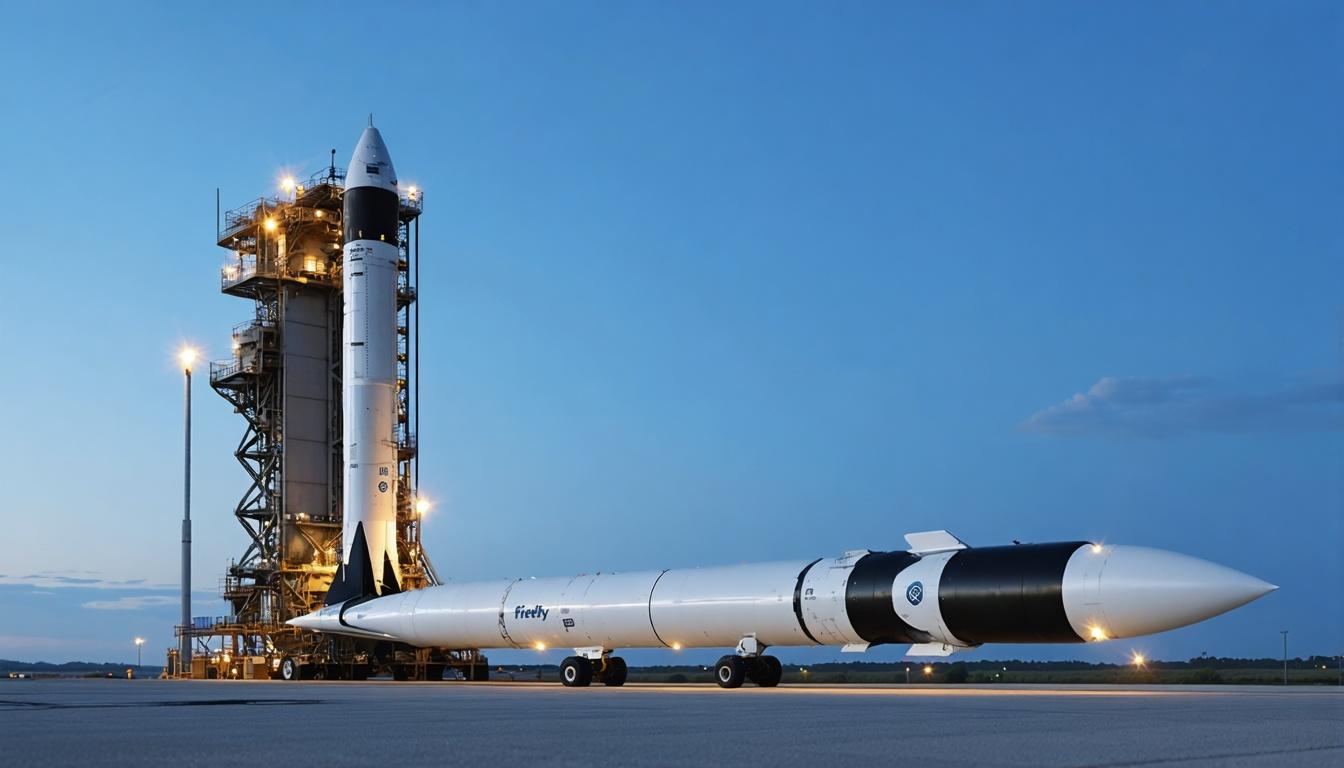
*this image is generated using AI for illustrative purposes only.
Firefly Aerospace Inc (NASDAQ: FLY) shares climbed 4.17% during Wednesday’s pre-market trading session, following the release of upbeat second-quarter 2026 financial results after the bell on Tuesday. The stock surge reflects investor confidence in the company’s operational momentum, as Firefly reported record quarterly revenue of $117.7 million, marking a 659% year-over-year increase from $15.549 million in Q2 2025. This performance significantly exceeded analyst estimates of $88.198 million and represented the first time the aerospace firm surpassed the $100 million quarterly revenue threshold.
The strong market reaction was driven by robust execution across rocket, spacecraft, and software segments, supported by multiple new contracts with NASA and national security agencies. CEO Jason Kim stated that breaking the $100 million mark demonstrates Firefly’s ability to align execution with incoming orders. The company also completed an underwritten public offering of common stock, generating net proceeds of $181.6 million to fund core business growth and recently awarded contracts. Despite the revenue beat, Firefly recorded a net loss of $92.319 million for the quarter, compared to a net loss of $63.778 million in the same period last year.
Key Financial Metrics
| Metric | Actual | Estimate | Variance |
|---|---|---|---|
| Revenue | $117.683 million | $88.198 million | +$29.485 million |
| Adjusted Loss Per Share | $(0.42) | $(0.52) | +$0.10 |
| Cash & Equivalents | $459.82 million | N/A | N/A |
| Short-Term Investments | $175.45 million | N/A | N/A |
Firefly closed the quarter with robust liquidity, holding $459.82 million in cash and cash equivalents and approximately $175.45 million in short-term investments. Operating expenses totaled $119.072 million, reflecting increased investment in research and development ($71.532 million) and selling, general, and administrative activities ($47.540 million). On a year-to-date basis, FLY stock surged 10.94%, closing at $26.36 on Tuesday after climbing 2.33%.
Strategic Contract Wins and Expansion
During the second quarter, Firefly expanded its mission manifest with significant contract awards:
- NASA CLPS Contract: Awarded a $144 million Commercial Lunar Payload Services contract for a rapid Blue Ghost lander mission, marking Firefly’s sixth contracted lunar mission.
- NASA MoonFall Subcontract: Secured a $75 million subcontract from NASA’s Jet Propulsion Laboratory to support the MoonFall mission, utilizing an Elytra spacecraft to deliver four drones to the Moon’s south pole.
- NASA SkyFall Mission: Awarded a $13 million subcontract through NASA’s Jet Propulsion Laboratory to manufacture, test, and deliver the aeroshell for the SkyFall mission, scheduled to launch in late 2028. This marks an expansion of Firefly’s focus from lunar to Mars missions.
- Space Force Contracts: Awarded a $94 million Space Force contract under the Ground-Based Radar Digitization program and onboarded to the $981 million Space Force IDIQ contract for NITE-STAR.
- Acquisition: Acquired Space-ng, a leader in AI-powered vision navigation, to bolster autonomous space operations capabilities for Blue Ghost landers and Elytra orbital vehicles.
Additionally, Firefly announced a collaboration with NVIDIA Corp (NASDAQ: NVDA) to enable rapid on-orbit processing in lunar orbit for its Ocula Moon imaging service. The company also extended its multi-launch agreement with Lockheed Martin for Alpha flights through 2031.
What the Numbers Show
The divergence between the strong Q2 revenue beat and the conservative annual guidance highlights execution risks inherent in the aerospace sector. While immediate operational metrics improved, future deliveries remain subject to technical milestones. The 659% year-over-year revenue growth underscores the scalability of Firefly’s model as it transitions from development to active production and launch cycles. However, operating expenses continue to outpace revenue, resulting in a widened net loss, indicating that profitability remains dependent on scaling revenue faster than cost structures in subsequent quarters. The addition of the Mars-focused SkyFall contract signals a strategic diversification beyond lunar operations, potentially broadening the addressable market for Firefly’s spacecraft technologies.

How will the integration of Space-ng's AI vision navigation technology impact the timeline and success rate of Firefly's upcoming Blue Ghost lunar missions?
Given the widened net loss despite record revenue, what specific operational milestones must Firefly achieve in Q3 2026 to demonstrate a credible path toward profitability?
How might the expansion into Mars-focused contracts via the SkyFall mission alter Firefly's competitive positioning against established players like SpaceX and Blue Origin?
 19
19










 Access Market Heat-map & Insights
  Create, Save & Share your Screener
  Use 200+ Screening Filters





