

Rio Tinto posts record H1 profits amid fragile copper supply chain


Rio Tinto achieved record first-half earnings of $6.85 billion, driven by an 84% jump in copper EBITDA. Despite this success, the global copper supply chain faces significant headwinds, including negative smelting charges outside China and reduced output targets from major producers like Codelco. Analysts at Citi maintain high price forecasts due to persistent supply pressures.

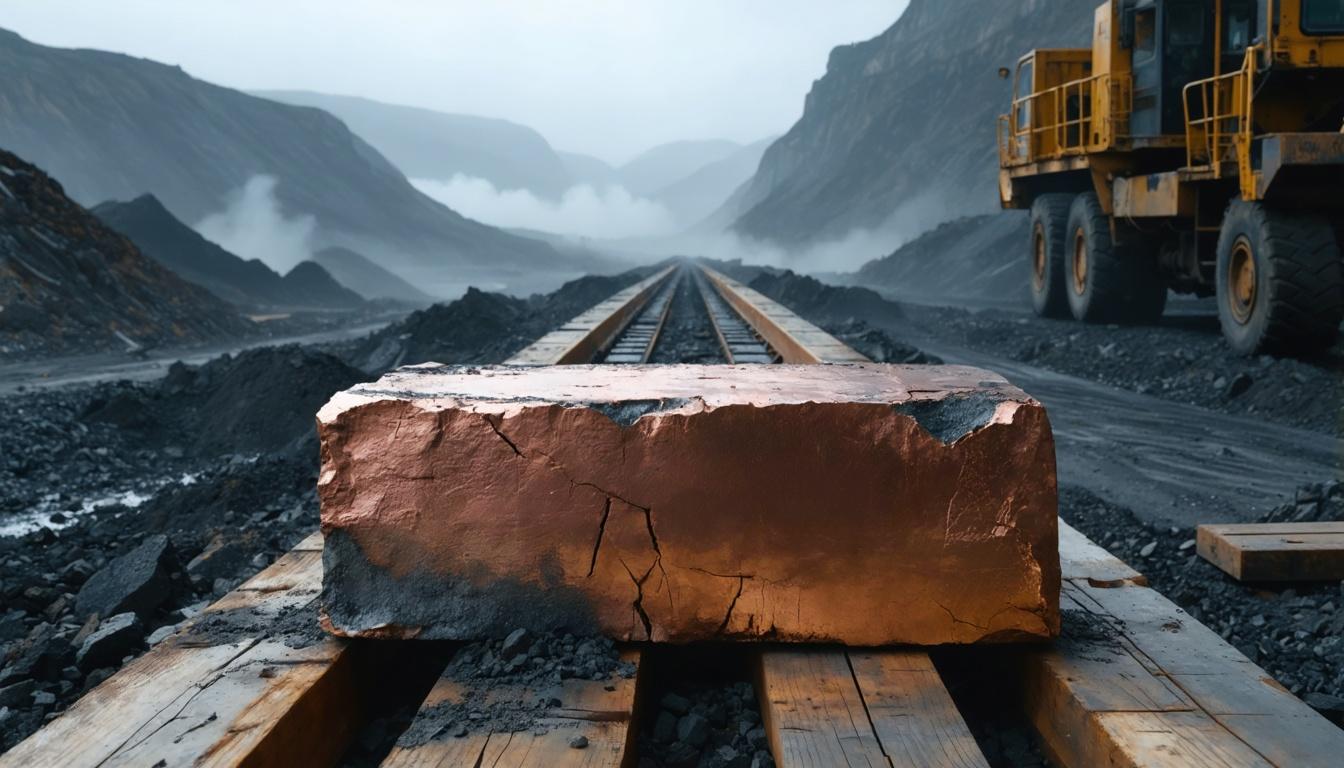

*this image is generated using AI for illustrative purposes only.
Rio Tinto (NYSE: RIO) reported underlying earnings of $6.85 billion for the six months through June, marking a 43% increase from the same period last year and its strongest first-half performance in four years. The results were primarily driven by its copper division, where EBITDA surged 84% to $5.7 billion, while copper and aluminum collectively contributed 56% of group profit, overtaking iron ore’s historical dominance. This financial strength has propelled Rio Tinto’s stock up 14.51% year-to-date, significantly outperforming the Global X Copper Miners ETF (NYSE: COPX), which rose 6.59% over the same period.
CEO Simon Trott described the results as a "step-change in performance," attributing the gains to higher commodity prices, increased copper output, and productivity improvements. He highlighted growing demand from data centers and grid storage batteries for both copper and lithium. However, the immediate profitability masks deeper structural vulnerabilities within the global supply chain, particularly regarding processing capacity and mine age.
Smelting Capacity Constraints
The International Energy Agency’s Global Critical Minerals Outlook 2026 projects a narrowing copper supply gap by 2035, reducing it to 25% from approximately 30% a year earlier. This improvement relies largely on extensions of existing operations rather than new discoveries, including projects at Kisanfu and Lumwana in Africa, Highland Valley in Canada, and Antamina in Peru.
Processing bottlenecks remain acute. China controls roughly half of the global smelting market, having built more than 90% of new capacity over the last two decades. Benchmark treatment and refining charges fell to zero in early 2026, with spot charges turning negative since 2024. Consequently, non-Chinese smelters operate at below 70% capacity, compared to 85% in China, often relying on byproduct sales for viability. Zambia recently suspended export duties on over 270,000 tons of copper concentrate after domestic smelters halted operations for maintenance.
Industry Outlook and Price Forecasts
Chilean state-owned Codelco, the world’s largest copper producer, has abandoned its target of reaching 1.7 million tons of annual output within four to five years. Chairman Bernardo Fontaine expects 2026 production between 1.331 million and 1.357 million tons, prioritizing profitability over volume amid operational delays and debt exceeding $20 billion. Pressure is mounting on domestic projects like Resolution Copper, owned jointly by BHP Group Limited (NYSE: BHP) and Rio Tinto Plc.
Citi maintains a bullish stance on copper prices, retaining a $14,500-per-ton target for the next zero to three months and a $15,000 year-end forecast, compared to London Metal Exchange prices near $13,770 per ton. The bank noted that while demand growth remains tepid, supply pressures are intensifying.
What the Numbers Show
The divergence between Rio Tinto’s surging profitability and the fragility of the broader supply chain highlights a critical market dynamic. While short-term earnings benefit from high prices and existing output, the industry’s reliance on aging infrastructure and concentrated Chinese processing creates long-term risk. The shift in profit contribution from iron ore to copper and aluminum signals a strategic pivot, yet the inability of major producers like Codelco to meet volume targets suggests that supply constraints may persist despite current financial gains.

How might the persistent negative treatment and refining charges impact the viability of non-Chinese smelters and accelerate the geographic diversification of global copper processing capacity?
Given Codelco's strategic pivot from volume growth to profitability, what does this signal for other major state-owned miners regarding their long-term expansion plans in a high-debt environment?
To what extent will the projected demand surge from data centers and grid storage batteries offset the structural supply constraints caused by aging mine infrastructure and limited new discoveries?
 19
19






 Create Custom Screeners
  Access 200+ Pre-built Filters
  Use 50+ Readymade Screener





