
 NewsMarket Expert Cites FII Outflows and US Tariffs as Key Volatility Drivers for Indian Stocks
Market Expert Cites FII Outflows and US Tariffs as Key Volatility Drivers for Indian Stocks


Vinit Bolinjkar from Ventura attributes Indian market volatility to FII outflows totaling ₹2.00 lakh crore plus ₹12,000.00 crore in January, with holdings at 15-year lows near 17%. US trade tensions including 50% tariffs on Indian goods add pressure. Despite challenges, he projects 8-16% Nifty EPS growth, the strongest in 8 quarters, supported by rupee weakness benefiting IT/pharma margins and infrastructure spending boosting industrials.



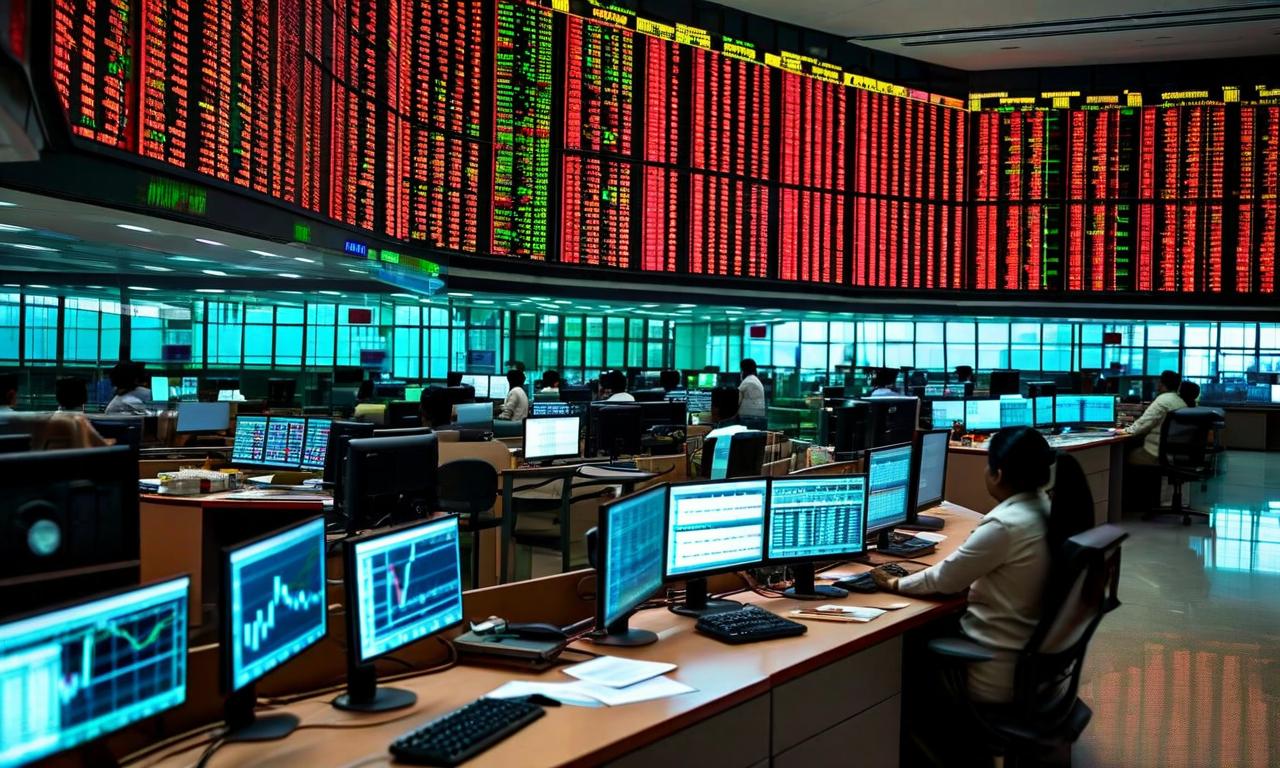
*this image is generated using AI for illustrative purposes only.
Market volatility has gripped Indian equities as foreign institutional investors continue their selling spree while trade tensions with the US escalate. Vinit Bolinjkar, Head of Research at Ventura, provides insights into the factors driving current market dynamics and sectoral opportunities despite global headwinds.
Key Drivers of Market Volatility
The Indian stock market faces multiple challenges that have contributed to sustained volatility. Foreign institutional investor outflows have emerged as the dominant factor, with FII holdings dropping to a 15-year low near 17%. The scale of selling has been substantial, with FIIs pulling ₹2.00 lakh crore from key sectors including financials and IT, followed by fresh exits of ₹12,000.00 crore in January amid global risk-off sentiment.
Trade tensions have intensified following President Trump's team citing PM Modi's unreturned call, leading to the imposition of 50% tariffs on Indian steel, textiles and electronics. While India continues ongoing talks to address these concerns, the uncertainty continues to weigh on export-oriented sectors.
| Challenge | Impact |
|---|---|
| FII Holdings | Dropped to 15-year low near 17% |
| Sector Outflows | ₹2.00 lakh crore from financials and IT |
| January Exits | ₹12,000.00 crore additional outflows |
| US Tariffs | 50% on steel, textiles, electronics |
Additional pressures include muted earnings growth expectations of 8-16% versus the anticipated 20%, elevated input costs with oil above $80 per barrel, and rich valuations with Nifty trading near 24x PE. Corporate-specific challenges such as Reliance facing capex delays and HDFC Bank dealing with net interest margin headwinds have also contributed to market sentiment.
Q3 FY26 Earnings Assessment
Despite the challenging environment, Bolinjkar maintains cautious optimism regarding earnings trends. The Nifty EPS growth projection of 8-16% year-on-year represents the strongest performance in 8 quarters, driven by earnings upgrades after five consecutive quarters of downgrades.
| Earnings Metric | Performance |
|---|---|
| Nifty EPS Growth | 8-16% YoY |
| Quarter Performance | Strongest in 8 quarters |
| Upgrade Cycle | After 5 downgrade quarters |
| Rupee Level | 86 per dollar |
Several factors support this optimistic earnings outlook. The rupee's position at 86 per dollar provides margin benefits for IT and pharmaceutical companies. Festive demand has supported consumption patterns, while infrastructure spending continues to lift industrial sectors. However, risks from potential US economic slowdown and raw material inflation remain key monitoring points.
Banking Sector Outlook
The banking sector presents a mixed but generally positive outlook with credit growth expected at 10-11% across segments. Retail banking is projected to grow at 15%, MSME lending at 12%, and corporate lending at 8%. Net interest margins may find stability through potential CRR cuts, while asset quality metrics show improvement.
| Banking Segment | Growth Projection |
|---|---|
| Overall Credit Growth | 10-11% |
| Retail Banking | 15% |
| MSME Lending | 12% |
| Corporate Lending | 8% |
| GNPA Range | 2.30-2.60% |
Asset quality is expected to peak with Gross Non-Performing Assets ranging between 2.30-2.60%, representing the lowest levels in decades. Public sector banks are positioned to outperform based on loan momentum, with SBI showing 13% growth, supported by government recapitalisation efforts. Private banks continue to excel in return on assets and return on equity metrics.
Sectoral Investment Themes
Bolinjkar identifies several multi-year investment themes aligned with India's 8% GDP growth trajectory, capex cycle expansion, and PLI scheme implementation. The BFSI sector stands to benefit from the credit boom and NBFC revival, while consumption and discretionary spending sectors may gain from rural recovery supported by favorable monsoon conditions and ongoing premiumization trends.
Defence and manufacturing sectors appear attractive due to strong order execution capabilities and the China+1 diversification factor. Green energy presents significant opportunities with India targeting 450 GW renewable capacity by 2030, representing a five-fold increase in solar capacity. Technology, IT, and telecom sectors offer potential through AI adoption, 5G rollout acceleration, and export market recovery.
Disclaimer: This analysis is for educational purposes only. The views expressed are those of individual analysts, not Mint. Investors should consult certified experts before making investment decisions.
 15
15














 Access Market Heat-map & Insights
  Create, Save & Share your Screener
  Use 200+ Screening Filters





