

IRB Infrastructure Developers Announces Ganga Expressway Trial Run Commencement


IRB Infrastructure Developers Limited, through its associate IRB Infrastructure Trust, announced that Meerut Budaun Expressway Limited will commence trial run traffic operations on the Ganga Expressway Group 1 (Meerut to Budaun corridor) from April 30, 2026. The six-lane greenfield expressway was inaugurated by Prime Minister Narendra Modi on April 29, 2026. The project spans 129.7 km with a total cost of Rs.6,538 crore and includes viable gap funding of Rs.1,746 crore. IRB Group's total investment in Uttar Pradesh's highway sector has reached approximately Rs.25,000 crore across five operational highway projects.

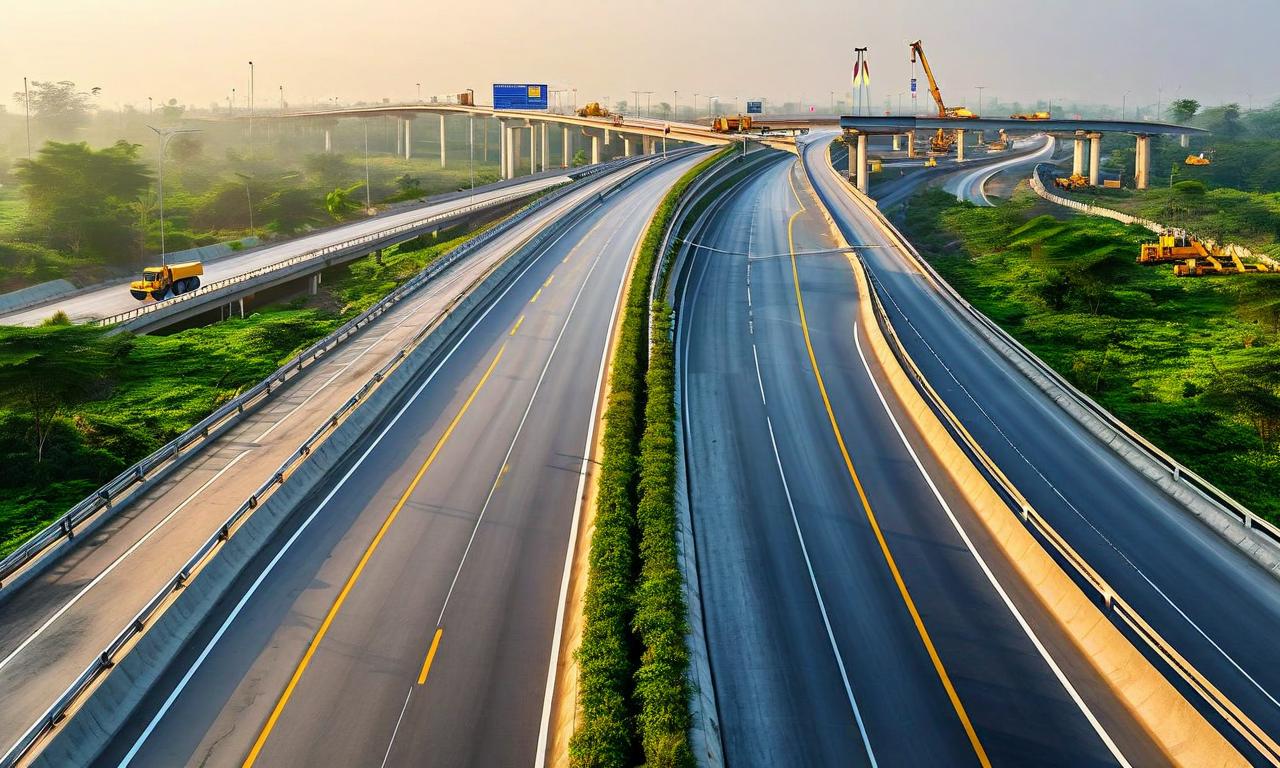

*this image is generated using AI for illustrative purposes only.
irb infrastructure developers announced through its associate IRB Infrastructure Trust that Meerut Budaun Expressway Limited, the project SPV for Ganga Expressway Group 1, will commence trial run traffic operations on the Meerut to Budaun corridor from April 30, 2026. The announcement follows the inauguration of the six-lane greenfield Ganga Expressway by Prime Minister Narendra Modi on April 29, 2026. Toll collection on the corridor is expected to commence soon after the trial runs.
Project Details
The Meerut-Budaun corridor represents Group 1 of the Ganga Expressway project, featuring the following specifications:
| Parameter | Details |
|---|---|
| Project Length | 129.7 Kms – 6 Lane Greenfield Expressway |
| Project Cost | Rs.6,538Crs |
| Viable Gap Funding | Rs.1,746Crs |
| Project Financing from Consortium of Lenders | Rs.2,659Crs |
| Equity by IRB Infrastructure Trust | Rs.2,133Crs |
| Concession Period | 30 Years (Extendable to 36 Years) |
The corridor traverses through six districts of Uttar Pradesh: Meerut, Hapur, Bulandshahar, Amroha, Sambhal and Budaun. Major structures include a 1 km long Ganga River Bridge, 9 major flyovers, 5 major bridges, 5 interchange flyovers, 14 minor bridges and 90 vehicular underpasses.
Strategic Impact
Virendra D. Mhaiskar, Chairman and Managing Director of IRB Group, highlighted that the corridor will significantly enhance regional connectivity and drive economic growth while enabling more efficient travel through reduced time, cost and environmental impact. The expressway provides the fastest road connectivity between the National Capital Region (NCR) and Eastern Uttar Pradesh and Bihar, reducing travel time by almost 50%.
The project offers easy access for Northern States, Punjab, Haryana and Delhi through Meerut via the Delhi-Meerut Expressway and Eastern Peripheral Expressway. It is expected to improve logistics and trade for agriculture and industrial sectors of Punjab and Haryana, de-congest the NCR and Delhi, and promote religious tourism through connectivity to pilgrimage places like Varanasi and Prayagraj.
IRB Group Portfolio
With the commissioning of this project, all projects in IRB Infrastructure Trust's portfolio are revenue generating. IRB Group has invested a total of approximately Rs.25,000 crore across five highways in Uttar Pradesh comprising three BOT and two TOT projects, all of which are now operational. These include the Agra-Etawah BOT Project, Hapur-Moradabad BOT Project, Lucknow-Ayodhya-Gorakhpur TOT Project, and Lucknow Sultanpur TOT Project.
IRB Group, comprising IRB Infrastructure Developers Limited and two listed Infrastructure Investment Trusts (IRB Infrastructure Trust and IRB InvIT Fund), is India's largest toll road concessionaire with an assets portfolio of 28 highways having approximately 17,500 operational lane kms and an asset base of approximately Rs.94,000 crore spread across 13 Indian states.
Historical Stock Returns for IRB Infrastructure Developers
| 1 Day | 5 Days | 1 Month | 6 Months | 1 Year | 5 Years |
|---|---|---|---|---|---|
| -2.80% | -5.71% | -10.85% | -23.22% | -17.48% | +66.99% |

How will the expected 50% reduction in travel time between NCR and Eastern UP impact freight logistics costs and industrial development in the region?
What toll revenue projections does IRB Infrastructure Trust anticipate from the Ganga Expressway, and how might this affect the Trust's dividend distribution to unitholders?
Could the success of this greenfield expressway model influence government policy toward more hybrid funding structures combining viable gap funding with private investment?
 18
18













 Access 50+ Readymade Screeners
  Use 200+ Custom Filters
  Get Full Market Insights





