

Himax launches HE Series iToF Depth Decoder ICs for robotics and AI vision


Himax Technologies, Inc. has launched its HE Series iToF Depth Decoder ICs, enhancing its 3D sensing portfolio with high-frame-rate and high-precision capabilities. The ICs feature a hardware-based architecture, advanced image enhancement technologies, and a comprehensive SDK for robotics and AI vision applications. The HE-2 model includes RGB integration and an edge AI NPU for advanced intelligent vision systems.

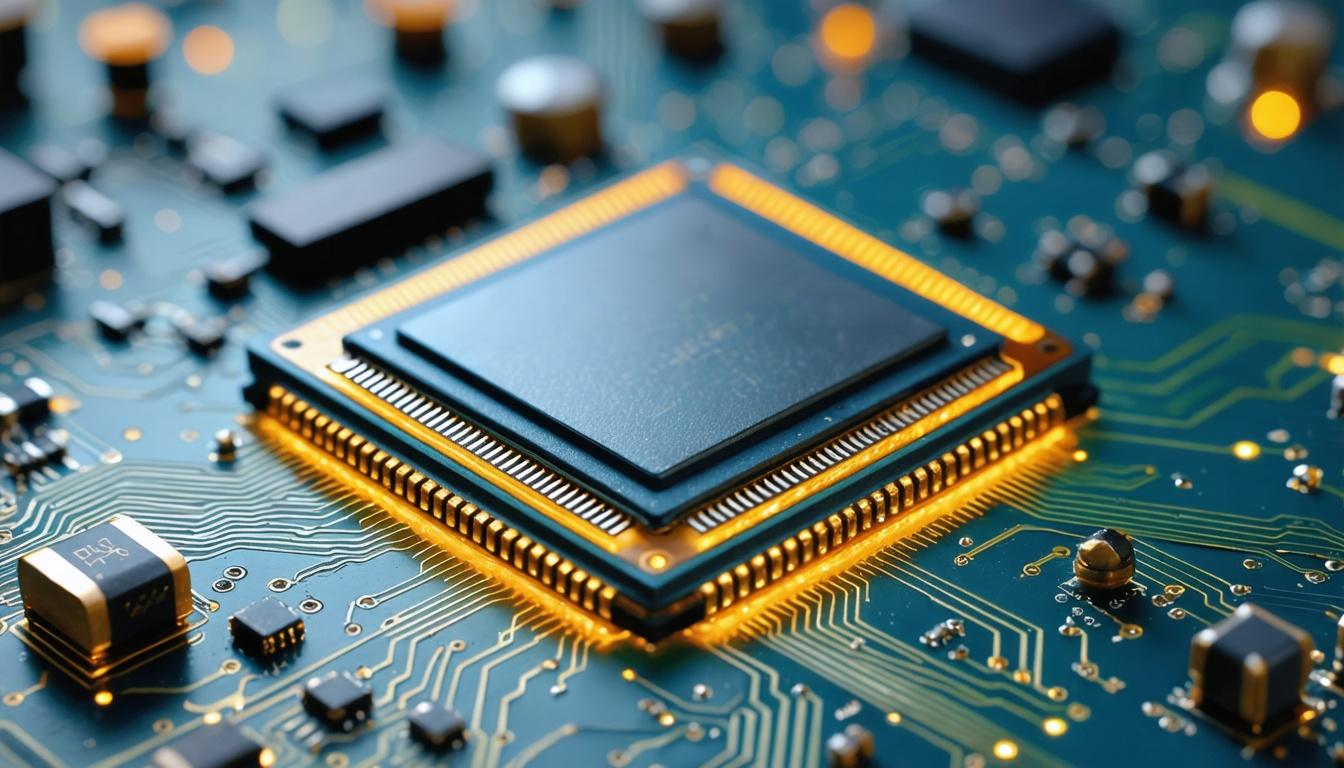

*this image is generated using AI for illustrative purposes only.
Himax Technologies, Inc. has announced the launch of its new HE Series indirect Time-of-Flight (iToF) Depth Decoder ICs, expanding its portfolio in 3D sensing and machine vision applications. The new ICs leverage a high-performance hardware-based depth processing architecture to deliver high-frame-rate and high-precision 3D sensing capabilities. This solution is designed for robotics, industrial automation, and a broad range of AI vision applications, offering a complete and easy-to-integrate platform.
The HE Series iToF depth decoder IC’s hardware-based architecture improves processing efficiency and reduces system latency compared to conventional software-based solutions. It supports up to 640 × 480 RAW data input at 240 fps in single-frequency and dual-frequency modes. Following high-speed depth decoding, the IC can simultaneously output 2D grayscale images and 3D depth information through MIPI and USB interfaces at frame rates of up to 120 fps.
The ICs have been validated for compatibility with leading industry-standard VGA-resolution iToF sensors, accelerating development and shortening time-to-market. Multiple industry partners, including optical module manufacturer OFILM, have adopted the solution for machine vision applications. OFILM has incorporated Himax’s iToF depth decoder IC into its new RoboVision solution, enabling high-precision 3D sensing for robotic tasks such as object picking, obstacle avoidance, and autonomous navigation.
To meet demand for high-precision depth sensing, the new iToF decoder IC incorporates advanced depth image enhancement technologies. These include depth noise reduction, flying pixel removal, and temporal filtering, which improve accuracy, stability, and reliability in high-speed motion scenarios and complex environments. Himax also provides a comprehensive Software Development Kit (SDK) and a professional iToF Calibration Library to support depth calibration algorithms, including Fixed Pixel Phase Noise (FPPN) correction and Wiggling Compensation.
The HE Series consists of the standard HE-1 and the advanced HE-2. The HE-2 supports RGB camera integration with a built-in RGB ISP, MJPEG encoder, and RGB-D alignment engine for precise fusion of RGB images and depth information. It also features an edge AI Neural Processing Unit (NPU) capable of supporting eye tracking, gesture recognition, and various AI vision algorithms, enabling advanced intelligent vision systems for robotics and AIoT applications.
Key Features of HE Series iToF Depth Decoder ICs
| Feature | Description |
|---|---|
| Architecture | Hardware-based depth processing |
| Input Support | Up to 640 × 480 RAW data at 240 fps |
| Output Interfaces | MIPI and USB at up to 120 fps |
| Enhancement Technologies | Depth noise reduction, flying pixel removal, temporal filtering |
| Calibration Support | FPPN correction, Wiggling Compensation, Thermal Compensation |
| HE-2 Additional Features | RGB ISP, MJPEG encoder, RGB-D alignment engine, edge AI NPU |
"As robotics, smart manufacturing, and other intelligent vision applications continue to advance, demand for real-time, high-precision 3D sensing is growing rapidly," said Pen-Hsin Chen, Vice President of the Image Processing SoC Business Unit at Himax. "Leveraging Himax’s extensive expertise in 3D sensing and image processing technologies, the HE series iToF decoder IC combines a high-speed depth processing architecture with advanced image enhancement capabilities to deliver a highly accurate, low-latency, and easy-to-integrate 3D sensing solution."

How will the HE Series' hardware-based architecture impact Himax's competitive positioning against software-based 3D sensing solutions?
What is the expected market demand for the HE-2 model's edge AI NPU capabilities in the robotics and AIoT sectors over the next year?
Could the adoption by OFILM signal a trend toward deeper integration between iToF decoder ICs and optical module manufacturers?
 20
20





 Access Market Heat-map & Insights
  Create, Save & Share your Screener
  Use 200+ Screening Filters





