
 NewsClean Max Enviro Energy Solutions Issues Q3 FY2026 Addendum Addressing Maharashtra Banking Norms and ToD Tariff Impact
Clean Max Enviro Energy Solutions Issues Q3 FY2026 Addendum Addressing Maharashtra Banking Norms and ToD Tariff Impact


Clean Max Enviro Energy Solutions Limited has issued an addendum to its Q3 FY2026 shareholders' letter dated March 18, 2026, addressing investor queries regarding potential regulatory changes in Maharashtra and other states. The addendum specifically analyses the impact of proposed restrictions on solar energy banking norms and the introduction of Time-of-Day (ToD) tariffs. The company conducted a comprehensive analysis across its operational portfolio of over 570 customers and 1,200+ PPAs, concluding that the worst-case EBITDA impact remains approximately 1.5% under a conservative retrospective stress test scenario.
The analysis reveals that 48% of the company's portfolio run-rate revenue of INR 2,162 crore, comprising onsite solar, CTU-connected capacity, and STU Third Party Open Access capacity, remains unaffected by the proposed regulations. The impact is concentrated in the STU Group Captive segment, which represents 52% of run-rate revenue. The company's wind-solar hybrid offerings provide a competitive advantage, with hybrid customers remaining largely unaffected due to the complementary generation patterns across different time slots. The Minimum Savings Guarantee (MSG) impact on the operational portfolio is expected to be nil, as hybrid customers see reduced daytime solar savings compensated by peak slot savings, and solar-only states have sufficient margin of safety in contract thresholds.

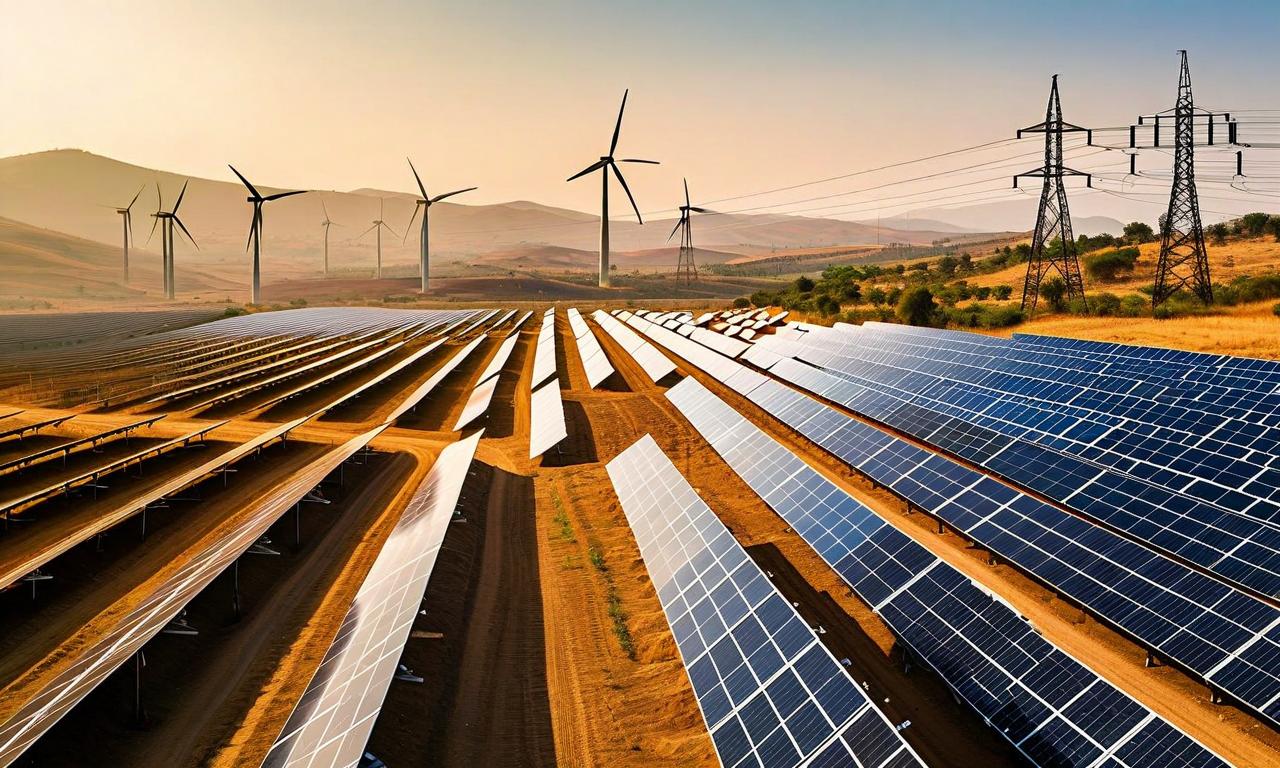

*this image is generated using AI for illustrative purposes only.
Clean Max Enviro Energy Solutions Limited has issued an addendum to its Q3 FY2026 shareholders' letter dated March 18, 2026, addressing investor queries regarding potential regulatory changes in Maharashtra and other states. The addendum specifically analyses the impact of proposed restrictions on solar energy banking norms and the introduction of Time-of-Day (ToD) tariffs. The company conducted a comprehensive analysis across its operational portfolio of over 570 customers and 1,200+ PPAs, concluding that the worst-case EBITDA impact remains approximately 1.5% under a conservative retrospective stress test scenario.
Maharashtra Regulatory Changes
Maharashtra's Multi Year Tariff order dated March 25, 2026, proposes two key changes. First, banking of renewable energy for Open Access consumers is now restricted to 9am-5pm solar hours, whereas previously power generated during solar hours could be used during the same calendar month during both solar hours and late night slots (12am-6am). Second, the order introduces ToD tariffs with varying charges and rebates across different time slots. Solar hours (09:00-17:00) carry a rebate of -15% to -25% of energy charge, normal hours (00:00-06:00 and 06:00-09:00) have 0% charge, and peak hours (17:00-24:00) carry a +25% charge.
| ToD Slabs | Time slabs | No. of Hours | Banking Settlement Order | TOD Charge/Rebate (% of Energy Charge) |
|---|---|---|---|---|
| Solar Hours | 09:00hrs to 17:00hrs | 8 | Solar | -15%* / -25%* |
| Normal Hours | 00:00hrs to 06:00hrs & 06:00hrs to 09:00hrs | 9 | Normal→ Solar | 0% |
| Peak Hours | 17:00hrs to 24:00hrs | 7 | Peak→ Normal→ Solar | +25% |
Portfolio Impact Analysis
The company analysed three dimensions of potential impact: capacity impact due to banking restrictions, Minimum Savings Guarantee (MSG) impact with ToD tariff implementation, and a retrospective stress test assuming immediate adoption across all key states. The analysis covered the full operational portfolio of 2,986 MW comprising 2,356 MWp solar and 630 MW wind capacity, with run-rate revenue of INR 2,162 crore as of March 1, 2026.
| Offering | Solar (MWp) | Wind (MW) | Total (MW) | Run-Rate Revenue (INR Cr) | Capacity impact | Run-Rate revenue impact | EBITDA impact |
|---|---|---|---|---|---|---|---|
| Diversified portfolio offerings — not impacted | 1,272 | 171 | 1,443 | 1,031 (48%) | Nil | Nil | Nil |
| STU Group Captive Capacity | 1,084 | 459 | 1,543 | 1,130 (52%) | 7.4% | 5.4% | 2.7% |
| Portfolio Total (March 1, 2026) | 2,356 | 630 | 2,986 | 2,162 | 3.8% | 2.8% | 1.4% |
Diversified Portfolio Segments
Three segments representing 48% of portfolio run-rate revenue (INR 1,031 crore) are unaffected by the proposed regulations. Onsite Solar (384 MWp, 12% of run-rate revenue) supplies power directly at customer premises without using the transmission network. CTU-connected EAPA deals (525 MWp, 12% of run-rate revenue) operate under the Central Transmission Utility framework governed by CERC regulations. STU Third Party Open Access (534 MW, 24% of run-rate revenue) includes contracts in Gujarat contributing 67% of run-rate revenue (INR 344 crore annually), which are primarily wind-solar hybrid with limited impact due to generation being split across time of day bands. Contracts in Karnataka contribute approximately 30% of run-rate revenue or INR 156 crore annually, benefiting from cross-subsidy surcharge waivers attached exclusively to the plant.
STU Group Captive Portfolio
The STU Group Captive portfolio, representing 52% of run-rate revenue, shows varying impacts across different categories. Solar-only capacity (467 MWp) faces a 12.1% capacity impact and 5.1% EBITDA impact, as surplus generation beyond solar-hour consumption lapses with no wind to offset it. Wind + Solar hybrid states (1,076 MW) show lower impact with 5.6% capacity impact and 1.9% EBITDA impact, demonstrating the advantage of hybrid solutions.
| Particulars | Solar (MWp) | Wind (MW) | Total capacity (MW) | Run-Rate Revenue (INR Cr) | Capacity impact | Generation/Revenue impact | EBITDA impact |
|---|---|---|---|---|---|---|---|
| Solar-only Capacity | 467 | — | 467 | 277 | 12.1% | 10.2% | 5.1% |
| Wind + Solar states | 618 | 459 | 1,076 | 854 | 5.6% | 3.9% | 1.9% |
| Overall STU-Group Captive impact | 1,084 | 459 | 1,543 | 1,130 | 7.4% | 5.4% | 2.7% |
Hybrid Advantage and Competitive Positioning
Wind-solar hybrid plants ensure generation is spread across different timeslots during the day, reducing dependency on banking and mitigating the effects of stringent banking regulations. In Gujarat, approximately 65-70% of renewable energy power consumption is from wind generation, meaning solar is already primarily consumed within solar hours, resulting in low capacity impact. The company's hybrid offerings provide a competitive advantage in markets where wind potential exists, with limited developers able to provide credible hybrid solutions at scale.
For instance, under an 8-hour banking restriction scenario, a solar-only developer can deliver only INR 4 crore savings at 33% offset for a customer with 62 million units consumption, compared to INR 16 crore savings at 66% offset under the previous 20-hour banking regime—a 75% reduction in customer savings. Clean Max's hybrid solution (9.9 MW wind + 13.2 MWp solar) restores offset to 72% and savings to INR 15 crore, nearly matching the original solar-only outcome despite tighter banking rules.
Historical Stock Returns for Clean Max Enviro Energy Solutions
| 1 Day | 5 Days | 1 Month | 6 Months | 1 Year | 5 Years |
|---|---|---|---|---|---|
| +1.64% | -5.89% | -8.42% | +47.36% | +51.07% | +51.07% |

Will other Indian states follow Maharashtra's lead in implementing similar banking restrictions and ToD tariffs for renewable energy projects?
How might Clean Max's competitive advantage in hybrid solutions influence its market share growth in states with wind potential over the next 2-3 years?
What timeline and investment scale is Clean Max considering for deploying Battery Energy Storage Systems in wind-deficient states like Haryana and Chhattisgarh?
 20
20













 Create Custom Screeners
  Access 200+ Pre-built Filters
  Use 50+ Readymade Screener





