

SpaceX Starmind AI plan needs nine daily launches to scale


- SpaceX aims for significant orbital AI scale by 2028 using Nvidia chips
- Maintaining 1 million satellites may require over nine daily Starship launches
- Current record stands at 13 launches since 2023 with mixed success
- Google sees competitive economics for space AI only by mid-2030s
- Kalshi traders assign low probability to rapid launch cadence growth


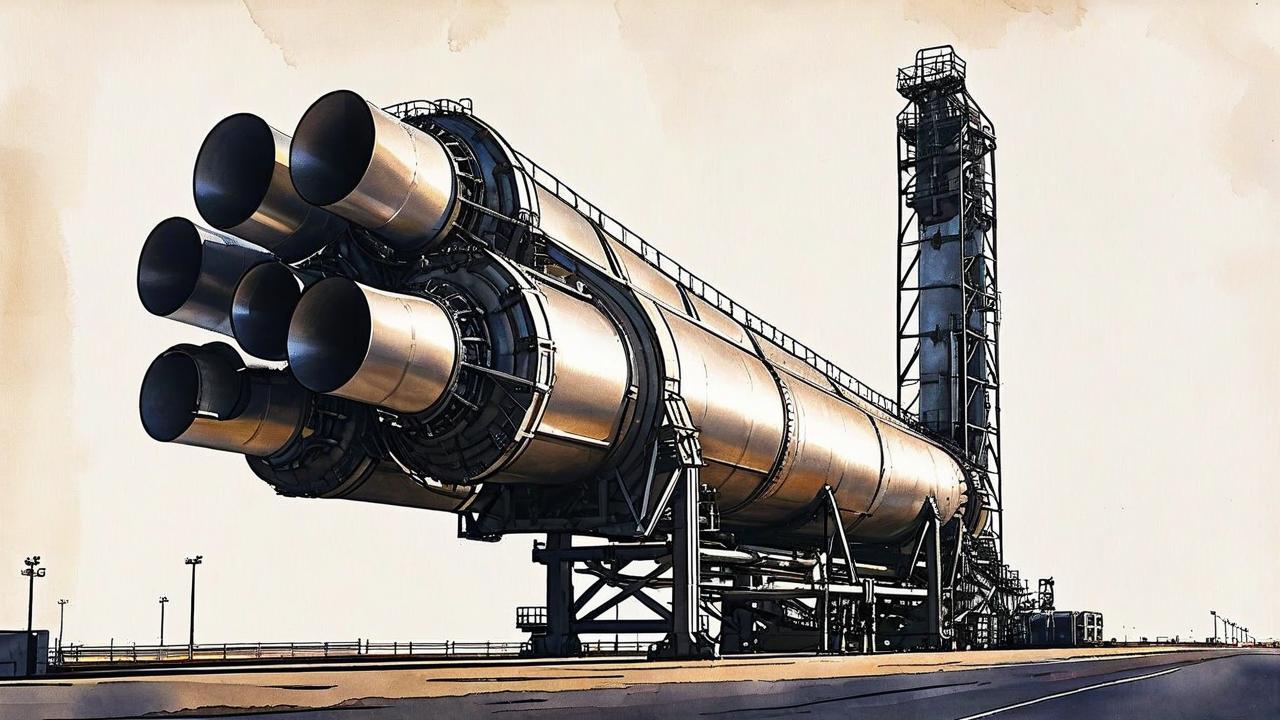
*this image is generated using AI for illustrative purposes only.
Space Exploration Technologies Corp. (NASDAQ: SPCX) plans to deploy orbital data centers into space as early as next year, leveraging its Starship rocket for an ambitious expansion into the AI economy.
The company acknowledges in its IPO filing that these plans remain highly speculative, relying on complex, unproven technologies that may never achieve commercial viability.
Logistical Challenges
To execute this vision at scale, SpaceX must overcome significant technical and logistical barriers. Christopher Smith, a senior aerospace engineer at UC Berkeley’s Space Sciences Laboratory, described the plan as logistically "crazy" and costly.
Smith’s calculations indicate that maintaining a constellation of 1 million satellites, named Starmind, would require launching more than nine Starship rockets daily. This estimate assumes SpaceX replaces data center chips every five years, with each rocket carrying about 60 satellites. Replacing aging hardware across one million satellites means roughly 200,000 new satellites a year, or about 3,300 flights annually.
Despite these challenges, Smith cautioned against dismissing the project, noting Elon Musk has repeatedly defied conventional expectations.
George Lordos, a space systems architect at MIT, believes an initial constellation of AI satellites could be deployed by 2028. However, he emphasized that SpaceX must significantly reduce Starship’s booster and upper-stage turnaround times to rapidly expand the network.
Orbital AI Compute Strategy
SpaceX is pitching investors on a trillion-dollar vision of millions of solar-powered satellites equipped with AI chips. The company aims to create a new orbital data center market, strengthening its position in the AI sector.
Elon Musk revealed that SpaceXAI is adopting Nvidia Corp.’s (NASDAQ: NVDA) Vera CPUs for a space-optimized Vera Rubin system. Musk stated that SpaceX designed a space-optimized Vera Rubin NVL72 system for launch to orbit in Q4 next year, with significant scale expected in 2028.
Solar Power Expansion
In May, Musk anticipated a steady surge in space solar power capacity. The company noted progression from 10 megawatts across 3,000 gen1 Starlink satellites to 100 megawatts with 7,000 gen2 satellites. The upcoming gen3 is expected to generate 1,000 megawatts.
Launch Cadence Targets
Musk stated SpaceX is targeting 30 Starship launches per day by 2030, equivalent to 9,000 launches annually. He acknowledged this number was "tiny" compared to daily airplane flights.
As of July 2026, there have been 13 Starship launches, with 8 successful missions and 5 failures. Starship has flown just 13 tests since 2023, several ending in explosions, and has yet to demonstrate full reusability.
Market Sentiment and Competitor Views
Traders on Kalshi give a 51% chance that Starship reaches space four times in 2026, a 39% chance of five flights, and just 2% odds of more than five. A separate market gives an 11% chance of a 1-Mega Watt data center going live in orbit before 2029, and 18% before 2030.
Alphabet Inc. (NASDAQ: GOOGL) is exploring the same idea through Project Suncatcher. Its research found no fundamental physics blocking AI in orbit, having radiation-tested its TPU chips and achieved 800 gigabits per second in bench-scale optical-link tests. Google projected that launch prices could fall below $200 per kilogram by the mid-2030s, making orbital data centers roughly comparable with terrestrial facilities on an energy-cost basis.
What the Numbers Show
The disparity between current launch frequency and operational requirements highlights the scale of infrastructure needed. With only 13 total launches recorded through July 2026, achieving the estimated nine daily launches required for the Starmind constellation represents a massive increase in operational throughput. Furthermore, SpaceX’s own IPO prospectus states that deploying 100 gigawatts of orbital compute each year would require thousands of Starship launches, moving roughly one million metric tons to orbit annually. At a payload capacity of 100 to 200 metric tons per flight, this implies 5,000 to 10,000 launches a year, far exceeding current capabilities.

How will the high radiation environment in orbit impact the longevity and performance of Nvidia's Vera Rubin chips compared to terrestrial AI hardware?
What regulatory hurdles might SpaceX face regarding orbital debris management when deploying and replacing a constellation of one million satellites?
Could Google's Project Suncatcher achieve cost parity with terrestrial data centers faster than SpaceX by leveraging existing launch infrastructure rather than relying on Starship's unproven daily cadence?
 16











 Access 50+ Readymade Screeners
 Use 200+ Custom Filters
 Get Full Market Insights





