

Flowers Foods cuts FY26 guidance as Q2 volume slump deepens


- Flowers Foods missed Q2 EPS estimate of $0.23 with $0.21 result
- Full-year EPS guidance cut to $0.75-$0.85 from $0.80-$0.90
- Volume declined 5.8% in Q2, outweighing 1.8% price/mix gain
- Management cites consumer shift to sourdough/protein as key headwind
- Q3 decline expected with stabilization anticipated in Q4

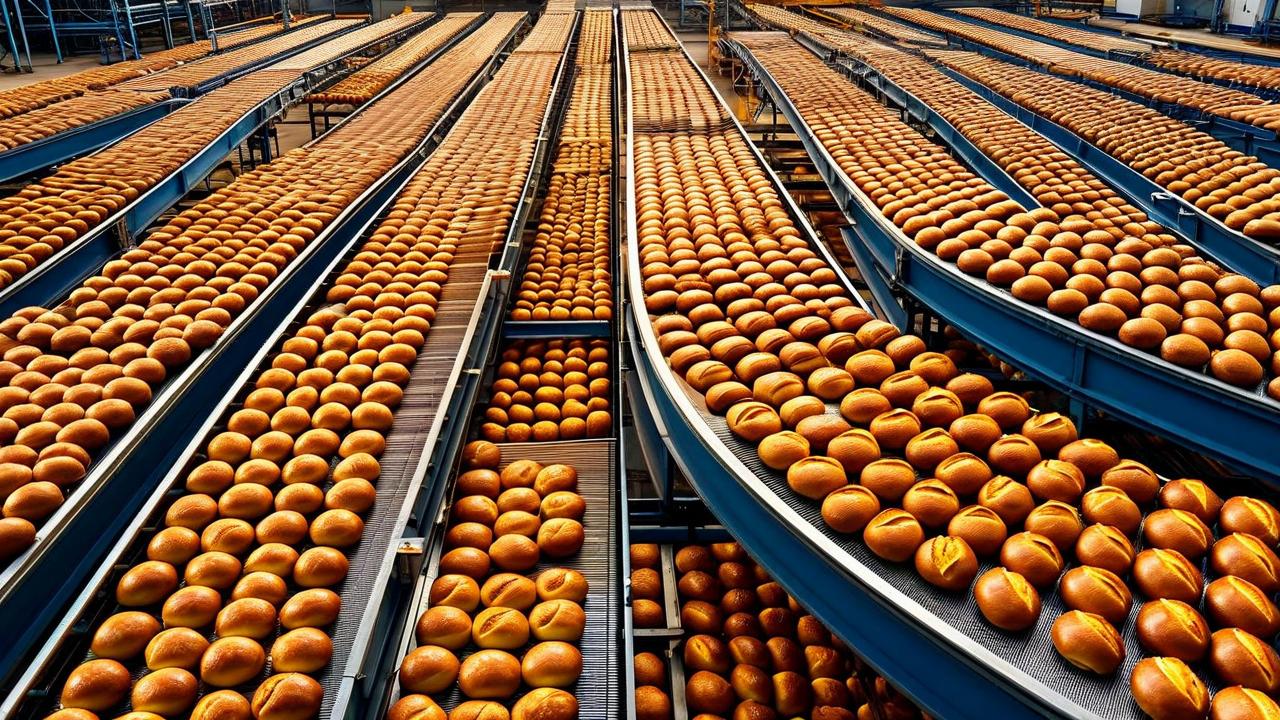

*this image is generated using AI for illustrative purposes only.
Flowers Foods Inc (NYSE: FLO) lowered its fiscal 2026 outlook for net sales and adjusted earnings per share, citing continued pressure from declining volumes and elevated costs.
The bakery producer reported second-quarter adjusted earnings per share of $0.21, missing the analyst consensus estimate of $0.23. Quarterly sales of $1.193 billion also missed the $1.228 billion estimate, driven by a 5.8% decline in volume that outweighed a 1.8% gain from favorable price and mix.
Guidance Reduction
The company cut its full-year adjusted diluted EPS guidance to $0.75 to $0.85, down from the previous range of $0.80 to $0.90. This new midpoint of $0.80 falls below the $0.83 analyst estimate. Net sales guidance was reduced to $5.07 billion to $5.14 billion, compared to the prior range of $5.16 billion to $5.27 billion and the $5.16 billion consensus.
Q2FY26 Performance Recap
For the 12-week second quarter ended July 18, 2026, Flowers Foods reported a 30.3% decline in net income to $40.7 million. Net sales fell 4.0% to $1.193 billion, representing a 3.95% decrease over sales of $1.242 billion in the same period last year.
Adjusted net income fell 30.5% to $44.1 million, while adjusted EBITDA dropped 19.2% to $111.3 million. Earnings per share of $0.21 represented a 30% decrease from $0.30 per share in the same period last year.
Revenue and Margin Dynamics
Branded retail sales declined 3.8% to $794.6 million, with volume falling 7.6% despite a 3.8% lift from pricing and mix. The "Other" segment, which includes store-branded products, saw sales drop 4.4% to $398.3 million as inflationary pressures weighed on consumer spending.
Gross margin excluding depreciation and amortization contracted to 48.4% of net sales, down 40 basis points from the prior year period. The margin compression was driven by lower production volumes and increased labor and outside purchase costs, which were only partially offset by moderating ingredient costs.
Operational Expenses and Cash Flow
Selling, distribution, and administrative (SD&A) expenses rose to 39.7% of net sales, up 160 basis points, reflecting higher workforce-related and freight costs alongside increased marketing spend. Excluding non-comparable items, adjusted SD&A was 39.1% of sales.
Year-to-date cash flow from operating activities decreased $24.9 million to $241.5 million. Capital expenditures fell $11.9 million to $44.5 million, while dividends paid dropped $23.7 million to $81.0 million. Cash and cash equivalents stood at $52.8 million at quarter-end.
Strategic Initiatives and Outlook
On the earnings call, CEO Ryles McMullen attributed the results to challenges in the fresh packaged bread category, reflecting consumer preference shifts and competitive pressures. The company is focusing on strategic initiatives such as innovation in smaller formats, sourdough, and protein products, improving in-store execution, and continuing to invest in leading brands like Nature's Own.
Management anticipates some year-over-year decline in Q3, with stabilization expected in Q4 due to reduced elasticities and ongoing investments. CFO Anthony Scaglione noted that most commodities are hedged for 2026, but planning for 2027 is still in progress, considering potential cost increases from oil, diesel, and resin exposure.
New business wins and cost-saving measures, including roughly $200 million taken out of the business over recent years, are expected to contribute to improved performance in the second half of 2026. The Nature's Own relaunch is being well-received, though it is too early for definitive results.
What the Numbers Show
The divergence between top-line pricing power and bottom-line profitability highlights significant operational leverage risks. While Flowers Foods achieved a 1.8% positive price/mix impact across total sales, this was insufficient to offset the 5.8% volume decline. Consequently, fixed costs such as labor and freight expanded as a percentage of revenue, driving SD&A expenses up by 160 basis points to 39.7% of sales. This indicates that without volume recovery, further pricing increases may face diminishing returns in protecting margins.

How might the anticipated 2027 cost increases for oil, diesel, and resin impact Flowers Foods' ability to restore margins if volume recovery remains sluggish?
What specific metrics will management use to determine if the Nature's Own relaunch is successfully reversing the long-term decline in the fresh packaged bread category?
Could the significant contraction in gross margins trigger a reassessment of the company's dividend sustainability given the reduced cash flow from operations?
 16
16






 Access Market Heat-map & Insights
  Create, Save & Share your Screener
  Use 200+ Screening Filters





