

Barrick beats Q2 earnings, says North America gold IPO is very close


Barrick Mining reported strong Q2 results with EPS of 82 cents and revenue of $5.29 billion, beating estimates. The company resolved disputes with Newmont via a $1.95 billion payment and confirmed its North American gold IPO is very close to completion.

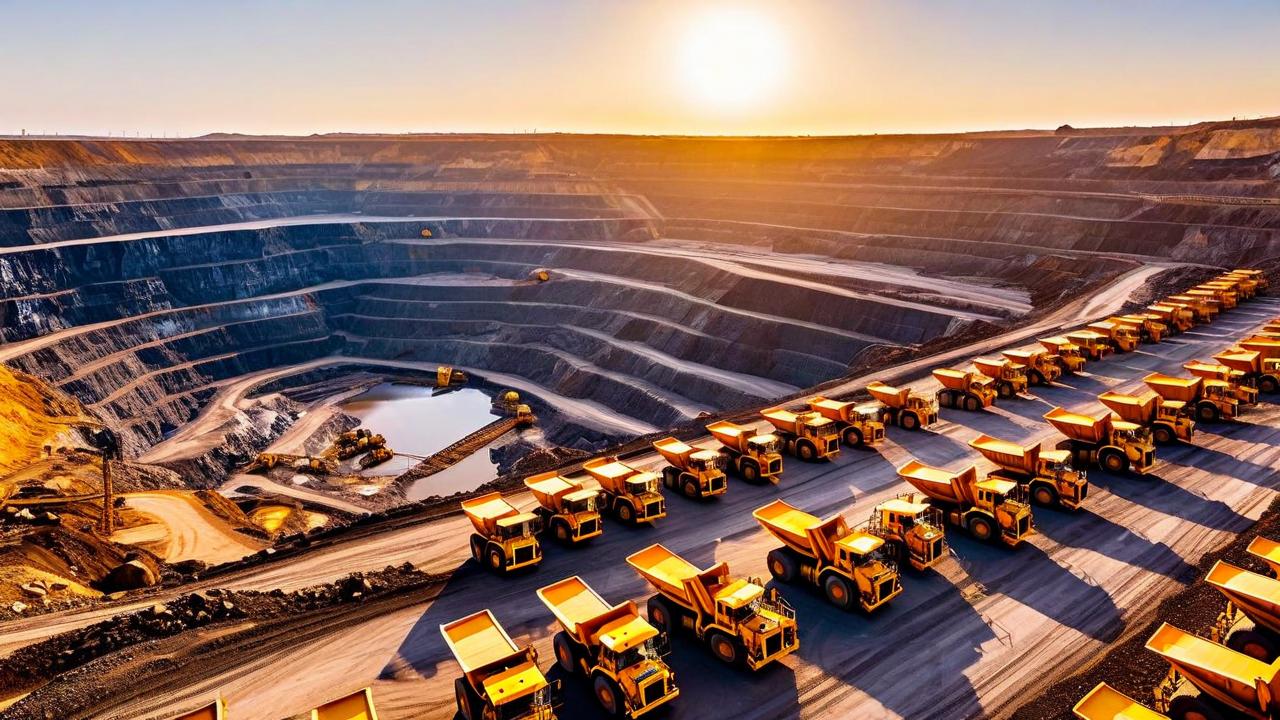

*this image is generated using AI for illustrative purposes only.
Barrick Mining Corporation delivered second-quarter adjusted earnings of 82 cents per share, surpassing the analyst estimate of 78 cents, while confirming its planned initial public offering of North American gold assets is "very close" to completion. Revenue reached $5.29 billion, exceeding the $4.53 billion consensus, driven by higher realized gold and copper prices. In a parallel development, Barrick finalized a $1.95 billion settlement with Newmont Corporation to resolve all outstanding disputes regarding their Nevada Gold Mines (NGM) joint venture, securing Newmont’s consent for the IPO.
The financial performance was bolstered by a 50% year-over-year increase in net earnings to $1.22 billion and a 28% rise in operating cash flow to $1.70 billion. Gold production climbed 11% from the first quarter to 796,000 ounces, outpacing the guidance range of 730,000 to 770,000 ounces. This production beat was attributed to an earlier-than-expected ramp-up at Loulo-Gounkoto, a faster recovery at Pueblo Viejo following maintenance, and record underground tonnes at Cortez as the Goldrush project ramps up.
Transaction Details
The resolution with Newmont involves a $1.95 billion cash top-up payment from Newmont to Barrick, scheduled within 30 days. This transaction integrates previously excluded properties into the NGM structure, creating a Nevada gold complex containing nearly 100 million ounces. Barrick contributes its Fourmile development, while Newmont adds its Fiberline and Mike developments. The agreement also modernizes the governance framework to improve decision-making efficiency.
| Asset Contributed | Contributing Company | Status |
|---|---|---|
| Fourmile Development | Barrick Mining Corporation | Included in JV |
| Fiberline Development | Newmont Corporation | Included in JV |
| Mike Development | Newmont Corporation | Included in JV |
Operational Costs and Guidance
Despite strong revenue, cost pressures emerged. Gold cost of sales rose to $1,993 per ounce from $1,654 a year earlier, while all-in sustaining costs increased 11% to $1,866 per ounce. Barrick cited lower grades at Carlin, Cortez, and North Mara, alongside higher fuel costs and royalties tied to stronger gold prices. Fuel costs remain elevated due to disruptions in oil flows from the U.S.-Israeli conflict with Iran.
For FY26, Barrick maintained its gold production guidance of 2.90 million to 3.25 million ounces. It expects gold cost of sales between $1,870 and $2,070 per ounce, assuming a gold price of $4,500 per ounce. Capital spending was lowered to $3.8 billion to $4.2 billion from $4.0 billion to $4.45 billion, primarily reflecting reduced plans at Reko Diq.
Strategic Implications
President and CEO Mark Hill stated that the new entity resulting from the IPO will operate as a pure-play gold producer with long-life assets in lower-risk jurisdictions. The removal of bilateral obstacles allows Barrick to proceed with unlocking value from its US-based operations independently. Total shareholder returns for the quarter reached $1.50 billion, up 242% from a year earlier, including $1.2 billion in share repurchases and a dividend of 17.5 cents per share payable Sept. 15.

How might the $1.95 billion cash settlement with Newmont impact Barrick's near-term liquidity and its ability to sustain the aggressive $1.2 billion share repurchase program?
Given the 11% rise in all-in sustaining costs, what specific operational efficiencies or hedging strategies will the new pure-play gold entity employ to mitigate margin pressure if gold prices stabilize below $4,500?
Will the inclusion of Newmont's Fiberline and Mike developments in the Nevada Gold Mines joint venture accelerate the timeline for achieving the projected 100 million ounce reserve base?
 17
17




 Create Custom Screeners
  Access 200+ Pre-built Filters
  Use 50+ Readymade Screener





