India's Electronics Industry Set to Match IT Services at $500 Billion by 2030


India's electronics industry is projected to grow from $125 billion to $500 billion by 2030, matching IT services sector revenue through a 32% compound annual growth rate. Government financial assistance since April 2020 has attracted major manufacturers including Foxconn and created numerous new companies. While currently employing fewer people with lower salaries than IT services, the Electronics Components Manufacturing Scheme aims to advance the value chain and improve employment prospects, positioning India as a preferred global electronics manufacturing destination.
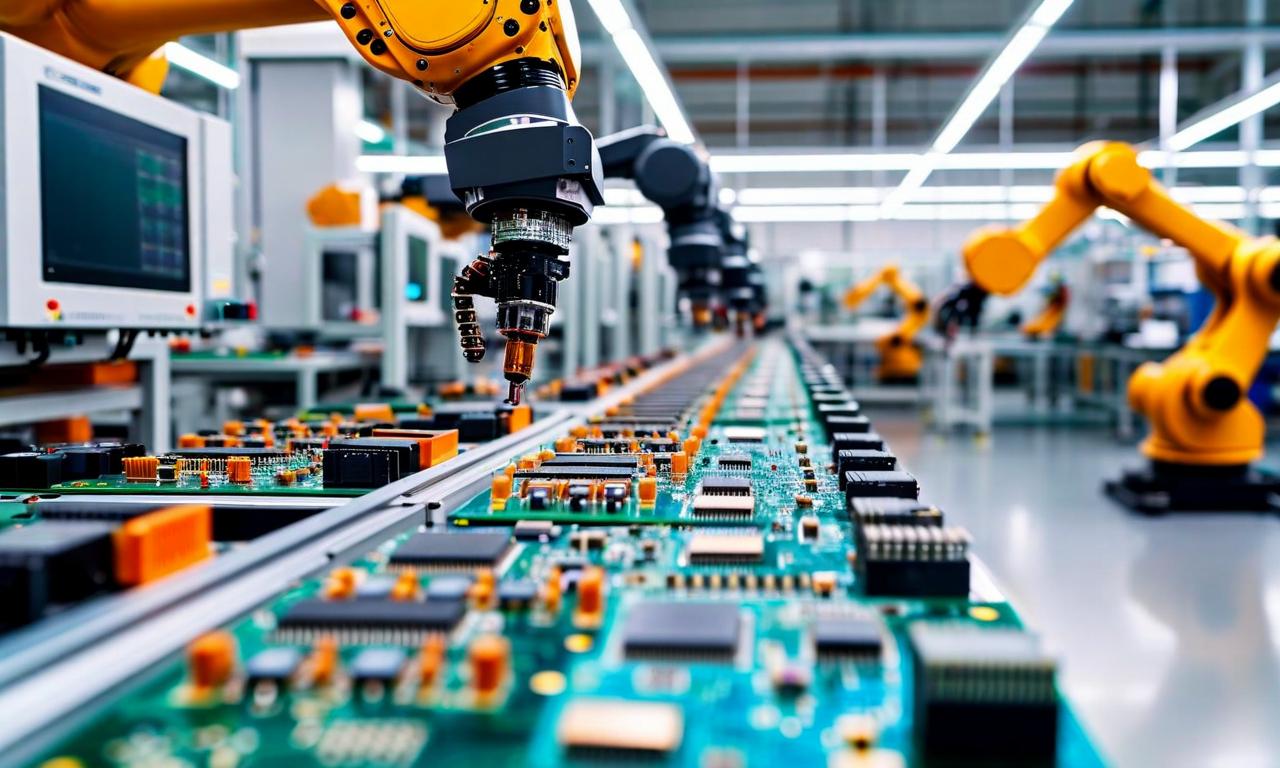
*this image is generated using AI for illustrative purposes only.
India's electronics industry is positioned for unprecedented growth, with projections indicating it will reach $500 billion in revenue by 2030, matching the milestone expected from the established IT services sector. This ambitious target represents a dramatic transformation for an industry that generated $125 billion in revenue last year, requiring a compounded annual growth rate of 32% over the next five years.
Growth Trajectory Comparison
The electronics sector's projected growth significantly outpaces the IT services industry's expected expansion. While IT services recorded $283 billion in revenue and is projected to grow at 12% annually, the electronics industry's accelerated pace reflects its emerging potential within India's digital economy framework.
| Sector | Current Revenue | Target Revenue (2030) | Growth Rate (CAGR) |
|---|---|---|---|
| Electronics | $125 billion | $500 billion | 32% |
| IT Services | $283 billion | $500 billion | 12% |
S Krishnan, secretary at the Ministry of Electronics and Information Technology (Meity), emphasized the strategic vision: "Our goal is to enable both the industries to grow quite rapidly, so that by 2030, India will generate $1 trillion in revenue from the digital economy—with electronics and IT both contributing about $500 billion each by the end of this decade."
Manufacturing Momentum and Industry Players
The electronics sector received substantial momentum following government financial assistance initiated in April 2020 for assembling mobile phones and other electronic goods. This policy intervention has catalyzed significant industry expansion, attracting both domestic and international manufacturers.
The initiative has resulted in the establishment of over half a dozen listed firms, a dozen private companies, and foreign players including Taiwanese giant Foxconn, which have either established new facilities or expanded existing operations for component assembly.
| Company Category | Revenue Performance |
|---|---|
| Top 4 Listed Companies* | $6.1 billion (last fiscal) |
| Tata Electronics (Private) | $7.4 billion |
*Dixon Technologies, Amber Enterprises, Kaynes Technology, and Syrma SGS
Strategic Positioning and Global Supply Chain Integration
India's emergence as a preferred destination for global electronics supply chains reflects both geopolitical advantages and policy support. Ankush Wadhera, managing director and partner at Boston Consulting Group, noted: "India is now among the most favoured destinations across the world for the global electronics supply chain, from a geopolitical standpoint."
The Electronics Components Manufacturing Scheme (ECMS) initiative offers incentives for local component manufacturing, encouraging global firms to establish manufacturing operations in India. This strategy aims to diversify supply chains beyond traditional locations including China, Taiwan, Malaysia, Thailand, and Vietnam.
Current Challenges and Future Prospects
Despite promising growth projections, the electronics sector currently operates with different employment and compensation structures compared to IT services. The IT industry employs 5.8 million people with average salaries of ₹3.50 lakh per year for engineers, while electronics employs 2.5 million people with average salaries of ₹1.80 lakh annually.
| Sector Comparison | IT Services | Electronics |
|---|---|---|
| Employment | 5.8 million | 2.5 million |
| Average Engineer Salary | ₹3.50 lakh/year | ₹1.80 lakh/year |
Margin pressures remain evident, with Tata Electronics posting ₹66,601.00 crore in revenue but ending with ₹69.00 crore in losses, contrasting with Tata Consultancy Services' ₹46,450.00 crore free cash flow generation.
Value Chain Development and Employment Generation
The ECMS implementation through 2025 is expected to enable companies like Tata Electronics, Foxconn, and Dixon to advance up the value chain, potentially creating higher-skilled engineering positions and improved compensation structures. Ajai Chowdhry, cofounder of HCL and founder of Epic Foundation, emphasized the importance of channeling government incentives into local industrial champions to reduce cross-border dependencies.
Krishnan acknowledged the current wage structure while highlighting broader employment benefits: "Electronics manufacturing factory jobs are low salary vis-a-vis other tech factories where the sophistication of jobs is high. They will eventually come to India too, but that will take some time as the industry matures. But at the same time, it's important to understand that electronics jobs are not low salary vis-a-vis employment in agriculture."
 15
15