

Virgin Galactic Q2 loss narrows, delays first commercial flight to 2027


Virgin Galactic narrowed its Q2 2026 net loss to $56 million, beating estimates, while delaying its first commercial spaceflight to February 2027 due to installation timelines. The company outlined a path to over $1 billion in annual adjusted EBITDA by doubling its fleet to four spaceships across two spaceports.


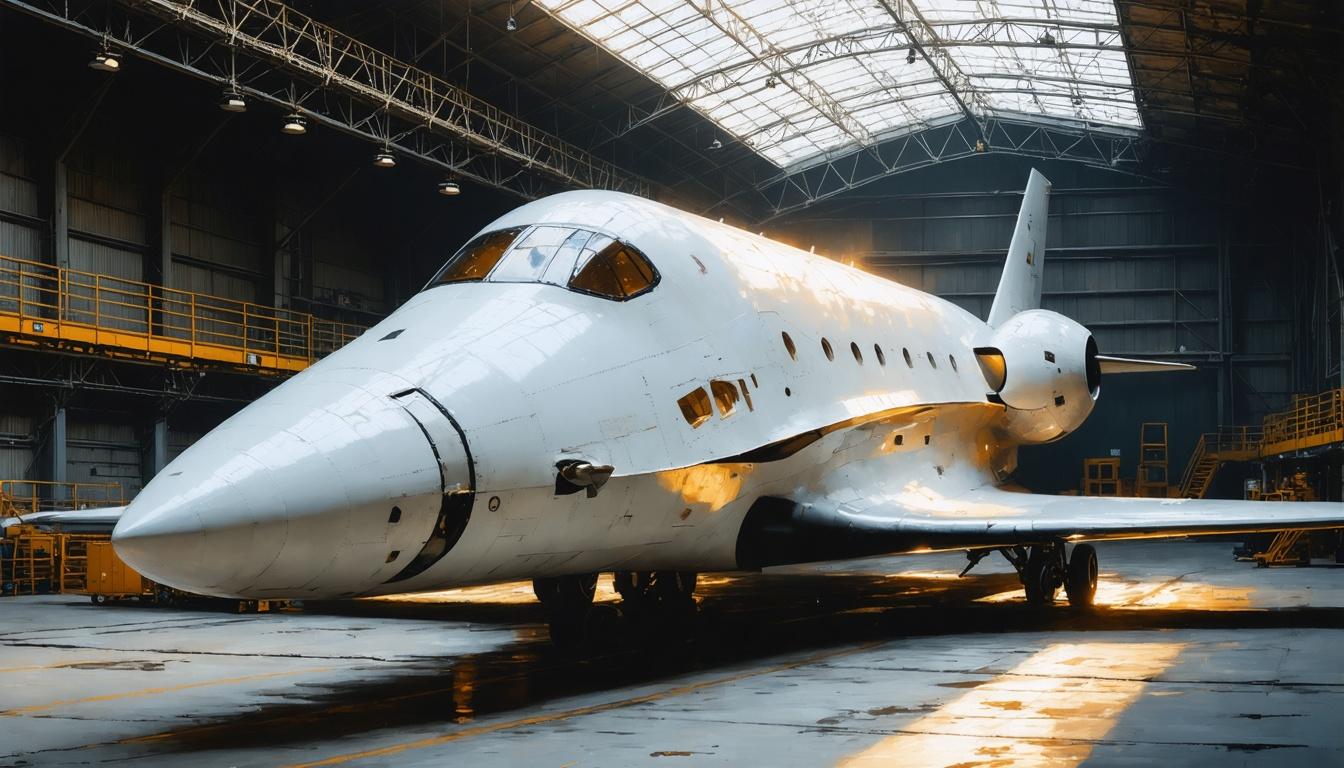
*this image is generated using AI for illustrative purposes only.
Virgin Galactic Holdings Inc. (NYSE: SPCE) reported a narrower second-quarter 2026 net loss of $56 million, down from $67 million in the same period last year. The company posted a quarterly loss of $0.50 per share, surpassing analyst consensus estimates for losses of $0.66. This result represents a significant improvement over the $1.47 per share loss recorded in Q2 2025.
Revenue for the quarter came in at $0.1 million, beating the Street estimate of $126,667 but marking a sharp year-over-year decline from $0.4 million. The top-line figure was attributable to access fees related to future astronauts. Despite the revenue contraction, management successfully reduced GAAP total operating expenses to $65 million from $70 million in Q2 2025. Non-GAAP total operating expenses fell to $54 million from $58 million in the prior year period.
Financial Performance
The improvement in the bottom line was primarily driven by a $8.6 million gain on the extinguishment of debt and lower operating costs. Adjusted EBITDA totaled $(52) million, consistent with the second quarter of 2025. Net cash used in operating activities decreased to $50 million from $55 million in Q2 2025, while capital expenditures dropped significantly to $41 million from $58 million. Consequently, free cash flow improved to $(91) million from $(114) million in the prior year quarter.
| Metric | Q2 2026 | Q2 2025 | Analyst Estimate |
|---|---|---|---|
| Revenue | $0.1 million | $0.4 million | $126,667 |
| Net Loss | $56 million | $67 million | — |
| EPS (Loss) | $(0.50) | $(1.47) | $(0.66) |
| Operating Expenses (GAAP) | $65 million | $70 million | — |
| Free Cash Flow | $(91) million | $(114) million | — |
What the Numbers Show
The divergence between the revenue beat and the severe year-over-year decline highlights the company’s transition phase. While management successfully managed costs to achieve a narrower loss than anticipated ($0.50 vs $0.66), the top-line revenue has contracted by approximately two-thirds compared to the prior year period. This suggests that current cash burn is being mitigated through cost control rather than organic demand growth, as the primary revenue driver—commercial spaceflights—remains deferred until 2027. Additionally, the $8.6 million gain on debt extinguishment contributed materially to the net loss improvement, indicating that non-operational factors played a key role in the quarter’s financial performance.
Operational Outlook and Fleet Expansion
CEO Michael Colglazier noted that the tranche of spaceflight expeditions priced at $750,000 was oversubscribed and booked out ahead of schedule, representing an addition of over $50 million to expected future spaceflight revenue. The company expects to release a new tranche of spaceflight expeditions at higher price points this fall.
The most material update concerns the company’s timeline for commercial operations. Virgin Galactic announced that its first commercial space flights have been pushed into 2027, specifically targeting February 2027, rather than the previously expected end of 2026. CEO Michael Colglazier confirmed that the move would "allow additional time" for the company "to complete avionics and systems installations," adding that "no single issue" was driving the schedule push. He stated that the team had experienced "modest time duration extensions across hundreds of relatively small but important installation tasks involved in the first build of our new spaceship." The company plans to commence the flight test phase with this vehicle in October 2026 and start rocket production in Q4 2026. With the second spaceship planned to join the fleet in March 2027, Virgin Galactic expects to deliver positive quarterly cash flow within 2027.
Looking beyond the immediate timeline, CFO Doug T. Ahrens outlined a long-term growth strategy involving fleet expansion. He stated that the company could "fully utilize one spaceport by doubling the size" of its fleet to four spaceships and adding a launch vehicle, projecting that adjusted EBITDA would more than quadruple to over $450 million per year. Ahrens added that by fully utilizing two spaceports, the company expects to generate over $1 billion of adjusted EBITDA annually, noting that economies of scale are expected to continue as it expands into additional spaceports globally.
Balance Sheet and Capital Raise
During the second quarter, Virgin Galactic substantially completed its at-the-market equity offering program, generating $134 million in gross proceeds through the issuance of 41 million shares. As of June 30, 2026, the company held cash, cash equivalents, and marketable securities of $286 million.
The company also reduced its debt load, cutting the outstanding principal balance of notes due February 2027 by $52.5 million to $17.9 million. For notes due December 2028, there are no mandatory principal payments due until March 2028 following a $40.5 million principal reduction during the quarter.
Financial Guidance
Virgin Galactic provided forward-looking statements for the remainder of 2026:
- Free cash flow for Q3 2026 is expected to be in the range of $(95) million to $(100) million.
- Free cash flow for Q4 2026 is expected to improve from the third quarter and be in the range of $(80) million to $(90) million.
Market Reaction
Investors reacted negatively to the updated timeline and continued losses. Virgin Galactic stock fell 14.55% to $2.82 in Wednesday’s extended trading session.

How might the delay of commercial spaceflights to February 2027 impact Virgin Galactic's ability to achieve positive quarterly cash flow within the same year, given the continued high burn rate?
What are the specific technical risks associated with the 'hundreds of relatively small but important installation tasks' that caused the schedule push, and could these lead to further delays in the October 2026 flight test phase?
With $286 million in cash and a projected Q3 2026 free cash flow burn of up to $100 million, is Virgin Galactic's current liquidity sufficient to fund operations through 2027 without additional dilutive equity raises or debt issuance?
 15
15







 Access 50+ Readymade Screeners
  Use 200+ Custom Filters
  Get Full Market Insights





