

Newsom accuses GM of helping Trump gut California emissions standards


Governor Gavin Newsom accused General Motors of aiding President Trump in rolling back California's clean car standards, following Trump's visit to a GM plant. The conflict arises amid rising gas prices and the end of federal EV credits, prompting California to launch its own rebate program. GM shares dipped slightly despite strong momentum rankings.

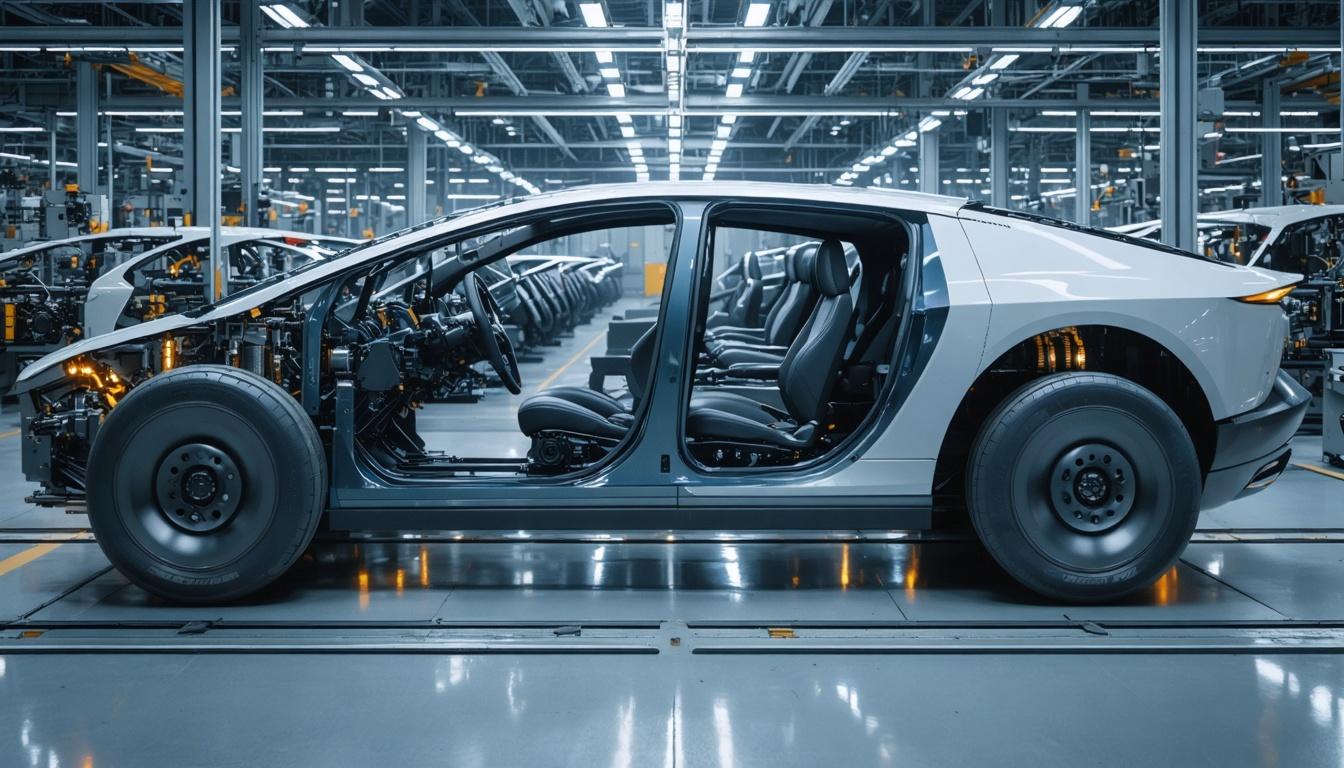

*this image is generated using AI for illustrative purposes only.
California Governor Gavin Newsom accused General Motors Co. of assisting President Donald Trump in dismantling the state's clean car emissions standards, arguing that the move undermines U.S. competitiveness against Chinese automakers. The sharp rebuke followed Trump's visit to a GM facility in Milford, Michigan, on Monday, where he addressed rising gas prices and announced a federal order for 250 Cadillac Escalade SUVs for the presidential motorcade.
Newsom's criticism centers on the claim that GM helped "gut" California's aggressive electric vehicle (EV) mandate, allowing the company to sell more polluting vehicles rather than competing in the EV market. This political friction coincides with broader regulatory shifts, as Sen. Adam Schiff (D-CA) has also accused the Trump administration of derailing state emissions goals. The dispute highlights the growing tension between federal deregulation efforts and California's push to maintain strict environmental standards.
Political Clash Over Gas Prices and Standards
During his address at the GM facility, Trump responded to questions about rising gas prices with a dismissive "No," when asked if he cared about the costs facing consumers. Newsom quoted a social media post from user @factpostnews to highlight this response, stating that Trump "flat-out doesn't care" about working Americans. The Governor emphasized that the administration's policies are making life harder for citizens while simultaneously weakening environmental protections.
The White House's procurement decision further fueled the controversy. Trump revealed that the administration had ordered 250 new Cadillac Escalades, praising the vehicles and noting that security personnel "like the Escalade." This purchase underscores the continued reliance on traditional internal combustion engine vehicles within the federal government, even as states like California push for electrification.
Regulatory Rollback and Market Implications
Newsom's Press Office specifically targeted GM CEO Mary Barra, citing her introduction of Trump at the Milford event as evidence of corporate complicity. The office stated that GM opposed California's EV mandate due to falling demand, thereby enabling the rollback of standards. Newsom warned that "American workers lose" and "China wins" from these policy changes, suggesting that reduced domestic standards will cede market leadership to foreign competitors.
In response to the end of the $7,500 Federal EV Credit, California unveiled the MyFirstEV Program to support first-time buyers. The initiative offers an instant $3,500 discount on new electric vehicles and a $1,750 discount on used EVs. Newsom framed this state-level intervention as necessary to fill the void left by federal policy changes and to help the U.S. clean energy sector compete globally.
Financial Context and Stock Performance
General Motors reported its second-quarter 2026 earnings earlier, amidst the ongoing political debate. Despite the regulatory headwinds and political criticism, Benzinga Edge rankings indicate that GM shares exhibit excellent momentum, along with strong value and quality metrics. The stock shows favorable price trends across short, medium, and long-term horizons.
However, market reaction to the immediate news was muted. General Motors shares were down 0.05% to $87.00 during overnight trading on Monday. Investors appear to be weighing the political risks against the company's fundamental performance and recent earnings guidance.
Key Developments
| Event | Detail | Impact |
|---|---|---|
| Trump Visit | Addressed crowd at GM Milford facility | Highlighted tension over gas prices |
| White House Order | 250 Cadillac Escalade SUVs ordered | Reinforces ICE vehicle usage |
| Newsom Criticism | Accused GM of gutting CA emissions standards | Political pressure on automakers |
| CA MyFirstEV | $3,500 new / $1,750 used EV discounts | State-level support for EV adoption |
| GM Stock Price | Down 0.05% to $87.00 | Minimal immediate market impact |
What the Numbers Show
The divergence between federal policy and state-level incentives creates a complex landscape for automakers. While the federal government has eliminated the $7,500 EV credit, California's introduction of targeted discounts suggests that regional demand drivers remain significant. For GM, the challenge lies in balancing its traditional strengths in internal combustion engines, evidenced by the Escalade orders, with the long-term necessity of EV competitiveness. The political backlash from Newsom indicates that regulatory risk remains a material factor for companies operating in California, potentially influencing future investment and production decisions.

How might California's MyFirstEV program influence consumer adoption rates if other states choose to implement similar regional incentives to counter federal credit eliminations?
Could the political friction between Governor Newsom and GM lead to stricter state-level regulatory penalties or procurement exclusions for automakers that oppose California's emissions standards?
What impact will the continued federal preference for internal combustion vehicles, such as the Cadillac Escalade, have on GM's capital allocation between ICE production and EV R&D?
 20
20






 Access Market Heat-map & Insights
  Create, Save & Share your Screener
  Use 200+ Screening Filters





