

Intel gets rare double upgrade on strong CPU, foundry outlook


Bank of America upgraded Intel from Underperform to Buy, raising the price target to $135 on strong CPU and foundry prospects. The firm projects earnings over $6 by 2030, driven by agentic AI and manufacturing opportunities, despite rich valuations.

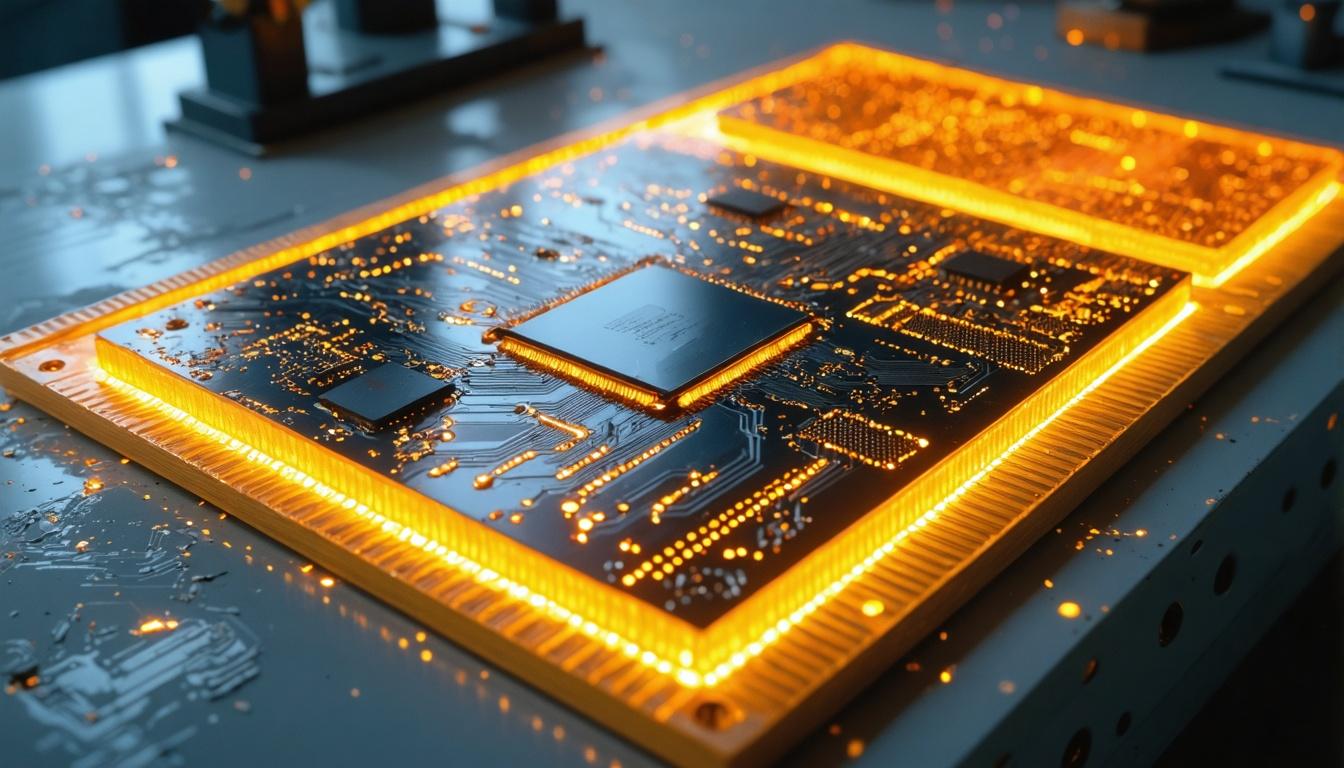

*this image is generated using AI for illustrative purposes only.
Intel Corp. shares jumped over 7% Thursday after Bank of America Corp. handed the chipmaker a rare double upgrade, lifting its rating two notches from Underperform straight to Buy. Analyst Vivek Arya raised the firm's price objective on Intel from $96 to $135, implying roughly 26% upside from Wednesday's close. The move reflects higher confidence in Intel's opportunity to address industry constraints in leading-edge wafers and packaging, alongside supply into a larger agentic CPU total addressable market. A double-upgrade skips the usual Neutral way station and jumps straight from sell to buy, a move banks reserve for moments when the thesis they were betting against breaks.
Bank of America now models Intel's earnings power at more than $6 per share by 2030, up sharply from a prior $3-to-$4 range. The firm expects Intel's central processing unit (CPU) sales to top $40 billion by 2030, representing about 25% of a $170 billion total addressable market. Arya frames the CPU as a structural winner from the shift toward agentic AI, where the processor moves from feeding GPUs to orchestrating autonomous reasoning loops, memory state, and tool use. The combined AI compute and agentic-node CPU opportunity is pegged at roughly $140 billion within a $2.1 trillion data-center systems market by 2030.
Foundry and Ownership
Intel's foundry business is a key growth driver, with Bank of America valuing the opportunity above $45 billion by 2030. This potential spans work for Apple Inc., MediaTek and others, supported by a recent Cadence Design Systems Inc. tie-up on Intel's 14A process node. Despite a market cap above $540 billion, Intel remains under-owned, sitting in just 16% of S&P 500 fund portfolios as of May. This compares to Advanced Micro Devices Inc., which saw ownership climb roughly 1,400 basis points year-over-year to 39% as its stock rose more than 300%, suggesting room for Intel's investor base to broaden.
Risks and Valuation
Key risks include intensifying competition from Arm-based and custom CPUs, potential moderation in AI capital spending, and execution risks at Intel's 18A and upcoming 14A nodes. Power and cost constraints also remain factors. From a valuation perspective, Intel trades near 100 times this year's expected earnings, among the richest multiples in the chip sector. Intel has been one of 2026's best stocks, surging roughly 210% year-to-date and putting it on pace for its best annual showing since 1975.

How will Intel's foundry business compete with established players like TSMC and Samsung as it seeks to capture the $45 billion opportunity by 2030?
What are the potential market impacts if Intel fails to execute on its 18A and 14A process nodes, given the high valuation expectations?
Could the shift toward agentic AI CPUs disrupt the dominance of GPUs in AI workloads, and how might competitors respond?
 19
19





 Create Custom Screeners
  Access 200+ Pre-built Filters
  Use 50+ Readymade Screener





