Exxon Links $80 Billion Kazakhstan Oil Venture to Ending Dispute

scanx
Reviewed by
Jubin VScanX News Team
Key Highlights

ExxonMobil ties a $80 billion Kazakhstan oil project to resolving a dispute. The deal signifies a major step towards normalizing relations and boosting investment in Central Asia's energy sector.


powered bylight_fuzz_icon
47587698

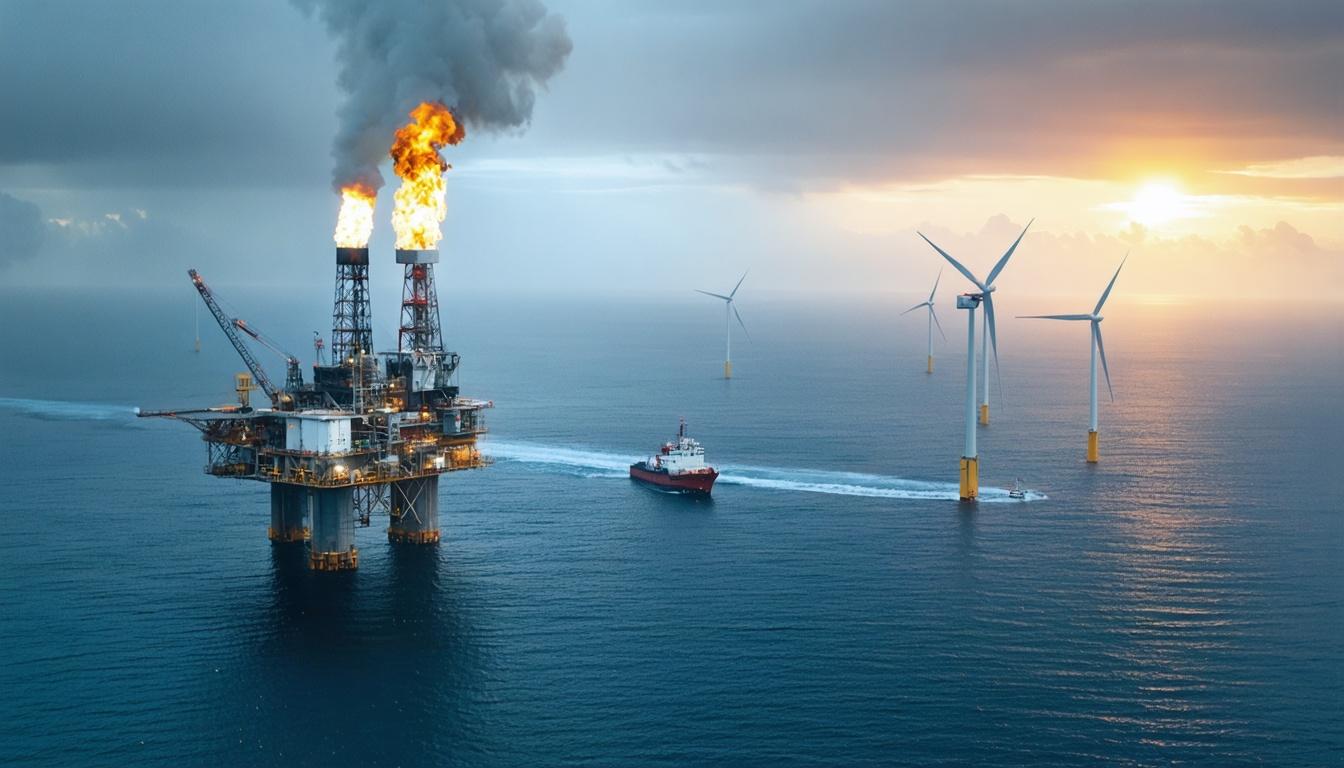
*this image is generated using AI for illustrative purposes only.

ExxonMobil has linked a new $80 billion oil venture in Kazakhstan to the resolution of an ongoing dispute, marking a pivotal moment for its operations in Central Asia. The announcement, reported by Bloomberg, suggests that the massive investment is contingent upon settling existing disagreements with Kazakh authorities. This development carries significant weight for global energy markets, as it indicates a potential thaw in relations and a renewed commitment to large-scale upstream projects in the region.

The $80 billion figure represents a substantial capital commitment, underscoring the strategic importance of Kazakhstan’s oil reserves to ExxonMobil’s long-term growth plans. By tying the venture to the ending of the dispute, the company is effectively using the investment as leverage to resolve outstanding issues. This approach highlights the complex interplay between corporate strategy and geopolitical negotiations in resource-rich nations.

Strategic Implications

The decision to link the venture to dispute resolution reflects a broader trend in the energy sector where major investments are increasingly tied to regulatory and political stability. For ExxonMobil, this move could pave the way for enhanced access to key fields and improved operational conditions. For Kazakhstan, it offers the prospect of significant foreign direct investment and technology transfer.

Metric Value
Venture Value $80 billion
Location Kazakhstan
Status Linked to dispute resolution

Market Reaction and Outlook

While specific details of the dispute remain undisclosed, the mere linkage of such a large sum to its resolution is likely to be viewed positively by investors. It suggests that both parties are engaged in serious negotiations aimed at a mutually beneficial outcome. The success of this endeavor will depend on the ability of ExxonMobil and Kazakh officials to finalize terms that satisfy both commercial and national interests.

What the Numbers Show

The sheer scale of the $80 billion venture dwarfs many other recent announcements in the upstream sector. This magnitude indicates that the project is not merely an incremental expansion but a transformative initiative for both the company and the host country. The dependency on dispute resolution introduces a layer of risk, but also a clear path to de-risking the investment through formal agreement.

What specific regulatory or fiscal terms are likely to be negotiated to justify an $80 billion capital commitment in Kazakhstan?

How might the resolution of this dispute influence other major oil majors' investment strategies in Central Asia?

What is the estimated timeline for finalizing the agreement and commencing initial production phases of this venture?

like20
dislike

ExxonMobil Q2 sales $116.017B beat estimate as EPS misses

scanx
Reviewed by
Riya DScanX News Team
Key Highlights

ExxonMobil Holdings Corporation reported second-quarter 2026 adjusted EPS of $3.52, missing the $3.60 estimate, but delivered strong sales of $116.017 billion, beating the $97.805 billion estimate by 18.62 percent and up 42.34 percent year-over-year.

powered bylight_fuzz_icon
47041222

*this image is generated using AI for illustrative purposes only.

ExxonMobil Holdings Corporation reported second-quarter 2026 adjusted earnings per share (EPS) of $3.52, missing the analyst consensus estimate of $3.60 by 2.22 percent. Despite the per-share shortfall, the company delivered a robust top-line performance, with quarterly sales reaching $116.017 billion. This figure significantly beat the analyst consensus estimate of $97.805 billion by 18.62 percent and represents a substantial 42.34 percent year-over-year increase from sales of $81.506 billion in the same period last year. The divergence between the EPS miss and the strong sales beat highlights a quarter defined by volume growth and operational scale, even as margin pressures or specific cost items impacted the bottom line relative to expectations.

The EPS miss occurred against a backdrop of significant year-over-year improvement, with the $3.52 figure rising 114.63 percent from $1.64 per share in the prior year. The company’s total earnings reached $14.5 billion, underpinned by record Permian production exceeding 1.8 million barrels of oil equivalent per day and strong reliability across its global integrated portfolio. This performance was further supported by robust cash flow generation, with free cash flow totaling $17.2 billion. The company returned $9.4 billion to shareholders through dividends and share repurchases during the quarter, reinforcing its commitment to capital return despite the slight shortfall in per-share expectations.

Financial Highlights

Metric 2Q26 1Q26 Change vs 1Q26
Earnings (U.S. GAAP) $14,525 million $4,183 million +$10,342 million
Adjusted Earnings $14,680 million $8,772 million +$5,908 million
EPS (U.S. GAAP) $3.48 $1.00 +$2.48
Adjusted EPS $3.52 $2.09 +$1.43
Free Cash Flow $17,236 million $2,699 million N/A
Quarterly Sales $116,017 million N/A N/A

Darren Woods, ExxonMobil chairman and chief executive officer, emphasized that the quarter was defined by execution rather than just market conditions. He highlighted the strength of the global integrated portfolio, which allowed the company to move products where needed, optimize assets, and support customers effectively. The company achieved cumulative structural cost savings of $16.3 billion relative to 2019 levels, surpassing all other integrated oil companies combined.

Segment Performance

Upstream earnings rose sequentially, driven by the absence of operational disruptions in Kazakhstan and record Permian volumes. Energy Products earnings increased on strong utilization rates, although scheduled maintenance impacted results. Chemical Products earnings improved due to margin capture enabled by reliability and North American feed advantages. Specialty Products earnings grew with higher basestock margins and a strong response in the Middle East region.

Segment 2Q26 Earnings (U.S. GAAP) 1Q26 Earnings (U.S. GAAP)
Upstream $7,927 million $5,737 million
Energy Products $5,465 million $(1,262) million
Chemical Products $1,131 million $110 million
Specialty Products $956 million $651 million
Corporate & Financing $(954) million $(1,053) million

What the Numbers Show

The combination of an EPS miss alongside a significant sales beat suggests that while operational execution and volume growth were strong, market pricing or specific cost items may have pressured margins slightly below analyst expectations. However, the 114.63 percent year-over-year growth in EPS underscores the significant recovery and expansion in profitability compared to the prior year. The company’s ability to generate $17.2 billion in free cash flow while investing $13.0 billion year-to-date demonstrates high capital investment efficiency. Looking ahead, the fifth Guyana floating production, storage, and offloading (FPSO) vessel set sail with production startup planned for the fourth quarter of 2026, adding 250,000 barrels per day of capacity. ExxonMobil declared a third-quarter dividend of $1.03 per share, payable on September 10, 2026, to shareholders of record as of August 17, 2026.

How might the divergence between record sales and the EPS miss influence ExxonMobil's capital allocation strategy for the remainder of 2026?

What impact will the startup of the fifth Guyana FPSO in Q4 2026 have on the company's upstream volume growth and margin stability?

Can ExxonMobil sustain its $16.3 billion cumulative structural cost savings trajectory as it scales operations in high-cost regions like Guyana?

like19
dislike

More News on exxonmobil