

Adani Green Energy profit rises 19%, shifts to de-risked C&I model


Adani Green Energy Limited posted a consolidated net profit of ₹983 crore in Q1FY27, up 19% year-on-year, supported by a 27% increase in renewable capacity to 20.1 GW. Key developments include a strategic partnership with Adani Energy Services Limited (AESL) to convert merchant projects into long-term C&I contracts, ensuring stable returns. The company also guided for ₹42,000 crore CapEx in FY27 and highlighted progress in battery storage, with 3.55 GW-hour now operational.

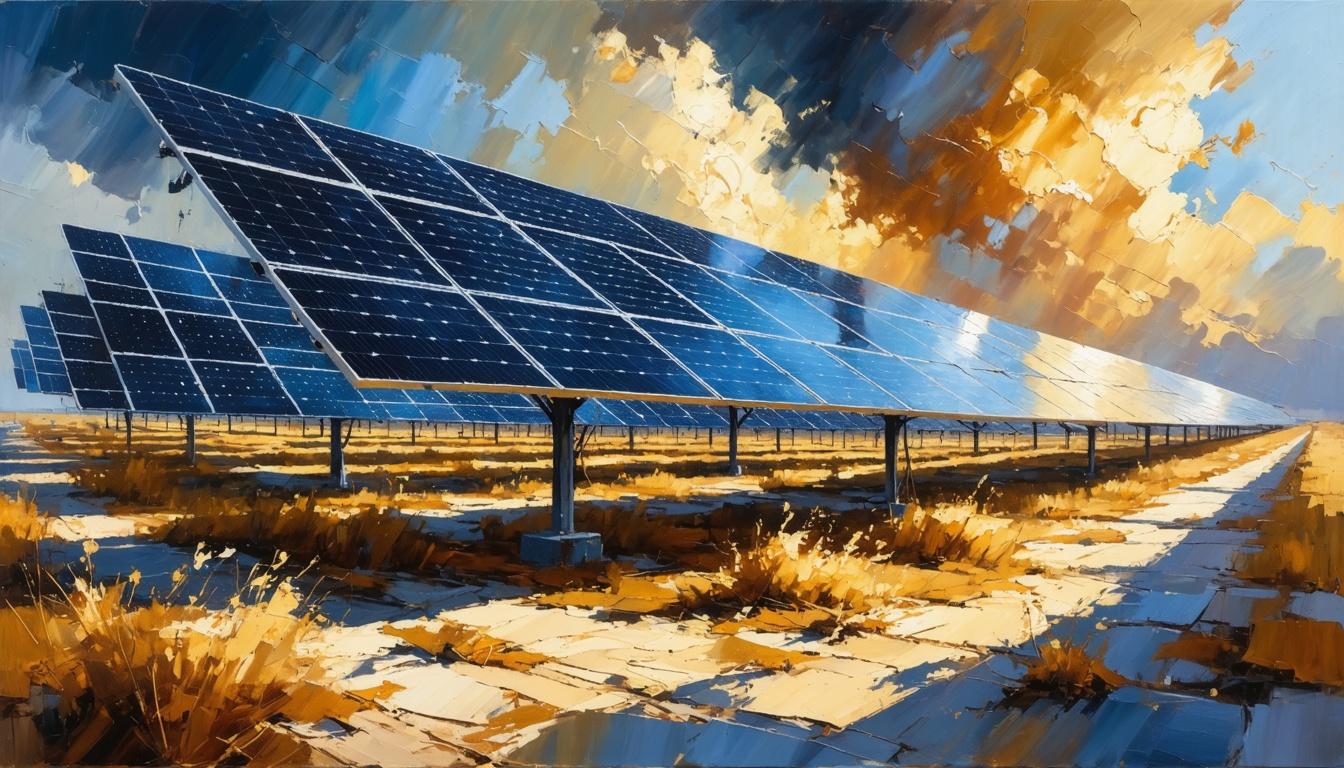

*this image is generated using AI for illustrative purposes only.
Adani Green Energy reported a consolidated net profit of ₹983 crore for the quarter ended June 30, 2026, marking a 19% increase from ₹824 crore in the corresponding period of the previous year. This profitability surge was primarily driven by a 27% year-on-year expansion in renewable generation capacity to 20,142 MW and a 30% rise in energy sales to 13,657 million units. Revenue from power supply grew 29% to ₹4,280 crore, while EBITDA from power supply expanded 33% to ₹4,122 crore, maintaining an industry-leading margin of 94%. The strong operational performance underscores the company’s ability to convert capacity additions into immediate financial gains.
In a significant strategic update during its July 22, 2026, earnings call, management disclosed a shift towards de-risking merchant exposure by entering long-term contracts with Adani Energy Services Limited (AESL). CEO Ashish Khanna stated that projects previously classified as merchant are now being structured as Commercial and Industrial (C&I) sales to AESL on an arm’s-length basis. This move aims to insulate Adani Green Energy from market volatility and ensure predictable returns aligned with project hurdle rates. CFO Saurabh Shah confirmed that solar and wind assets are tied up for 25 years at fixed benchmark rates, while battery storage contracts span 15 years.
Financial Performance
The unaudited financial results for Q1FY27 demonstrate robust growth across key metrics compared to the same quarter last year. The following table summarises the consolidated performance:
| Metric: | Q1FY27 (Current) | Q1FY26 (Prior Year) | YoY Change |
|---|---|---|---|
| Consolidated Net Profit: | ₹983 crore | ₹824 crore | 19% |
| Revenue from Power Supply: | ₹4,280 crore | ₹3,312 crore | 29% |
| EBITDA from Power Supply: | ₹4,122 crore | ₹3,108 crore | 33% |
| EBITDA Margin: | 94% | — | — |
| Total Income: | ₹4,663 crore | ₹4,006 crore | 16% |
The company's cash profit increased 28% year-on-year to ₹2,225 crore. Capital expenditure (CapEx) rose 41% year-on-year to ₹8,800 crore during the quarter, reflecting aggressive deployment in greenfield projects and storage infrastructure. Management provided full-year guidance of approximately ₹42,000 crore for CapEx in FY27, targeting 5 GW of renewable energy expansion and over 10 GW-hour of cumulative battery storage capacity.
Operational Highlights and Storage Strategy
Adani Green Energy commissioned 848 MW of renewable capacity during the quarter. Notably, this included 1.97 GW-hour of Battery Energy Storage System (BESS) capacity at Khavda, bringing the total installed BESS capacity to 3.55 GW-hour. The operational capacity at Khavda reached 10.3 GW. CEO Rajat Seksaria clarified that BESS unit economics rely on an arbitrage model, with expected spreads between ₹4 and ₹5 per unit based on historical market trends. He also addressed safety concerns regarding battery fires, clarifying that recent industry incidents involved Power Conversion Systems (PCS) or inverters rather than the battery cells themselves, and affirmed that all assets are covered by standard insurance policies.
The company remains on track to add 5 GW of renewable capacity and more than 10,000 MWh of BESS capacity by FY27. Additionally, the maiden 500 MW pump storage project at Chitravathi, Andhra Pradesh, is scheduled for commissioning in FY27. Regarding curtailment, Ashish Khanna noted that while current curtailment impacts EBITDA by 5% to 7%, the company expects no curtailment issues from Khavda by the end of calendar 2026 as transmission lines come online.
What the Numbers Show
The strategic pivot to long-term contracts with AESL fundamentally alters Adani Green Energy’s risk profile. By converting merchant exposure into fixed-return C&I arrangements, the company sacrifices potential upside from favorable spot market prices but gains stability against tariff volatility. With run-rate EBITDA projected to grow from ₹17,000 crore currently to ₹21,000 crore by FY27 end, the focus is clearly on capitalizing new assets into predictable cash flows. The high CapEx intensity relative to revenue highlights the company’s aggressive scaling phase, particularly in storage, which is becoming a distinct profit center separate from traditional generation.
Historical Stock Returns for Adani Green Energy
| 1 Day | 5 Days | 1 Month | 6 Months | 1 Year | 5 Years |
|---|---|---|---|---|---|
| +1.63% | -1.59% | -2.80% | +21.96% | +20.16% | +6.74% |

How might the shift from merchant exposure to fixed-return C&I contracts with AESL impact Adani Green Energy's valuation multiples compared to peers relying on spot market volatility?
Given the ₹42,000 crore CapEx guidance for FY27, what are the primary funding sources planned to sustain this aggressive expansion without significantly diluting equity or increasing leverage ratios?
To what extent could the expected resolution of curtailment issues at Khavda by late 2026 influence the company's EBITDA margins in the subsequent fiscal quarters?
 20
20





 Access Market Heat-map & Insights
  Create, Save & Share your Screener
  Use 200+ Screening Filters





