NewsStocksD&B Projects India's GDP Growth at 6.6% by FY2027, Driven by AI and Clean Energy Transformation
D&B Projects India's GDP Growth at 6.6% by FY2027, Driven by AI and Clean Energy Transformation


Dun & Bradstreet projects India's GDP growth at 6.6% by FY2027, supported by macroeconomic stability and transformation across key sectors. The report highlights AI's potential to add $600 billion to GDP over the next decade, while manufacturing shifts from volume to value creation with technology focus. Clean energy development, particularly green hydrogen, emerges as a strategic driver for industrial decarbonisation, with inflation projected at 3.1% in 2026 and digital economy contributing 20% of gross value added by 2030.
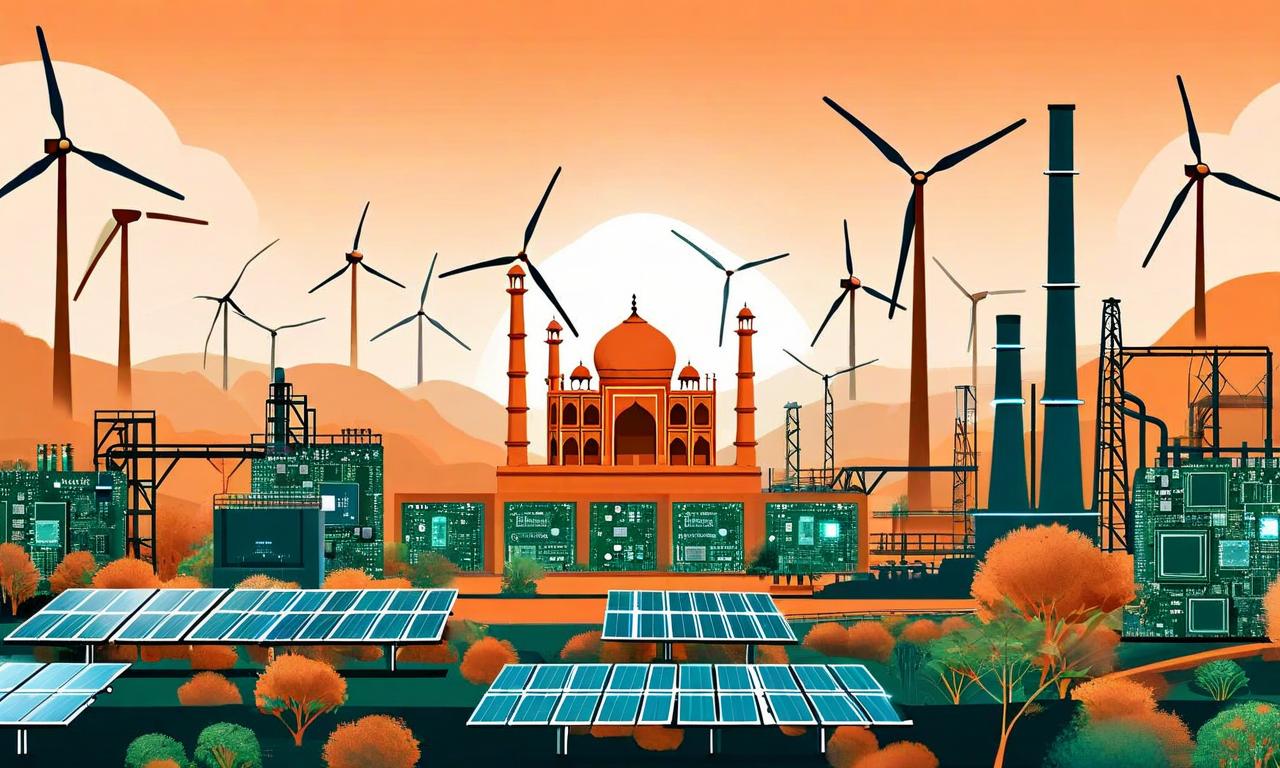
*this image is generated using AI for illustrative purposes only.
India is positioned for sustained economic transformation with GDP growth projected at 6.6% by FY2027, according to Dun & Bradstreet's India 2026 report. The outlook emphasises a shift from traditional growth models to technology-driven, diversified expansion across artificial intelligence, clean energy, and advanced manufacturing sectors.
Macroeconomic Foundation Supports Growth Trajectory
The report projects India's growth momentum will remain resilient through FY2026, anchored by consumption as the primary engine. Policy support, festive demand, and gradual normalisation in rural spending are expected to sustain household consumption, while continued public capital expenditure will drive investment across infrastructure and manufacturing sectors.
| Economic Indicator | FY2026-27 Projection |
|---|---|
| GDP Growth | 6.60% by FY2027 |
| Inflation Rate | 3.10% in 2026 |
| Current Account Deficit | ~1% of GDP |
| Digital Economy Contribution | 20% of GVA by 2030 |
Inflation is projected to remain controlled at approximately 3.1% in 2026, enabling calibrated policy easing while maintaining mildly positive real interest rates. The current account deficit is expected to stay near 1% of GDP, supported by services exports and remittances, with robust foreign exchange reserves providing protection against external headwinds.
Manufacturing Evolution Towards Value Creation
Dun & Bradstreet identifies a fundamental shift in India's manufacturing approach from volume-driven models to technology-focused value creation. The report projects manufacturing's share of GDP could reach the mid-20s percentage range over the next decade, driven by strategic sector development.
Defence manufacturing, semiconductor design and packaging, and electronics clusters supported by Production Linked Incentive schemes are leading this transformation. The spatial distribution of manufacturing activity is expanding beyond traditional centres, with Tier-2 and Tier-3 cities emerging as investment destinations through industrial corridors and logistics infrastructure development.
Artificial Intelligence as Economic Growth Engine
The report positions artificial intelligence as a core productivity driver, moving beyond pilot projects to platform-scale adoption. India's digital economy is projected to grow at nearly twice the rate of the overall economy, with AI alone potentially adding $600 billion to GDP over the next decade.
| AI Impact Areas | Expected Benefits |
|---|---|
| BFSI Sector | Enhanced productivity and services |
| Manufacturing | Process optimisation and automation |
| Healthcare | Improved diagnostics and delivery |
| Public Services | Streamlined governance and citizen services |
| Data Centres | Mumbai, Chennai, Hyderabad clusters |
Global Capability Centres are evolving into innovation hubs, while Digital Public Infrastructure integration accelerates AI adoption across sectors. Major cities including Mumbai, Chennai, and Hyderabad are developing as significant data centre clusters supporting this digital transformation.
Clean Energy and Green Hydrogen Development
Green hydrogen emerges as a strategic platform for industrial decarbonisation and energy security enhancement. The report indicates that focus during 2026-28 will shift towards cost reduction through localisation and renewable energy integration, building on existing mission architecture and pilot projects.
Port-based infrastructure development for ammonia and methanol, combined with clear offtake pathways in refining, fertilisers, steel, and shipping sectors, is expected to establish commercial viability for green hydrogen. This development could reduce import dependency, strengthen external balances, and position India as a clean technology export hub.
Emerging Consumption and Service Sectors
Tourism is gaining strategic importance as preferences shift towards wellness, spiritual, and experiential offerings. Spiritual tourism currently accounts for approximately 60% of domestic trips, with this share expected to grow through 2026. Infrastructure investments in destination development, multimodal connectivity, and digital tools including AR and VR-enabled planning are enhancing both domestic and inbound tourism potential.
Quick commerce represents another rapidly evolving sector, with dark stores, micro-fulfilment centres, and digital payment infrastructure transforming retail economics from scale-focused to speed-optimised models. The anticipated rollout of Beyond Visual Line of Sight drone regulations in 2026 could further revolutionise last-mile logistics, particularly for medical and essential goods delivery.
Demographic and Infrastructure Drivers
India's demographic transition is creating substantial opportunities in the silver economy, encompassing senior living, assisted care, and home-based healthcare services. The senior population is projected to exceed 347 million by 2050, generating significant market opportunities particularly in southern and western urban areas.
The maritime sector supports long-term growth through blue economy initiatives, with India's maritime trade volume projected to exceed 7,100 million metric tonnes annually by 2047. This growth will be supported by green port infrastructure, digital logistics systems, and offshore renewable energy projects under the Harit Sagar initiative.
According to Arun Singh, Global Chief Economist at Dun & Bradstreet, India's 2026 outlook represents a clear transformation point, with macroeconomic stability providing the foundation for broader, technology-driven growth that could prove faster, cleaner, and more structurally resilient.
 17
17