India's Exports Show Resilience Amid US Tariff Challenges


India's export sector has shown remarkable resilience, reaching $407 billion in Jan-Nov 2025 despite facing 50% US tariffs. The country's total goods and services exports hit a record $825.25 billion in 2024-25, growing 6% YoY. This growth is attributed to market diversification and product expansion. Electronics emerged as a key growth driver with a 39% increase in November 2025. The government has implemented support measures including a ₹25,060 crore Export Promotion Mission and additional credit facilities. India has also expanded its Free Trade Agreements, signing deals with countries like UAE, Australia, and EFTA. Despite global challenges, including WTO's projection of slowing trade growth, industry experts remain optimistic about India's export prospects.
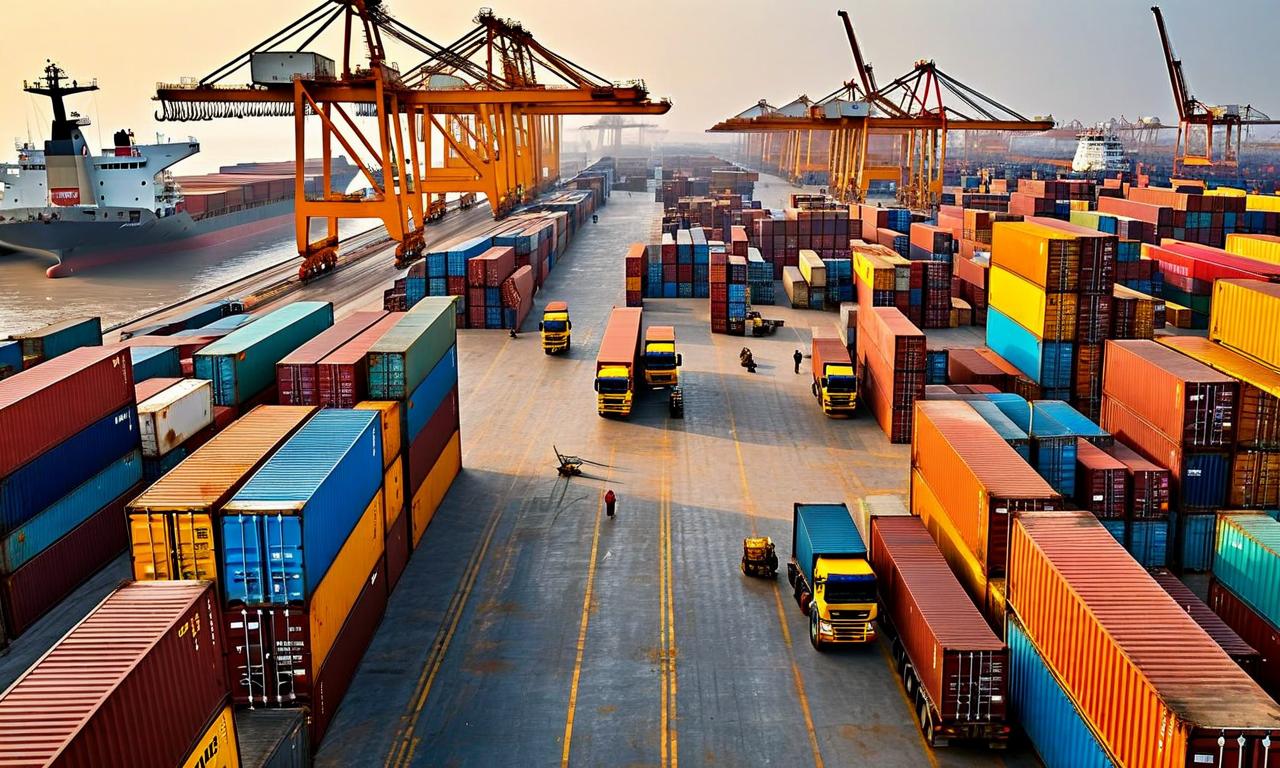
*this image is generated using AI for illustrative purposes only.
India's export sector has demonstrated remarkable adaptability, maintaining steady growth despite facing significant tariff pressures from its largest trading partner, the United States. The resilience shown by Indian exporters through strategic market diversification and product expansion has positioned the country for continued export momentum.
Export Performance Trajectory
India's merchandise exports have shown consistent recovery and growth over recent years, adapting to multiple global disruptions. The following table illustrates the export journey:
| Year | Merchandise Exports | Key Events |
|---|---|---|
| 2020 | $276.50 billion | Covid-19 pandemic impact |
| 2021 | $395.50 billion | Recovery phase |
| 2022 | $453.30 billion | Russia-Ukraine war begins |
| 2023 | $389.50 billion | Multiple global disruptions |
| 2024 | $443.00 billion | Momentum recovery |
| 2025 (Jan-Nov) | $407.00 billion | US tariff challenges |
India's merchandise exports reached $407.00 billion in Jan-Nov 2025 despite 50% US tariffs. Total goods and services exports hit a record $825.25 billion in 2024-25 with 6% YoY growth, driven by market diversification.
Impact of US Tariff Measures
The United States imposed steep 50% duties on Indian exports starting August 2025, creating initial challenges for exporters. While these tariffs impacted shipments to America in September and October 2025, the sector demonstrated quick recovery. November 2025 marked a significant turnaround, with exports to the US surging 22.61% to $6.98 billion.
This recovery reflects the adaptability of Indian exporters who, as described by a senior commerce ministry officer, found that "trade is like water, it finds its own course." The sector's ability to navigate through various disruptions including the Covid-19 pandemic, Russia-Ukraine war, Israel-Hamas conflict, Red Sea shipping crisis, and semiconductor supply shortages has strengthened its resilience.
Government Support Measures
The government has implemented a comprehensive multi-pronged strategy to support exporters facing global uncertainties:
| Initiative | Details |
|---|---|
| Export Promotion Mission | ₹25,060 crores allocated |
| Credit Facilities | Up to ₹20,000 crores additional collateral-free credit |
| Debt Support | Repayment moratorium and tenor extension for export credit |
| Trade Agreements | Multiple FTAs leveraged for market access |
Free Trade Agreement Expansion
The current administration has signed several Free Trade Agreements (FTAs) in recent years, creating enhanced market access opportunities:
- Mauritius (implemented April 2021)
- UAE (implemented May 2022)
- Australia (implemented December 2022)
- EFTA (implemented October 2025)
- Oman (signed December 2025)
- UK (signed July 2025)
- New Zealand (talks concluded December 2025)
Three additional FTAs with UK, Oman, and New Zealand are expected to enter into force in 2026, potentially unlocking further market access for both goods and services exports.
Sector-Wise Performance and Diversification
Electronics emerged as a key growth driver, with exports rising nearly 39% in November 2025, reflecting sustained FDI-led capacity creation and deeper integration into global value chains. Engineering goods, pharmaceuticals, and automotive exports continued reinforcing this momentum.
Geographic diversification has become a notable feature, with exports spreading across Europe, East Asia, and South Asia beyond traditional markets like the US and UAE. Specific regional performance included:
- Spain: Nearly 150% surge in exports
- China and Bangladesh: Strong growth recorded
- US: 22% growth in November 2025 despite tariff pressures
Global Trade Outlook and Challenges
The World Trade Organization projected global trade growth of 2.4% in 2025, with the outlook for 2026 deteriorating to 0.5%. The organization cited higher tariffs, trade policy uncertainty, and possible signs of weakness in developed economies as contributing factors.
Despite these global headwinds, industry experts remain optimistic about India's export prospects. Federation of Indian Export Organisations Director General Ajay Sahai noted that global supply-chain realignments, expanding trade partnerships, and India's improving ease of doing business position exporters well to sustain momentum.
However, challenges persist including geopolitical tensions, slower growth in developed markets, rising protectionism, exchange-rate volatility, and high freight costs. The Indian rupee remained volatile in 2025, dipping about 5% and trading around 90 per dollar towards December's end.
 15
15