

RoboStrategy CEO says Anthropic's $65B jump redefines robotics valuation


- RoboStrategy Inc CEO Andrew Kang argues traditional revenue multiples undervalue humanoid robotics firms
- Kang cites Anthropic's growth from $10m in 2022 to $65B ARR in 2026 as a scaling benchmark
- Investors should prioritize hardware IP, manufacturing scalability, and robot foundation models
- Standard price-to-sales multiples may misprice firms with strong tech but low initial sales



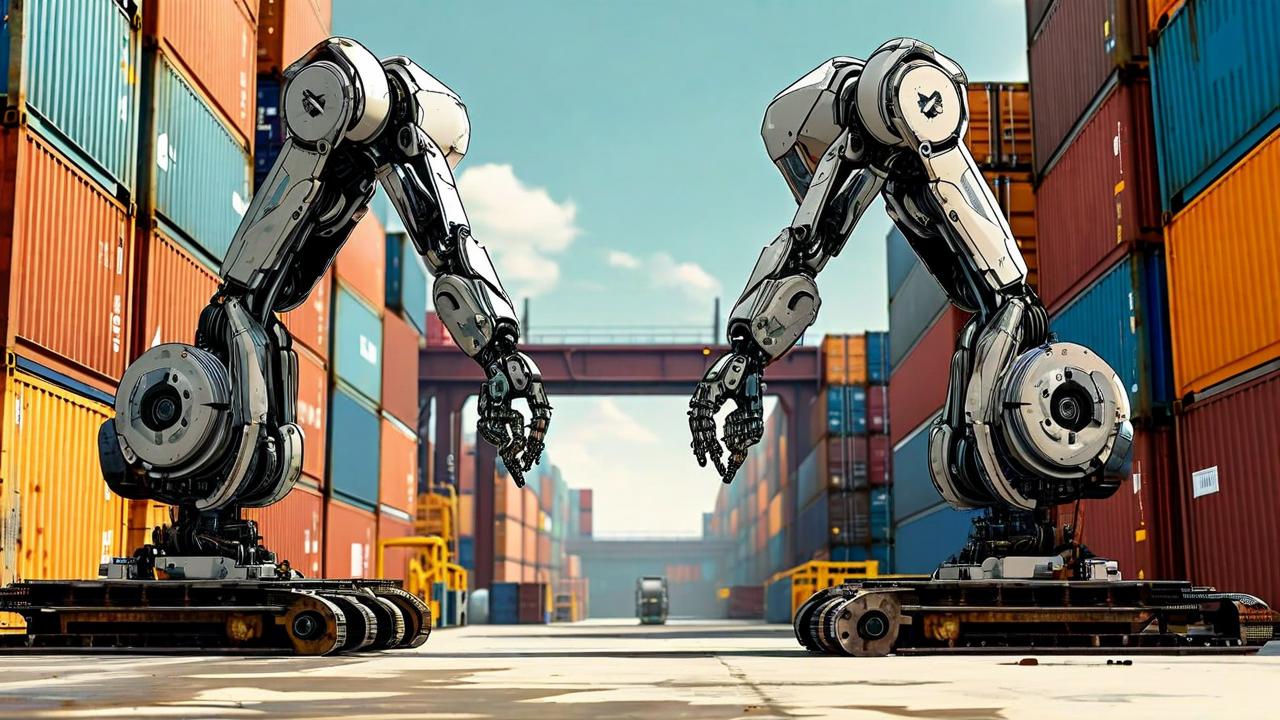
*this image is generated using AI for illustrative purposes only.
RoboStrategy Inc (NASDAQ: BOT) CEO Andrew Kang argues that traditional revenue multiples are insufficient for valuing humanoid robotics companies. In an exclusive interview, he outlined a framework prioritizing manufacturing scalability and proprietary technology over current financial metrics.
Kang stated that while conventional methods have a place, they often understate the long-term value of firms developing breakthrough technologies. He suggested investors should balance traditional metrics with harder-to-measure indicators such as artificial intelligence capabilities and hardware intellectual property.
Revenue Is Only Part of the Valuation Equation
Kang acknowledged that discounted future cash flows remain relevant. He noted that current revenue can be small relative to future expectations if a company successfully scales. Investors can model future robot production and sales to estimate growth rates.
To illustrate the potential disconnect between current revenue and long-term value, Kang pointed to Anthropic. He cited its rapid expansion, noting that the company went from $10m in revenue in 2022 to an expected $65B ARR in 2026. This example underscores his view that quantitative measures alone are less useful when evaluating companies pursuing trillion-dollar markets.
Valuing Robotics: The Metrics That Could Matter More
Beyond financial models, Kang identified three qualitative factors that investors should monitor closely:
- Hardware intellectual property: Whether a company has built differentiated robotic systems that competitors will struggle to replicate.
- Manufacturing scalability: The ability to produce robots efficiently and at scale, which is critical for commercial success beyond the prototype stage.
- Robot foundation models: The performance of AI systems that allow humanoid robots to perceive, reason, and perform complex physical tasks.
What the Numbers Show
The valuation framework proposed by RoboStrategy shifts focus from immediate profitability to structural competitive advantages. By citing Anthropic’s growth from $10m to $65B over four years, the data suggests that early-stage revenue figures may bear little correlation to eventual market capitalization in high-growth technology sectors. This divergence implies that standard price-to-sales multiples could significantly misprice companies with strong proprietary technology but low initial sales volumes.
Investment Takeaway
Kang’s framework suggests investors should differentiate humanoid robotics from mature technology companies. While revenue and production estimates remain important, they tell only part of the story. Companies combining scalable manufacturing, differentiated hardware, and capable robot AI may create lasting value independent of their current revenue generation.

How might institutional investors adapt their risk models to quantify 'hardware intellectual property' and 'robot foundation models' without relying solely on traditional financial multiples?
What specific manufacturing bottlenecks could prevent humanoid robotics companies from achieving the scalability required to validate Kang's valuation framework?
Could the proposed valuation shift lead to increased volatility in the robotics sector as companies struggle to meet non-financial performance benchmarks?
 15
15










 Access Market Heat-map & Insights
  Create, Save & Share your Screener
  Use 200+ Screening Filters





