

KLA Q4 earnings beat estimates but Q1FY27 guidance miss triggers sell-off


KLA Corporation beat Q4FY26 earnings and revenue estimates with EPS of $1.05 and sales of $3.658 billion. Despite strong operational results and cash flow, the stock dropped significantly due to weak Q1FY27 guidance that missed analyst expectations for both EPS and revenue.


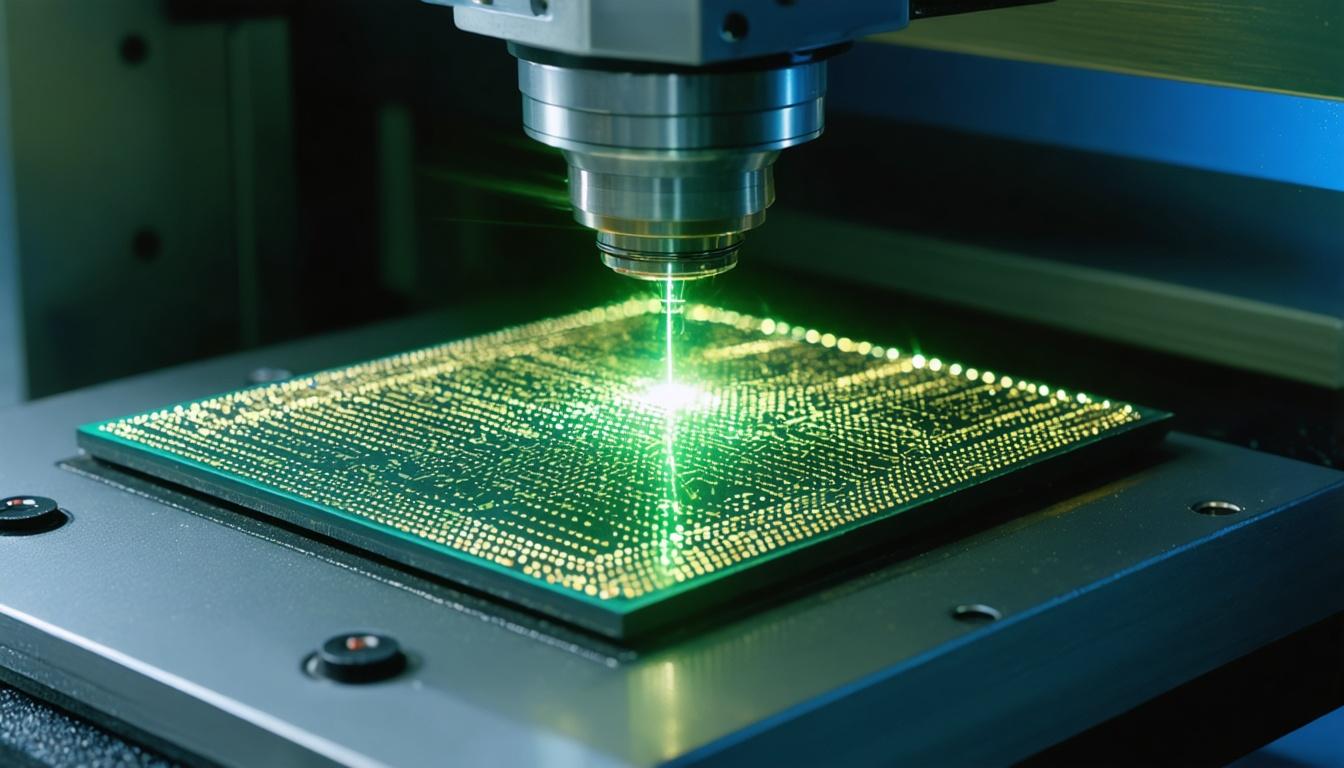
*this image is generated using AI for illustrative purposes only.
KLA Corporation (NASDAQ: KLAC) shares plunged 9.6% to $172.48 in extended trading on Tuesday, erasing gains from a fourth-quarter fiscal year 2026 earnings beat. The semiconductor process control equipment maker reported quarterly earnings of $1.05 per share, surpassing the analyst consensus estimate of $1 by 5%, while quarterly revenue of $3.658 billion exceeded the Street estimate of $3.598 billion. Despite these top-line and bottom-line beats, the market reacted negatively to disappointing forward guidance for the first quarter of fiscal year 2027. Investors are concerned about near-term growth momentum in the AI infrastructure sector after KLA’s guidance for both GAAP and adjusted metrics fell short of consensus.
The company now expects Q1FY27 GAAP EPS to range between $1.04 and $1.24, falling short of the $1.10 analyst estimate. For adjusted EPS, KLA projects $1.06 to $1.26, missing the $1.14 estimate. Revenue is projected to be between $3.8 billion and $4.2 billion, compared to the $3.916 billion consensus estimate. The stock had already shed 6.18% during regular trading hours before continuing its decline after the closing bell. This sell-off underscores the market’s sensitivity to forward-looking metrics, even when current-period results exceed expectations.
Financial Performance Breakdown
KLA’s Q4 FY26 results showed robust operational performance across all segments. Total revenues reached $3.658 billion, up 15.21% year-over-year from $3.175 billion. GAAP net income was $1.36 billion, compared to $1.20 billion in the prior year quarter. Non-GAAP diluted EPS was $1.05, beating the consensus estimate of $1. Earnings per share increased by 11.7% from $0.94 in the same period last year.
| Metric | Q4 FY26 Actual | Analyst Estimate | YoY Change |
|---|---|---|---|
| Revenue | $3.658 billion | $3.598 billion | +15.21% |
| Non-GAAP EPS | $1.05 | $1.00 | +11.7% |
| Operating Cash Flow | $906.4 million | N/A | N/A |
| Free Cash Flow | $817.1 million | N/A | N/A |
Cash flow from operating activities for the quarter totaled $906.4 million, with free cash flow at $817.1 million. For the full fiscal year 2026, operating cash flow reached $4.14 billion, and free cash flow stood at $3.77 billion. Capital returns to shareholders amounted to $876.3 million in the quarter and $3.35 billion for the full year, comprising dividends and stock repurchases.
Outlook and Market Reaction
Looking ahead, KLA provided guidance for Q1FY27 that fell short of analyst expectations on multiple fronts. The lower bounds of both the adjusted and GAAP EPS ranges suggest potential margin pressure or higher costs. Rick Wallace, CEO of KLA Corporation, stated, “KLA’s June quarter results reinforce that the trends driving our growth are strengthening, and we see momentum across our business accelerating in the second half of calendar 2026 and continuing through 2027.” However, the immediate market reaction indicates skepticism about the near-term trajectory, particularly given the high valuation multiples often associated with AI-related semiconductor plays.
What the Numbers Show
The divergence between the earnings beat and the stock’s performance highlights the premium placed on growth visibility in the semiconductor sector. While KLA’s core operations remain strong, with service revenues rising to $820 million from $703 million year-over-year, the cautious guidance implies that the rapid expansion seen in previous quarters may be moderating. Investors are likely weighing the risk of a slowdown in AI infrastructure spending against KLA’s dominant market position in process control solutions.
The company’s ability to generate significant free cash flow ($817.1 million in Q4) supports its capital return program, but the decline in share price reflects a repricing of future growth expectations. The ten-for-one stock split effected on June 11, 2026, has been retroactively applied to all share and per-share figures, ensuring comparability with historical data.

How might KLA's cautious Q1 FY27 guidance influence capital expenditure decisions among its major semiconductor manufacturing clients in the near term?
Will the market's negative reaction to KLA's guidance trigger a broader revaluation of high-multiple AI infrastructure stocks beyond just process control equipment makers?
Given the divergence between strong Q4 cash flow and weak forward guidance, is KLA likely to adjust its dividend or share repurchase program to stabilize investor confidence?
 17
17





 Create Custom Screeners
  Access 200+ Pre-built Filters
  Use 50+ Readymade Screener





