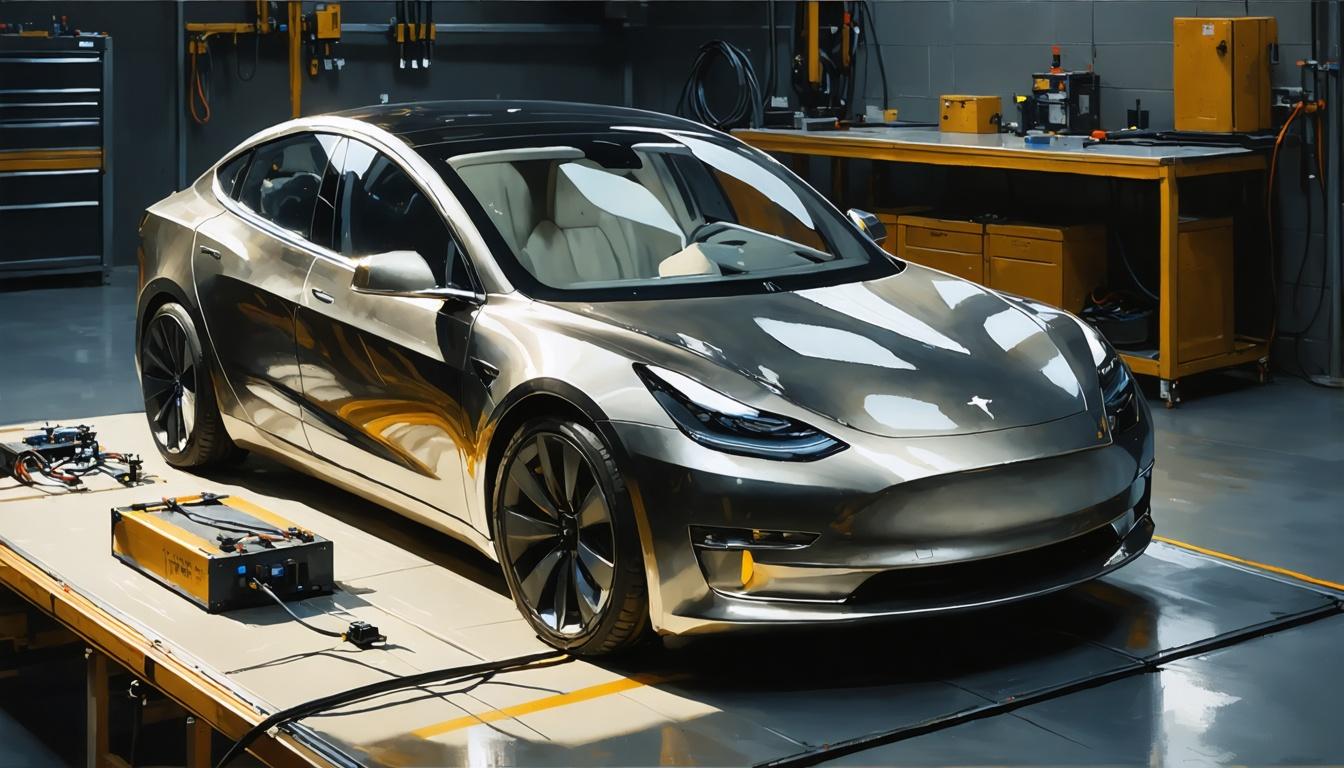
Battery X Metals Inc., an energy transition resource exploration and technology company, has announced the successful completion of a first-generation proprietary battery adaptor working prototype designed for Tesla Model 3 and Model Y vehicles. Developed through its wholly-owned subsidiary, Battery X Rebalancing Technologies Inc., in collaboration with strategic hardware and software development partner Beijing Pengneng Science & Technology Ltd. ("BJPN"), the milestone represents a significant step forward in the Company's broader multi-platform commercialization strategy for its patent-pending lithium-ion battery rebalancing platform.
Development of the First-Generation Tesla Adaptor
The first-generation Tesla Adaptor was developed as an engineering validation prototype, building upon the Company's Tesla battery interface characterization program previously disclosed in its news release dated January 2, 2026. The prototype represents the initial physical implementation of the Company's proprietary digital engineering model, designed to establish a standardized interface with Tesla Model 3 and Model Y battery platforms.
The engineering validation program successfully confirmed several key technical objectives, as summarized below:
| Engineering Objective: |
Outcome |
| Mechanical Fitment: |
Confirmed |
| Dimensional Accuracy: |
Confirmed |
| Electrical Interface Alignment: |
Confirmed |
| Standardized Battery Pack Connectivity: |
Confirmed |
These achievements validate the foundational interface architecture and establish an engineering platform for the continued development, optimization, and future commercialization of the Company's battery rebalancing ecosystem. Management believes this also establishes a repeatable engineering framework to support future proprietary adaptor development across additional high-volume electric vehicle battery platforms.
Commercial Significance
The Tesla Model 3 and Model Y collectively represent one of the largest and most strategically significant electric vehicle platforms globally. Tesla is expected to surpass 10 million cumulative global vehicle sales during the third quarter of 2026. Of these cumulative deliveries, the Tesla Model 3 is estimated to account for approximately 3.50 million vehicles, while the Tesla Model Y is estimated to account for approximately 5.39 million vehicles. Together, the two models are estimated to represent approximately 8.89 million cumulative vehicle sales, accounting for approximately 89% of Tesla's expected cumulative global deliveries.
The following table highlights the market share significance of these platforms in the United States:
| Model: |
U.S. EV Market Share |
| Tesla Model Y: |
Approximately 34.20% |
| Tesla Model 3: |
Approximately 20.20% |
| Tesla (Overall): |
Approximately 59.70% (as of January 2026) |
Collectively, the Tesla Model 3 and Model Y account for more than half of the U.S. electric vehicle market. Management believes focusing commercialization efforts on battery architectures supporting these market-leading vehicles positions the Company's battery rebalancing platform to address one of the largest installed electric vehicle populations in North America.
Next Steps and Ongoing Development
With the foundational engineering validation phase complete, Battery X Rebalancing Technologies has commenced the next stage of development focused on advancing the Tesla Adaptor toward a production-oriented commercial product. As part of this initiative, the Company acquired a Tesla Model 3 battery pack from an arm's length third party for $500, plus applicable GST, for dedicated research and development purposes. The battery pack will be used to further refine the commercial version of the Tesla Adaptor, conduct additional engineering validation, and perform working prototype testing under representative operating conditions.
Future development activities are expected to include:
- Continued engineering optimization and industrial design refinement
- Material selection and manufacturability assessment
- Durability enhancement and commercial product integration
- Ongoing interface validation for repeatability, reliability, and compatibility
- Hardware refinement and Underwriters Laboratories ("UL") certification
The Company is currently evaluating the scope, timing, and anticipated costs associated with these commercialization activities, including engineering, certification, manufacturing readiness, and go-to-market initiatives. Commercialization of both the battery rebalancing platform and the Tesla Adaptor remains subject to the completion of these development activities, receipt of UL certification, manufacturing readiness, and the availability of adequate capital resources.
The Battery Lifecycle Challenge and Battery X's Solution
The commercial context for Battery X Metals' technology is underpinned by the rapid growth of global electric vehicle adoption. In 2024, global EV sales reached approximately 17.1 million units, representing a 25% increase from 2023. Cumulative global EV sales from 2015 to 2023 totaled an estimated over 40 million units, with a significant share of the global EV fleet expected to exit warranty coverage in the coming years. By 2031, nearly 40 million electric, plug-in hybrid, and hybrid vehicles worldwide are anticipated to fall outside of their original warranty coverage.
Battery X Rebalancing Technologies' proprietary rebalancing technology, validated by the National Research Council of Canada ("NRC"), addresses battery cell imbalance in lithium-ion battery packs. Key findings from the NRC validation are presented below:
| Validation Parameter: |
Details |
| Battery Module Composition: |
Fifteen 72Ah LiFePO₄ cells connected in series |
| Initial Balanced Discharge Capacity: |
71.10Ah |
| Post-Imbalance Discharge Capacity: |
46.24Ah (decrease of approximately 35%) |
| Post-Rebalancing Discharge Capacity: |
70.94Ah |
| Capacity Recovery: |
Approximately 99% of capacity lost due to cell imbalance |
Through the development of proprietary adaptor solutions for leading electric vehicle battery architectures, the Company intends to establish a scalable compatibility ecosystem capable of supporting deployment across automotive service centres, dealership networks, fleet operators, and other commercial customers. The first-generation Tesla Adaptor represents a foundational milestone in executing this strategy, enabling standardized integration with one of the industry's largest battery platforms.





 16
16







 Create Custom Screeners
  Access 200+ Pre-built Filters
  Use 50+ Readymade Screener





