

Silver Briefly Overtakes Nvidia to Become World's Second-Largest Asset by Market Cap


Silver briefly surpassed Nvidia to become the world's second-largest asset by market capitalisation, reaching $4.57 trillion compared to Nvidia's $4.559 trillion. The precious metal's rally reflects strong industrial demand from electric vehicles, solar panels, and AI infrastructure, combined with five consecutive years of supply deficits and near-historic low inventories. Geopolitical tensions and potential U.S. trade restrictions have added to silver's appeal, while its fragile market structure amplifies price movements amid global shortages.

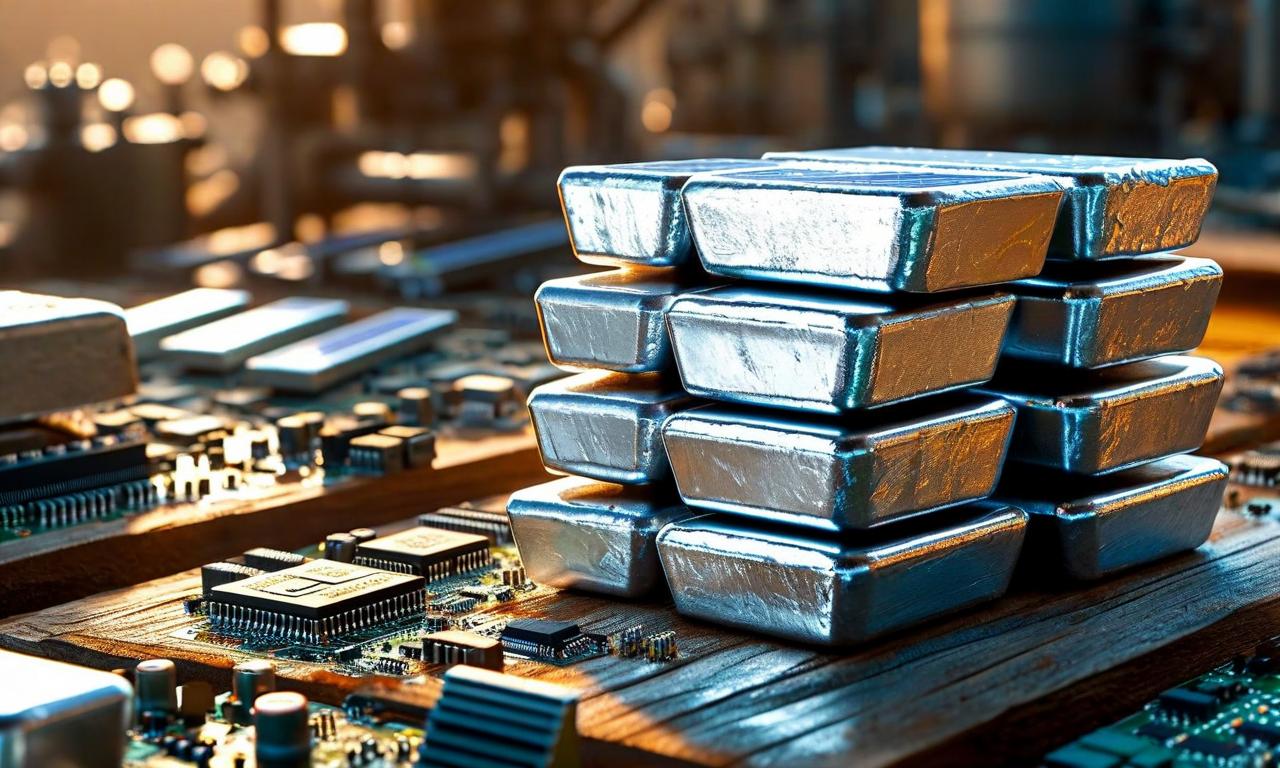

*this image is generated using AI for illustrative purposes only.
Silver achieved a remarkable milestone this week, briefly overtaking Nvidia to claim the position as the world's second-largest asset by market capitalisation. The white metal's meteoric rally pushed its market value to $4.57 trillion, edging past the AI chipmaker's $4.559 trillion valuation, though prices later eased to $79 per ounce.
Market Capitalisation Rankings
The brief overtaking highlighted silver's extraordinary surge, positioning it among the world's most valuable assets. The hierarchy at the time of the milestone demonstrates the scale of silver's achievement:
| Asset: | Market Value |
|---|---|
| Gold: | $31.30 trillion |
| Silver: | $4.57 trillion |
| Nvidia: | $4.559 trillion |
| Apple: | $3.89 trillion |
| Alphabet: | $3.79 trillion |
Silver's ascent is particularly noteworthy as it surpassed Nvidia, widely regarded as the poster child of the artificial intelligence boom, while outperforming nearly every major asset class in 2025.
Industrial Demand Drives Silver's Rally
Silver's surge stems from its indispensable role across multiple high-growth sectors. The metal serves as a critical component in electric vehicles, solar panels, electronics, and AI data centers. Government acceleration of energy transitions and rapid expansion of data infrastructure have created robust and largely unavoidable demand patterns.
The market faces its fifth consecutive year of supply deficits, with mining output consistently lagging behind consumption levels. Above-ground inventories have fallen to near historic lows, creating additional upward pressure on prices. Lower interest rates have further enhanced the appeal of non-yielding assets like silver, with three U.S. Federal Reserve rate cuts fueling expectations for additional monetary easing in 2026.
Geopolitical and Trade Factors
A weaker dollar and various geopolitical developments have contributed to silver's haven appeal. U.S. actions in Venezuela and Nigeria have created additional flashpoints that support precious metals demand. Meanwhile, a U.S. Commerce Department probe into critical mineral imports has raised prospects of tariffs or trade restrictions on silver, injecting fresh uncertainty into already strained supply chains.
Market Structure Vulnerabilities
Unlike gold, which benefits from deep liquidity and lending pools estimated at $700 billion in London, silver lacks comparable market buffers. This structural fragility became evident during October's historic supply squeeze. While London vaults have experienced some inflows since then, shortages persist in other global markets.
In China, inventories connected to the Shanghai Futures Exchange dropped to their lowest levels since 2015. Much of the world's readily available silver now sits in New York warehouses, as traders await clarity on U.S. trade policy developments. This concentration has created what market observers describe as a global game of musical chairs, with insufficient metal available to meet widespread buyer demand.
 15
15





 Access Market Heat-map & Insights
  Create, Save & Share your Screener
  Use 200+ Screening Filters





