Gold Futures Drop ₹301 While Silver Gains ₹399 After Record Highs Amid Geopolitical Tensions

2 min read     Updated on 13 Jan 2026, 11:02 AM
scanx
Reviewed by
Radhika SScanX News Team
Overview

Gold February futures declined ₹301 to ₹1,41,731 per 10 grams while silver March futures gained ₹399 to ₹2,69,369 per kilogram on MCX after both metals hit record highs. The volatility followed Trump's announcement of 25% tariffs on countries trading with Iran, which triggered safe-haven buying. International gold retreated from record peaks above $4,600 per ounce as investors booked profits amid geopolitical uncertainty.

29827965

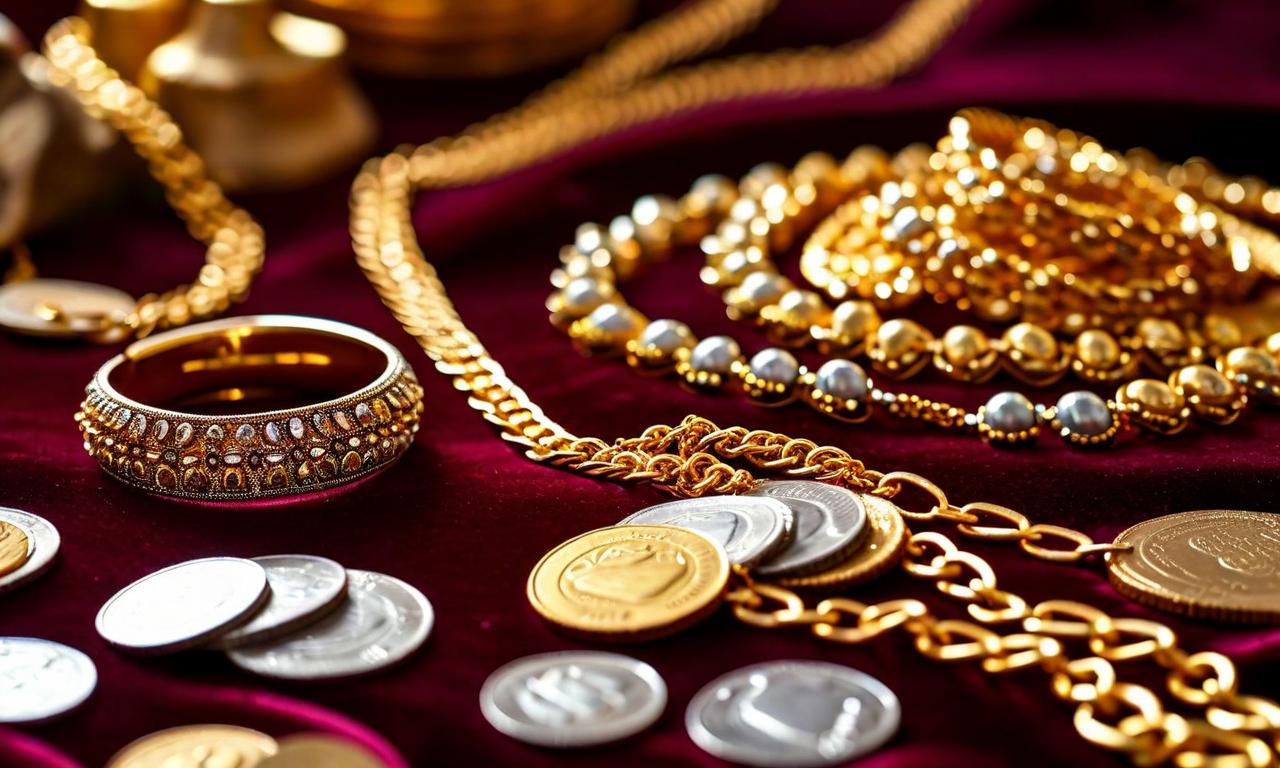
*this image is generated using AI for illustrative purposes only.

Gold and silver futures displayed contrasting movements on the Multi Commodity Exchange (MCX) following their surge to record highs, as investors navigated heightened geopolitical tensions and profit-booking activities. The precious metals market experienced significant volatility after Trump's aggressive policy announcements regarding Iran sparked safe-haven demand.

MCX Futures Performance

The commodity futures showed mixed signals in today's trading session:

Metal Contract Opening Price Change Percentage Change
Gold February ₹1,41,731 per 10g -₹301 -0.21%
Silver March ₹2,69,369 per kg +₹399 +0.15%

Gold February futures opened lower at ₹1,41,731 per 10 grams, declining by ₹301 or 0.21% after breaching lifetime highs in the previous session. Silver March futures moved in the opposite direction, edging up by ₹399 or 0.15% to trade at ₹2,69,369 per kilogram.

International Market Movements

Global gold prices retreated after hitting record peaks, with investors taking profits amid ongoing uncertainty. International spot gold declined 0.40% to $4,576.79 per ounce, while U.S. gold futures for February delivery slipped 0.60% to $4,585.40. The precious metal had climbed to a record peak of $4,629.94 on Monday before the current pullback.

Geopolitical Catalysts

The recent surge in precious metals stemmed from escalating geopolitical tensions and safe-haven demand. Trump announced a 25% tariff on any country trading with Iran, as Washington considers responses to the country's anti-government protests. These developments, combined with other assertive U.S. foreign policy moves including efforts regarding Venezuela and debates over Greenland, have underpinned demand for precious metals.

Previous Session Performance

Monday's trading session witnessed substantial gains across both metals:

Contract Closing Price Daily Gain
Gold February ₹1,42,032 per 10g +2.31%
Silver March ₹2,68,970 per kg +6.43%

Trading Recommendations and Support Levels

Market analysts have identified key technical levels for both metals. Manoj Kumar Jain of Prithvifinmart Commodity Research expects silver to maintain support near $70.00 per troy ounce and gold around $4,380.00 per troy ounce on a closing basis. The analyst pointed to growing optimism around potential U.S. Federal Reserve rate cuts and portfolio diversification as additional factors supporting precious metals.

Recommended trading ranges for MCX include gold support at ₹1,40,400 to ₹1,39,100 with resistance at ₹1,43,300 to ₹1,44,500, while silver shows support at ₹2,65,500 to ₹2,61,000 and resistance at ₹2,74,000 to ₹2,80,000.

Physical Gold Rates Across Major Cities

Physical gold prices varied across major Indian cities:

City 22 Carat (8g) 24 Carat (8g)
Delhi ₹1,07,208 ₹1,15,552
Mumbai ₹1,06,232 ₹1,14,408
Chennai ₹1,06,136 ₹1,14,312
Hyderabad ₹1,05,832 ₹1,14,080
like15
dislike

Gold and Silver Rally Largely Priced In, Copper Outlook Remains Positive: IME Capital

3 min read     Updated on 13 Jan 2026, 10:51 AM
scanx
Reviewed by
Radhika SScanX News Team
Overview

IME Capital's Ashi Anand warns that the precious metals rally in gold and silver may be largely complete, driven by geopolitical concerns and central bank diversification. While maintaining strong momentum, caution is warranted at current levels. Industrial metals like copper, aluminum, and zinc show more promise due to AI-driven capital expenditure, though steel faces headwinds from weak Chinese demand. The IT sector presents mixed prospects, with digital platforms offering structural growth opportunities while traditional services companies navigate AI-driven transformation from FY27 onwards.

29827261

*this image is generated using AI for illustrative purposes only.

The metals rally has emerged as one of the standout themes in equity markets over the past year, with segments ranging from base metals to steelmakers delivering strong outperformance. However, market experts suggest this momentum requires careful segment-wise analysis rather than broad-based optimism.

Ashi Anand, Founder & CEO of IME Capital, emphasizes the need for granular evaluation across the metals space. "Actually, metals are really quite broad and you really need to break up metals into precious metals, some of the base metals, and even within base metals there are different underlying demand drivers for steel, for zinc, for copper, etc.," Anand explained in an interview.

Precious Metals Rally May Be Exhausted

Precious metals, particularly gold and silver, were among the strongest asset-class performers last year, driven by multiple factors:

Key Drivers: Impact
Geopolitical Uncertainty: Strong upward pressure
Central Bank Diversification: Away from dollar holdings
Investor Appetite: Sustained demand

Despite the strong momentum, Anand expresses caution about current precious metals valuations. "What you have seen in the precious metals pack and this gold and silver, where you have seen substantial up moves and were probably the big outperformers in terms of an asset class last year, has really moved up largely on account of geopolitical concerns, and a very large amount of this move does appear to be done," he noted.

The challenge lies in timing market peaks during strong bull runs. "In any very strong bull market, it is always very difficult to call the top of a bull market… very often towards the end of a bull market you still see very strong demand tailwinds. So on gold and silver, we are aware that there is extremely strong momentum, but we are a bit more cautious because you have already seen a very large part of the move," Anand added.

Industrial Metals Show Promise

The outlook becomes more constructive for certain industrial metals linked to technological advancement. Anand highlights specific opportunities:

Metal: Outlook Key Driver
Copper: Positive AI capex, supply constraints
Aluminum: Moderately positive Electronics demand
Zinc: Selective positive Industrial applications

"When it comes to metals, we are a little more positive on certain materials that go into electronics and electricals, so things like copper, to some extent aluminium, zinc at some level. What you are seeing is very strong AI capex that is going to come in over the next decade," Anand observed.

Copper faces particular supply-demand dynamics. "Copper has seen very significant mine shutdowns which has led to the very sharp rally that we have seen. As those mines come back, you should see copper settle down a bit," he explained, while noting that longer-term AI-driven demand remains supportive.

Steel Sector Faces Headwinds

Steel continues to present challenges due to demand concerns. "Steel is something we are a bit more cautious about. It is still very infra- or auto- or consumer goods- or housing-driven. The biggest market, which is China, you are not seeing very strong demand growth drivers coming in from there. Until you do get a lot more positive about the Chinese economy, we have a bit more of a cautious view on the steel pack," Anand stated.

IT Sector Presents Mixed Outlook

Anand draws clear distinctions within the IT sector, separating digital platforms from traditional services:

Digital Platforms Show Structural Growth

Indian digital platforms represent a long-term structural theme. "We believe that this is the theme for the decade. This decade is likely to see sustained value migration away from traditional businesses towards new-age digital tech firms. And as these companies continue to scale, we also see profitability and cash flows improving substantially," Anand explained.

Traditional IT Services Face Transition

Traditional IT services companies like Infosys and TCS face different dynamics. Near-term performance depends on US demand recovery, while AI presents both opportunities and challenges from FY27 onwards.

"As AI becomes a bit more mainstream, we are expecting fairly large enterprise-wide AI projects coming in where larger enterprises are trying to incorporate AI into their overall tech stack. We see Indian IT companies being very well positioned here," Anand noted.

However, AI adoption will also impact operational models. "AI is also going to be used quite substantially by these companies to increase the productivity of their labour force. Because they need to pass on some of these cost benefits to clients, this is likely to have a deflationary impact. You are therefore likely to see revenues possibly not grow as much, but improvement in margins, and therefore profitability should be decent," he concluded.

like17
dislike
More News on Gold and Silver
Explore Other Articles