

HeartBeam wins U.S. patent for acoustic sensing, impedance


HeartBeam, Inc. has secured a new U.S. patent integrating acoustic sensing and thoracic impedance measurement into its ECG device, enabling future applications in structural heart disease and heart failure monitoring. The technology allows the device to function as a digital stethoscope and assess fluid levels without a new form factor. The company now holds 26 issued patents worldwide.

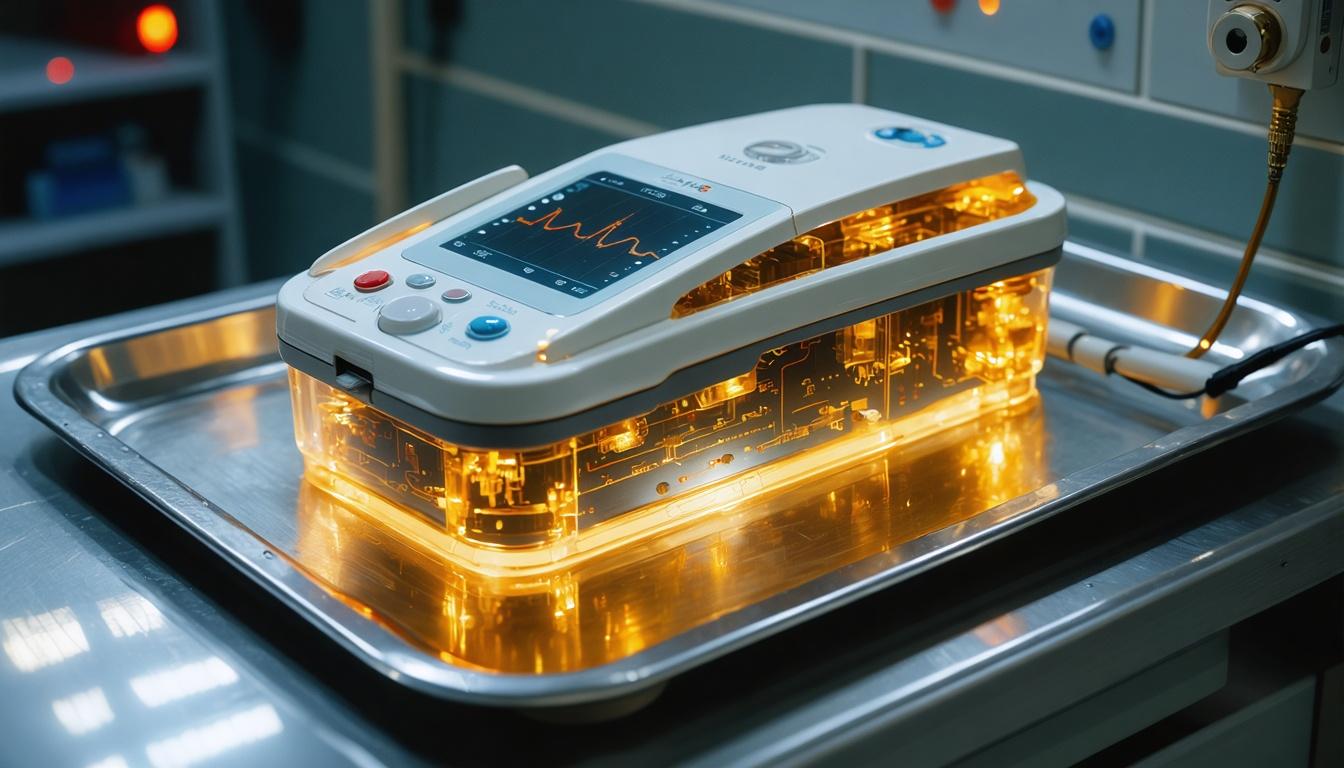

*this image is generated using AI for illustrative purposes only.
HeartBeam, Inc. (NASDAQ: BEAT) has secured a new U.S. patent that expands the capabilities of its credit card-sized, cable-free ECG device by integrating acoustic sensing and thoracic impedance measurement. This technology aims to support future applications in structural heart disease and heart failure monitoring without requiring a new form factor. The patent reinforces the company's intellectual property portfolio, bringing its total to 26 issued patents worldwide.
The newly patented acoustic sensors are integrated into the foldable arms of the HeartBeam device, allowing it to function as a "digital stethoscope." These sensors capture sounds produced when the heart's valves, such as the mitral and tricuspid valves, open and close. This capability is designed to help physicians identify structural irregularities and assess how the heart is functioning mechanically.
The patent also covers thoracic impedance measurement, which involves injecting a small, imperceptible current through the device's finger electrodes and measuring the resulting voltage across the chest electrodes. This process assesses fluid levels in the chest, a critical metric for managing heart failure. Unlike wrist- or finger-worn wearables, HeartBeam's device is positioned at the chest, the anatomically relevant location for accurate measurement.
Heart failure affects nearly 6.7 million adults in the U.S. and costs an estimated $30,000 per patient annually. A major challenge in managing the condition is that patients accumulate fluid over days before symptoms become severe enough to require hospitalization. Earlier detection of fluid buildup could enable physicians to intervene with medication adjustments before hospitalization becomes necessary.
"Continuous fluid monitoring remains a major challenge in heart failure care," said John L. Jefferies, MD, MBA, MPH, FACC, FAHA, Professor at the School of Public Health, University of Memphis. "A non-invasive, patient-operated approach to thoracic impedance measurement could broaden access to meaningful home monitoring for a much larger population of heart failure patients."
Branislav Vajdic, Ph.D., President and Founder of HeartBeam, emphasized the strategic importance of the patent. "This patent not only deepens our IP foundation but also advances our strategy of building a multi-modal ambulatory cardiac sensing platform," he said. "The ability to detect fluid congestion and assess heart valve function from the same credit card-sized device patients already use for ECG rhythm monitoring may support future reimbursement pathways and broader clinical adoption."
The acoustic sensing and thoracic impedance capabilities described in the patent are investigational and not FDA cleared. The company's existing 3D ECG technology received FDA clearance for arrhythmia assessment in December 2024, and its 12-Lead ECG synthesis software received clearance in December 2025.
Patent Portfolio and Technology Scope
HeartBeam's 26 issued patents span signal acquisition, ECG synthesis algorithms, diagnostic applications, and device hardware. The portfolio covers both the HeartBeam System and its investigational on-demand 12-lead patch.
| Feature | Description |
|---|---|
| Acoustic Sensing | Integrated into foldable arms; acts as a digital stethoscope |
| Thoracic Impedance | Measures fluid levels via finger and chest electrodes |
| Form Factor | Credit card-sized, cable-free device used at the chest |
| Patent Status | 26 issued patents worldwide |

What is the projected timeline for initiating clinical trials to validate the accuracy of the acoustic sensing and thoracic impedance features?
How will the integration of these new modalities influence the reimbursement strategy and potential pricing models compared to the existing ECG-only functionality?
Does the company plan to pursue separate FDA clearances for the acoustic and impedance capabilities, or will they be combined into a single submission?
 19
19







 Access Market Heat-map & Insights
  Create, Save & Share your Screener
  Use 200+ Screening Filters





